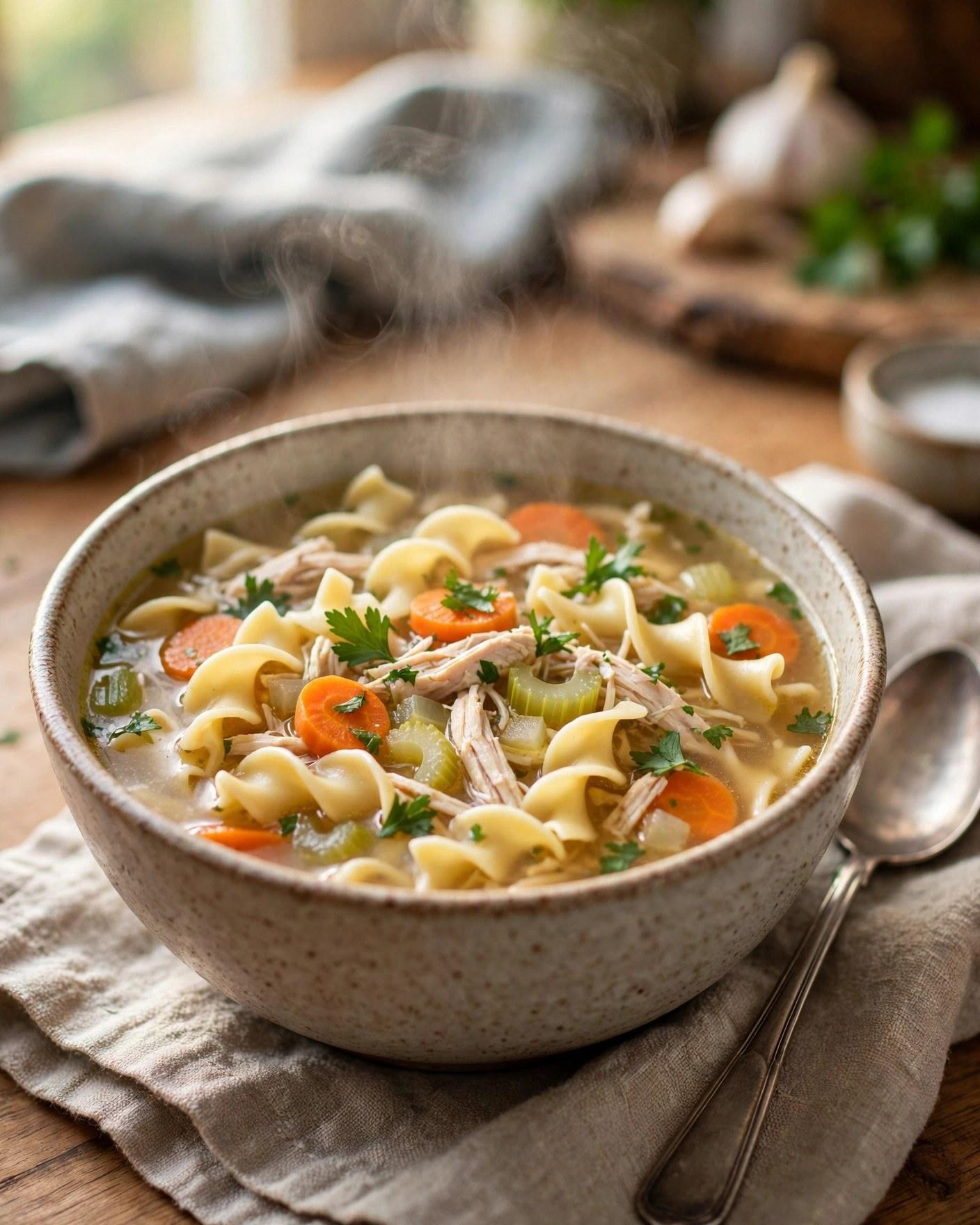
Crockpot Chicken Noodle Soup
There is a particular kind of day that calls for chicken noodle soup, and it rarely announces itself in advance. The light goes flat by mid-afternoon, someone in the house is sniffling, the week has run long, or the weather has simply turned cold enough that a warm, brothy bowl feels like the only sensible plan for dinner. Crockpot Chicken Noodle Soup is built for exactly those days. It is a homemade chicken noodle soup in the most practical sense: boneless chicken, sliced carrots, celery, yellow onion, and garlic go into the slow cooker with low-sodium chicken broth, dried thyme, and bay leaves in the morning, and by evening the chicken is tender enough to shred with two forks and the broth tastes like it has been tended all day — because, in a quiet way, it has.
What makes this version work is the timing of a single ingredient: the noodles. Wide egg noodles are wonderful in chicken soup, but they are also fragile. Cooked for six hours, they swell, soften, and fall apart until the soup turns starchy and heavy. Here, the noodles wait. They are stirred in only for the final 20 to 30 minutes, just long enough to become tender while still holding their shape, so every spoonful has distinct, silky noodles alongside the shredded chicken and sweet carrots. A handful of fresh parsley and an optional squeeze of lemon at the very end keep the bowl bright instead of sleepy.
This is also, honestly, a dump-and-go crockpot soup. There is no browning step, no separate pot, and no sauté pan to wash. Fifteen minutes of chopping and loading the cooker is the whole morning commitment, and the slow cooker handles the rest at a gentle, steady simmer. If you are building a small collection of slow cooker soup recipes to rotate through the colder months, this is a good anchor recipe to have — and it sits naturally alongside the other bowls in our Slow Cooker Soup Recipes hub.
The recipe makes six generous servings at roughly 310 calories each (estimated), enough for dinner tonight with a couple of bowls left for lunch tomorrow. The broth is clear and savory rather than creamy, the vegetables stay tender without disappearing, and the seasoning is deliberately simple — thyme, bay, salt, and pepper — so the chicken and vegetables carry the flavor.
Why You'll Love This Recipe
- Truly dump-and-go. Everything except the noodles, parsley, and lemon goes into the slow cooker in one step — no browning, no sautéing, and no extra pans. Fifteen minutes of prep in the morning is the whole hands-on commitment before the final half hour.
- Noodles that stay noodles. The wide egg noodles are stirred in only for the last 20 to 30 minutes, so they cook up tender and silky without swelling into mush or thickening the broth into a starchy stew. Timing is the entire trick, and it is an easy one.
- A clear, savory homemade broth. Low-sodium chicken broth, thyme, bay leaves, garlic, and the natural juices from the chicken build a broth that tastes rounded and honest, with the seasoning fully in your hands at the end.
- Chicken that shreds effortlessly. Six hours on Low turns boneless chicken breasts or thighs meltingly tender, so the meat pulls apart with two forks in minutes and distributes through every bowl instead of sitting in a few large chunks.
- An easy chicken soup recipe for cold days. This is chicken soup for cold days in the truest sense — warm, brothy, and gentle — the kind of bowl that suits a chilly evening, a quiet weekend, or a house where someone needs a comforting dinner without any fuss.
- Flexible for the chicken you have. Breasts give you a leaner, cleaner shred; thighs give you a richer, more forgiving cook. The recipe works with either, or a mix of both, with no other changes needed.
- Leftovers that reheat kindly. The soup keeps well for days, the flavors deepen overnight, and a gentle reheat with a splash of broth brings the bowl back to life.
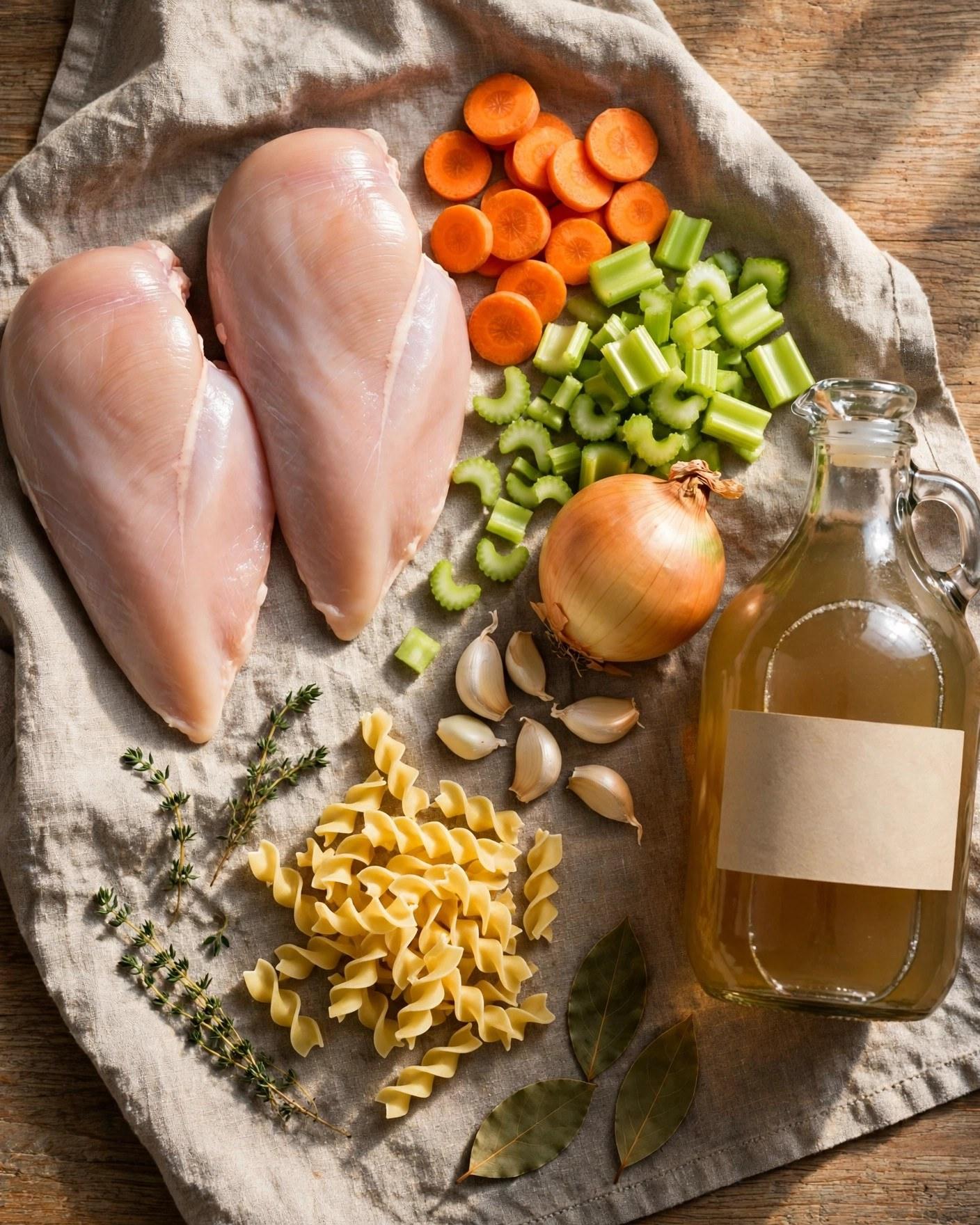
Ingredients
For the soup
- 1 1/2 pounds (680 g) boneless, skinless chicken breasts or thighs
- 3 medium carrots (about 2 cups / 260 g), peeled and sliced into 1/4-inch (6 mm) rounds
- 3 celery stalks (about 1 1/2 cups / 180 g), sliced into 1/4-inch (6 mm) pieces
- 1 medium yellow onion (about 1 1/2 cups / 225 g), diced
- 4 cloves garlic, minced
- 6 cups (1.4 L) low-sodium chicken broth
- 1 teaspoon dried thyme
- 2 bay leaves
- 1 teaspoon fine sea salt, plus more to taste
- 1/2 teaspoon black pepper, freshly ground if possible, plus more to taste
For finishing
- 6 ounces (170 g) dried wide egg noodles
- 1/4 cup (15 g) fresh flat-leaf parsley, chopped, plus more for serving
- 1 tablespoon fresh lemon juice, optional, plus lemon wedges for serving
- Crusty bread, for serving, optional
Why these ingredients matter
Boneless, skinless chicken. The chicken is both the protein and a quiet flavor base for the broth. As it cooks low and slow, it releases its juices into the surrounding liquid, which is part of why a simple broth tastes rounder after six hours than it did at the start. Breasts are the leaner choice and shred into clean, pale strands; thighs are a little richer and more forgiving if the soup sits on Warm for a while. Either works at the same weight and timing. There is no need to cut the chicken before cooking — whole pieces shred far more easily after the long cook, and leaving them whole keeps the prep at fifteen minutes.
Carrots. Carrots bring the gentle sweetness that balances a savory broth, and their orange rounds are part of what makes a bowl of chicken noodle soup look like itself. Sliced about 1/4 inch (6 mm) thick, they have enough body to survive six hours in the cooker and come out tender without collapsing. Much thinner, and they can go soft and ragged; much thicker, and they may still be firm in the center when the chicken is ready to shred. Peel them, and keep the slices even so they finish together.
Celery. Celery is easy to overlook and hard to replace. It contributes a savory, slightly herbal background note that makes chicken broth taste more like itself, and it softens into the soup over the long cook while still holding a little structure. Slice the stalks at a similar thickness to the carrots so the vegetables finish together, and include a few pale inner leaves if your bunch has them — they carry concentrated celery flavor.
Yellow onion. A yellow onion, diced and added raw, spends six hours softening and sweetening until it nearly disappears into the broth, leaving depth behind rather than distinct pieces. Yellow onions are the right choice here because their flavor is balanced — sweeter than a white onion once cooked, gentler than a red onion in a clear broth. Dice it fairly small so it melts down evenly; large chunks can stay stubbornly distinct even after a long cook.
Garlic. Four cloves, minced, is a generous but sensible amount for six cups of broth. Garlic mellows considerably over a long, gentle cook, so what starts out pungent settles into a warm, savory background that supports the thyme and chicken without ever tasting sharp. Mince it finely or press it so it distributes through the pot rather than landing in a few strong bites.
Low-sodium chicken broth. The broth is the soup — six cups of it — so its quality and seasoning level matter more here than in almost any other soup. Low-sodium broth is the practical choice because the liquid reduces slightly and you will want to make the final salt decision by taste at the end. A good store-bought broth keeps this an easy chicken soup recipe; homemade stock, if you have it, works beautifully at the same measure.
Dried thyme. Thyme is the classic herb for chicken soup, earthy and quietly aromatic, and the dried form suits a six-hour cook because it releases its flavor slowly and does not turn bitter. One teaspoon spread through the whole pot is enough to perfume the broth. If your thyme has been in the cupboard a long time and smells faint, use a heaped teaspoon.
Bay leaves. Two bay leaves work in the background the way they always do: hard to point to in the finished bowl, but noticeable in their absence. They add a subtle depth that rounds out the broth. Add them whole so they are easy to find, and fish them out before the noodles go in — the leaves do not soften enough to eat.
Salt and black pepper. Salt is what makes the difference between a broth that tastes flat and one that tastes like soup, and the amount here is a starting point rather than a verdict. Broths and palates vary, so the recipe seasons modestly at the start and expects a final adjustment once the chicken is shredded. Black pepper adds gentle warmth; freshly ground has a brighter bite, but pre-ground works fine in a long-cooked soup.
Wide egg noodles. Wide egg noodles are the traditional choice for chicken noodle soup for good reason: their broad ribbons have a soft, almost silky bite that suits a clear broth, and they cook quickly — which matters, because they only get 20 to 30 minutes in the hot soup. Six ounces (170 g) is a measured amount on purpose. Egg noodles swell as they cook and keep absorbing broth as they sit, so a heavier hand can quietly turn a brothy soup into a noodle casserole.
Fresh parsley. Parsley, stirred in at the end and scattered over the bowls, is more than decoration. Its clean, green flavor lifts a long-cooked soup, and because it goes in at the end, it keeps its color instead of turning olive. Flat-leaf parsley chops neatly and has a cleaner flavor than curly parsley.
Lemon, optional. A tablespoon of fresh lemon juice, added at the very end, brightens the broth the way a pinch of salt does, sharpening the chicken and herb flavors without making the soup taste lemony. The soup is complete without it, but if your broth tastes a little flat after salting, lemon is often the missing piece.
Instructions
- Prepare the vegetables and keep the pieces even. Peel the carrots and slice them into rounds about 1/4 inch (6 mm) thick. Slice the celery at about the same thickness, dice the yellow onion fairly small, and mince the garlic. Even pieces are the whole goal here: vegetables cut to a similar size finish at the same time, so nothing in the bowl is crunchy while the rest has gone soft. Set the parsley and lemon aside for the end, and leave the egg noodles in their package — keeping them out of the cooker until the final stretch is the most important timing decision in the recipe.
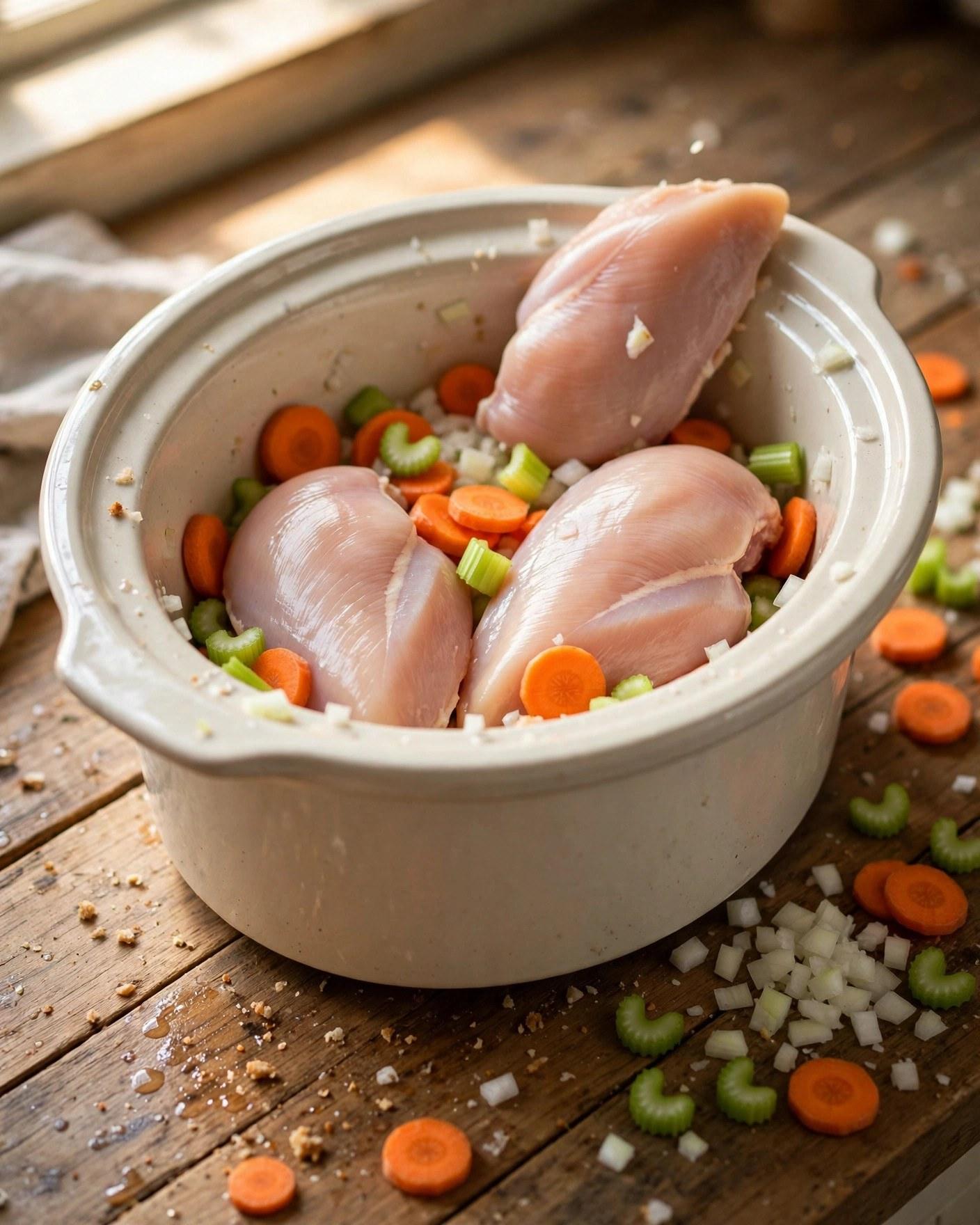
- Load the slow cooker in one step. Place the boneless, skinless chicken in the bottom of a 5- to 6-quart (about 5 L) slow cooker in a single layer as much as your insert allows. Scatter the carrots, celery, onion, and garlic evenly over and around the chicken. Pour in the 6 cups (1.4 L) of low-sodium chicken broth, then sprinkle the dried thyme, salt, and black pepper over the surface and tuck the 2 bay leaves down into the liquid where they will stay submerged. There is no need to stir thoroughly — a gentle nudge to settle everything under the broth is enough. This is the dump-and-go moment the recipe promises: once the lid goes on, the morning's work is done.
- Cook on Low for 6 hours without lifting the lid. Put the lid on securely and cook on LOW for 6 hours, until the chicken is completely tender and the carrots are soft all the way through. Resist lifting the lid to check during the first several hours; a slow cooker loses a surprising amount of heat each time the lid comes off. The Low setting is the right choice for this soup rather than a faster High cook, because the gentle temperature is what lets the chicken turn shreddable while the broth gathers flavor. If your cooker runs hot, begin checking at about 5 1/2 hours — tenderness, not the clock alone, is the test.
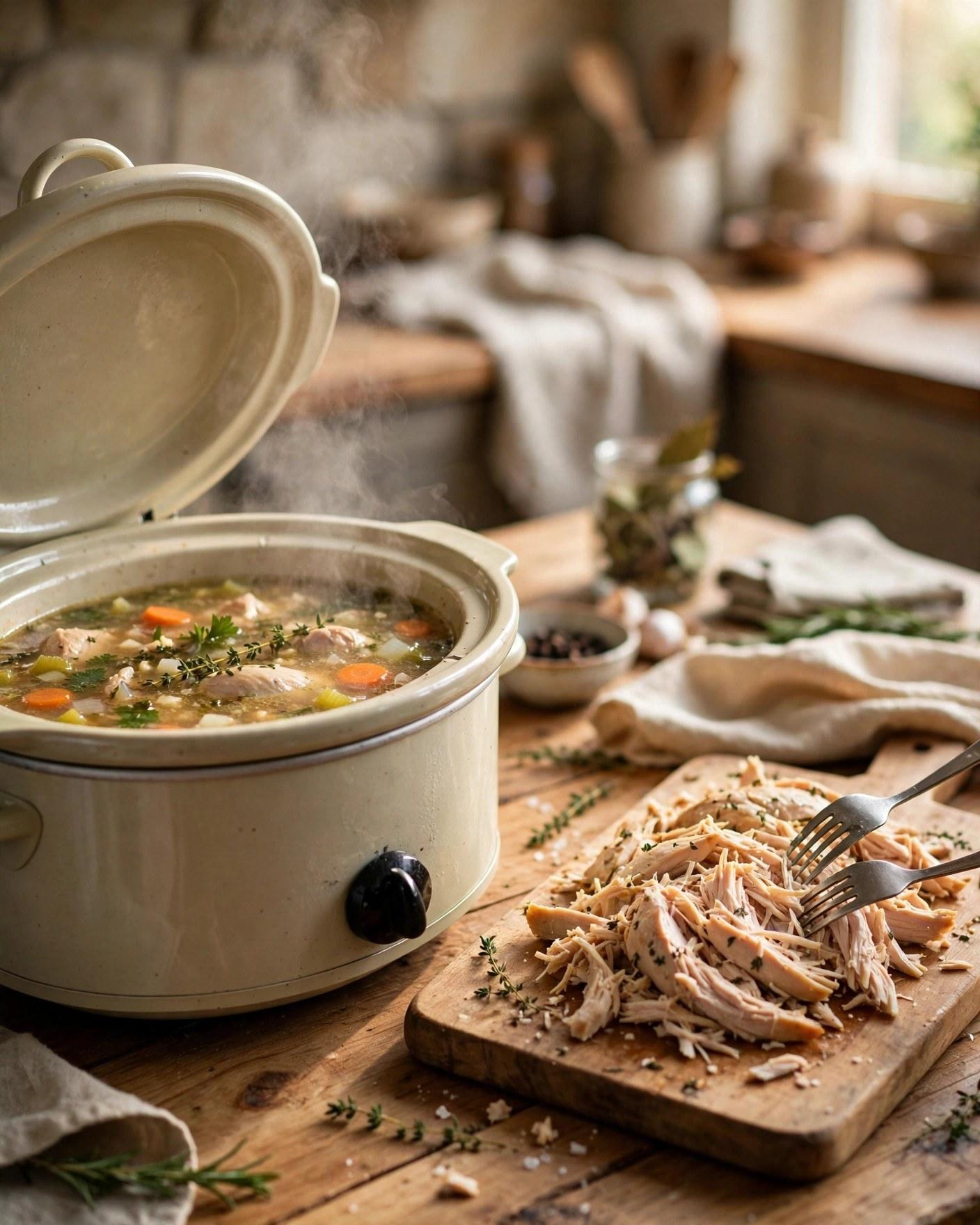
- Remove the bay leaves and shred the chicken. When the cooking time is up, fish out and discard both bay leaves — do this now, while the pieces of chicken are still whole and the leaves are easy to spot. Lift the chicken pieces out with tongs onto a cutting board or into a wide, shallow bowl. Using two forks, pull the meat apart into bite-size shreds, working with the grain so the strands separate naturally. The chicken should offer very little resistance; if a piece feels firm or rubbery rather than tender, return it to the cooker for another 20 to 30 minutes before shredding. Discard any small pieces of fat or gristle you come across as you work.
- Return the chicken and taste the broth. Stir the shredded chicken back into the slow cooker, distributing it through the soup. Now taste a spoonful of the broth on its own — this is the seasoning moment, before the noodles go in and begin absorbing liquid and salt. Add more salt a little at a time until the broth tastes full and savory rather than flat, and add another pinch of black pepper if you like. Remember that the noodles will drink up some of the broth in the next step, so the soup should taste well seasoned, even very slightly bold, at this point.
- Stir in the egg noodles for the final 20 to 30 minutes. Turn the slow cooker to HIGH. Stir in the 6 ounces (170 g) of dried wide egg noodles, pressing them down gently so they are mostly submerged in the hot broth. Replace the lid and cook for 20 to 30 minutes, stirring once halfway through to separate the noodles. Begin tasting at 20 minutes: the noodles are done when they are tender all the way through with just a little body left — soft and silky, not chalky in the center and not swollen or falling apart. Noodle brands vary, so let taste, not the timer, make the final call, and move on promptly once they are tender, because they keep softening in the hot broth.
- Finish with parsley and an optional squeeze of lemon. Switch the slow cooker off or to Warm. Stir in the chopped fresh parsley and, if you are using it, the tablespoon of fresh lemon juice. Let the soup stand for about 5 minutes so the parsley settles in and the flavors come together. Taste one final time — a noodle, a piece of chicken, and a spoonful of broth together — and adjust with a last pinch of salt, a little more pepper, or another small squeeze of lemon until the bowl tastes balanced: savory, bright, and warm.
- Serve in warm bowls with bread at the table. Ladle the soup into warm, deep bowls, making sure each serving gets a fair share of chicken, vegetables, and noodles along with plenty of broth. Scatter extra fresh parsley over each bowl and serve lemon wedges alongside. Crusty bread is a natural partner for soaking up the last of the broth. Serve promptly while the noodles are at their best, and keep any extra on Warm for second helpings.

Tips for Success
- The noodles always go in last — no exceptions. This is the single rule that protects the whole soup. Egg noodles cooked for hours swell, break down, and thicken the broth into something starchy and heavy. Twenty to thirty minutes at the end, on High, in broth that is already hot, is all they need. If you take one tip from this page, take this one.
- Choose Low over High for the main cook. Six hours on Low gives the chicken time to become genuinely shreddable and lets the vegetables soften gradually into the broth. A shorter High cook can work in a pinch — about 3 to 3 1/2 hours — but the chicken shreds less cleanly and the broth tastes less settled. When the schedule allows, Low is worth it.
- Season in two stages. A measured teaspoon of salt at the start seasons the vegetables and chicken as they cook, but the final judgment belongs at the end, after shredding, when you can taste the actual broth. Broths vary widely in sodium, so adjust by taste, a pinch at a time.
- Cut the vegetables to an even thickness. Carrots and celery sliced to about the same 1/4-inch (6 mm) thickness finish together. Thick carrot coins can stay firm in the center after six hours, and paper-thin celery disappears entirely.
- Do not lift the lid during the long cook. Each peek releases the accumulated heat and steam that a slow cooker depends on, and can add 15 to 20 minutes to the cooking time. Load the cooker, close it, and trust it until the shredding step. If you need to check, do it once, near the end of the range.
- Try the lemon before you decide you do not need it. If the finished soup tastes good but somehow flat — savory, yet missing something — a tablespoon of lemon juice stirred in off the heat usually fixes it without making the soup taste like lemon. Add it after the final salt adjustment, taste again, and stop there; the goal is brightness, not acidity.
- Use a cooker that fits the batch. A 5- to 6-quart (about 5 L) slow cooker holds this soup comfortably with room for the noodles at the end. In a much smaller cooker the noodles crowd; in a very large one, the liquid spreads thin and can reduce more than expected.
Variations
- Chicken thigh version, richer and more forgiving. Use all boneless, skinless thighs in place of breasts, at the same 1 1/2 pounds (680 g), and proceed exactly as written. Thighs bring a deeper chicken flavor and stay moist even if the finished soup holds on Warm for an extra hour, which makes them the practical choice for a flexible serving time. The shred will be darker and a little less uniform than breast meat — that is expected and entirely fine.
- Extra-vegetable soup. Add 1 cup (130 g) of diced parsnip or a small diced potato with the carrots at the start, and stir in 1 cup (150 g) of frozen peas along with the parsley at the very end, letting the peas warm through in the hot broth for a few minutes without cooking. The peas keep their color and sweetness because they never endure the long cook, and the root vegetables make the bowl feel more substantial on the coldest days.
- Herb variations beyond thyme. Keep the thyme and add 1/2 teaspoon of dried oregano or a teaspoon of Italian seasoning for a more herbal broth, or stir 2 tablespoons of chopped fresh dill in with the parsley at the end for a fresher finish. Fresh soft herbs always belong at the end; dried herbs go in at the start.
- A gentle, warming spice note. Add 1/4 teaspoon of ground turmeric and a pinch of red pepper flakes with the thyme for a broth with a golden color and quiet warmth in the background. Neither makes the soup taste strongly spiced — the turmeric mostly adds color and an earthy note, and the flakes warm rather than heat.
- Rice instead of noodles. For a chicken and rice version, skip the egg noodles and stir in 3 cups (about 420 g) of cooked long-grain rice at the finishing step, warming it through for about 10 minutes on Warm. Cook the rice separately rather than adding it raw — raw rice absorbs an unpredictable amount of broth and can turn gummy. This version also freezes better than the noodle version.
- Creamy finish, if your table prefers it. Stir 1/3 cup (80 ml) of heavy cream into the soup along with the parsley for a softer, richer bowl. The base recipe is a clear-broth soup, so treat this as a true variation rather than an upgrade: the broth turns pale and mellow, and the lemon becomes more important for balance. Add the cream at the end, never at the start, so it stays smooth.
Storage
Let the soup cool until it is no longer steaming, then refrigerate it promptly in an airtight container. It keeps well for up to 3 to 4 days, and the broth's flavor genuinely settles and deepens by the second day as the thyme, garlic, and chicken finish mingling. One honest warning belongs with any chicken noodle soup: the egg noodles keep absorbing broth as the soup sits, so leftovers will be thicker and the noodles softer than the fresh bowl. That is normal, not spoilage, and it is easy to manage at reheating time with extra broth.
If you know in advance that you are cooking for leftovers, the neatest solution is to store a portion of the soup without noodles. Ladle out the amount you plan to keep before the noodles go in, refrigerate that noodle-free soup, and cook fresh egg noodles in the reheated soup for 10 to 15 minutes when you serve it.
To reheat, spoon the soup into a saucepan, add a splash of chicken broth or water — about 2 to 3 tablespoons per serving, more if the noodles have absorbed a great deal — and warm it gently over medium-low heat, stirring occasionally, until it is steaming hot throughout. Avoid a hard boil, which can break the noodles down further. A microwave works for a single bowl: heat in short intervals, stirring between each, with the same splash of liquid stirred in first. Finish a reheated bowl the way you finished the fresh one — a little fresh parsley and a squeeze of lemon wake it right back up.
Freezing takes one adjustment. The noodle-free soup freezes beautifully: cool it completely, pack it into freezer-safe containers leaving a little headspace, and freeze for up to 3 months. Thaw overnight in the refrigerator, reheat gently, and cook fresh egg noodles in the hot soup before serving. Soup frozen with its noodles already in it is safe and still pleasant, but the noodles thaw noticeably softer and the texture never quite recovers, so when freezing is the plan, freeze the soup before the noodle step and add the noodles fresh at serving time.
FAQ
Can I cook this soup on High instead of Low, and how long does it take? Yes, when the day requires it. Cook the chicken, vegetables, and broth on HIGH for about 3 to 3 1/2 hours, until the chicken is tender enough to shred easily and the carrots are soft, then shred the chicken and add the noodles for the same final 20 to 30 minutes. The Low setting is preferred in this recipe because the gentler, longer cook gives the broth a more settled flavor and the chicken a cleaner shred, but the High version is still a good bowl of soup — just begin checking the chicken a little early, since slow cookers vary.
Why can't the egg noodles cook in the slow cooker from the start? Because dried egg noodles only need about 20 to 30 minutes in hot liquid, and six hours is far beyond what they can withstand. Cooked from the start, they swell, turn mushy, and fall apart, releasing starch that thickens the clear broth into something heavy and cloudy. Adding them at the end, once the broth is fully hot and the chicken is shredded, gives them exactly the time they need to become tender while keeping their shape.
Should I use chicken breasts or thighs in a crockpot chicken noodle soup? Either works well, and the choice is about preference rather than correctness. Breasts are leaner and shred into pale, clean strands with a lighter flavor. Thighs are richer and noticeably more forgiving — they stay moist if the soup holds on Warm or the cook runs slightly long. A mix of both is a good middle path. Use the same total weight, 1 1/2 pounds (680 g), and the same timing either way.
Can I make this soup ahead, or freeze it for later? Yes, with one adjustment for the noodles. The soup base — chicken, vegetables, and broth — can be cooked a day ahead, refrigerated, and reheated gently, with fresh noodles cooked in the hot soup for 20 to 30 minutes before serving. For freezing, freeze the noodle-free soup for up to 3 months, thaw it overnight in the refrigerator, reheat it, and add fresh noodles at serving time. Finished soup with the noodles already in it still freezes safely, but the noodles thaw soft and the broth needs loosening with extra liquid, so the noodle-free route gives a noticeably better second serving.
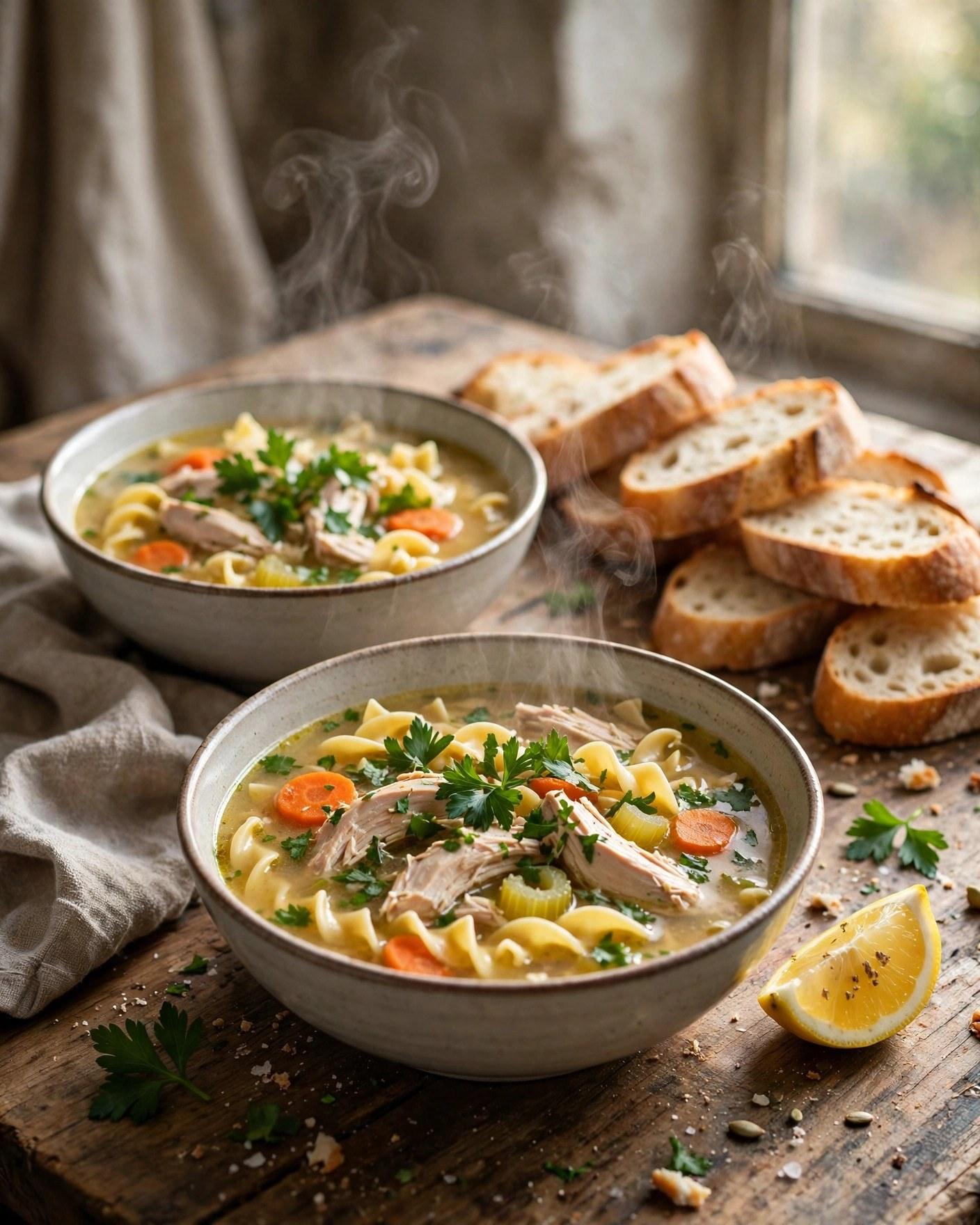
Recipe Card
Crockpot Chicken Noodle Soup
- Prep Time: 15 minutes (PT15M)
- Cook Time: 6 hours (PT6H)
- Total Time: 6 hours 15 minutes (PT6H15M)
- Servings: 6 servings
- Calories: 310 kcal per serving (estimated)
Boneless chicken, sliced carrots, celery, yellow onion, and garlic simmered on Low in low-sodium chicken broth with dried thyme and bay leaves until the chicken shreds easily with two forks, finished with wide egg noodles stirred in for the final 20 to 30 minutes, fresh parsley, and an optional squeeze of lemon. Cook time reflects cooking on Low; see the FAQ for the High timing alternative.
Nutrition (estimated): 310 kcal per serving (estimated, for soup with shredded chicken, wide egg noodles, carrots, celery, and onion in chicken broth), 28 g carbohydrates, 32 g protein, 7 g fat, 3 g fiber, 5 g sugar, 640 mg sodium. Nutrition is estimated and will vary with whether breasts or thighs are used, the brand of broth and its sodium level, the exact noodle brand, how much salt is added at the end, and any variations or substitutions.

Hi, I’m Emma! I’m the cook and recipe developer behind Sizzle & Sage. From my sunny home kitchen, I share easy, flavor-packed recipes for real life — quick breakfasts, cozy weeknight dinners, and simple bakes anyone can make. Pull up a chair and stay a while!