
Broccoli Cheddar Soup
Broccoli cheddar soup is the bowl that cafés built their soup cases on: thick, golden, and creamy, with tender broccoli folded through a cheddar broth that coats the spoon. It tastes like it simmered all afternoon in a restaurant kitchen, but the home version is a one-pot, weeknight-friendly recipe that goes from counter to table in about 30 minutes — no canned soup, no processed cheese block, and nothing fussy standing between you and a very cozy dinner.
The secret is building the soup the way a good cheese sauce is built. Onion, carrot, and garlic soften in butter, a little flour toasts into a roux, and milk and broth whisk into a smooth base before the broccoli ever goes in. Once the broccoli is tender, the pot comes off the boil and real sharp cheddar melts in by the handful. That order matters: cheese added to a boiling soup can turn grainy, while cheese melted into a hot-but-not-boiling base stays silky every single time.
This is the other anchor of our creamy soup lineup. If the Loaded Baked Potato Soup is the hearty, bacon-counter classic of the pair, this one is its bright green counterpart — same comfort, same one-pot ease, with the sharp cheddar turned all the way up. The two together cover just about every cold night between October and March.
Serve it the café way: ladled into warm bowls with extra cheddar on top and crusty bread for dunking, or poured into hollowed-out bread bowls when you want the full treatment. A simple green salad alongside is all it needs. The recipe makes six generous bowls, reheats beautifully, and — fair warning — the leftovers tend to disappear faster than the first serving did.
Why You'll Love This Recipe
- Ready in about 30 minutes. Ten minutes of prep and twenty on the stove. The broccoli simmers right in the broth, and the cheese melts in off the heat, so there is no long simmer and no second pot to wash.
- Real sharp cheddar, melted properly. Three full cups of freshly shredded sharp cheddar go in at the end, off the boil, so the soup tastes like cheese — not like a can — and the texture stays smooth and glossy instead of grainy or stringy.
- Thick and creamy without processed cheese. The butter-and-flour roux plus a splash of cream give the broth real body. It clings to the broccoli and the spoon the way the café version does, with ingredients you can pronounce.
- One pot, simple ingredients. Broccoli, carrots, onion, garlic, butter, milk, broth, and cheddar — a short grocery list of everyday staples, most of it already in a typical kitchen.
- Vegetable-forward comfort. Five cups of broccoli go into this pot, so every bowl is genuinely loaded with the green stuff, softened into the cheesy broth until even devoted broccoli skeptics tend to come back for seconds.
- Bread-bowl ready. The soup is thick enough to hold up in a hollowed-out sourdough loaf without soaking straight through, and equally happy in a regular bowl with bread on the side.
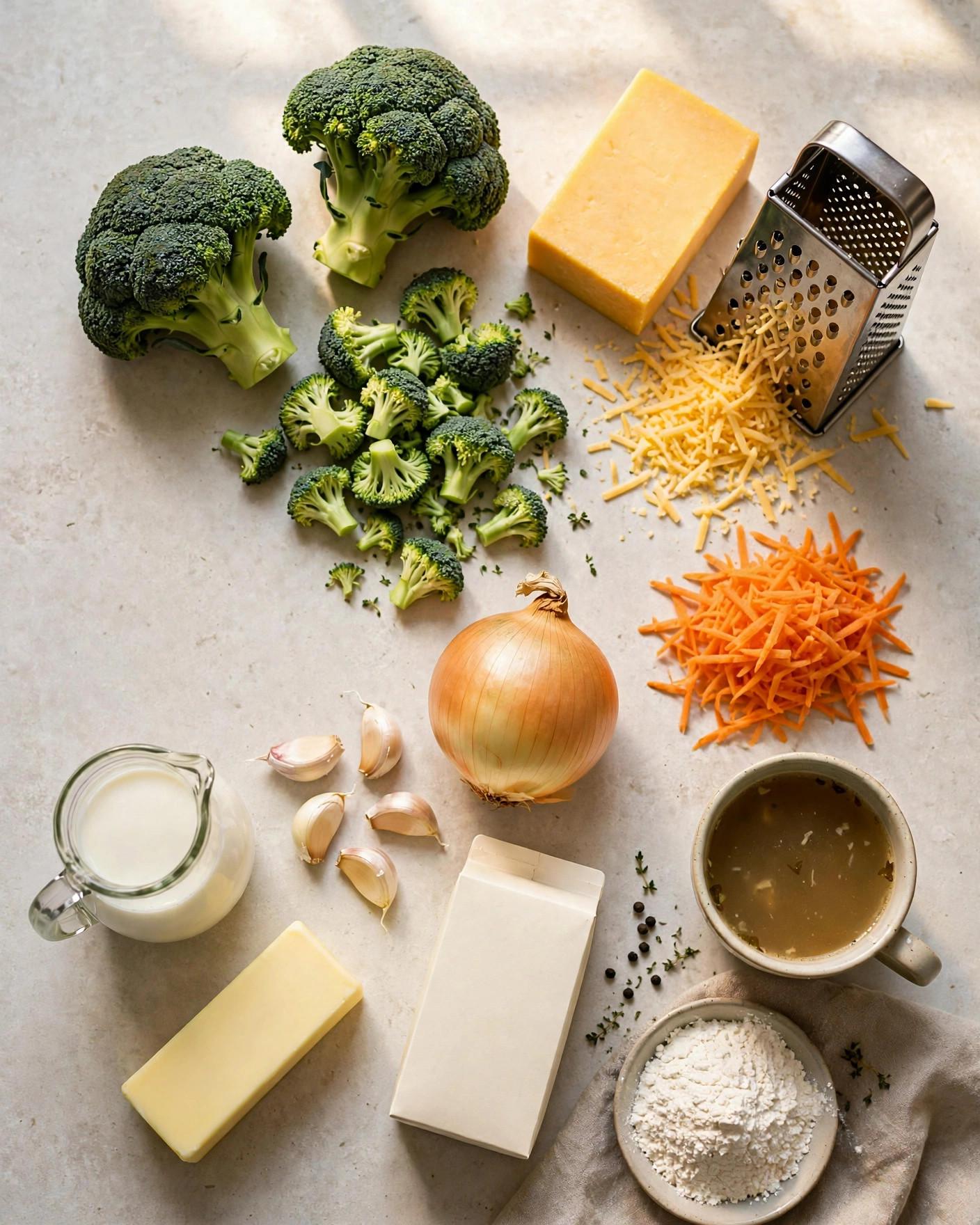
Ingredients
For the broccoli cheddar soup
- 4 tablespoons (57 g) unsalted butter
- 1 medium yellow onion (about 1 cup / 150 g), finely diced
- 1 cup (110 g) shredded carrots (about 2 medium carrots), coarsely grated or julienned
- 2 cloves garlic, minced
- 1/4 cup (32 g) all-purpose flour
- 2 cups (480 ml) whole milk, at room temperature if possible
- 2 cups (480 ml) low-sodium chicken broth or vegetable broth
- 5 cups (about 450 g / 1 lb) small broccoli florets, cut bite-size, plus tender stems peeled and diced
- 1 teaspoon Dijon mustard
- 1/2 teaspoon sweet paprika
- 1/4 teaspoon ground nutmeg, optional
- 3/4 teaspoon fine sea salt, plus more to taste
- 1/2 teaspoon black pepper, plus more to taste
- 1/2 cup (120 ml) heavy cream
- 3 cups (340 g / 12 ounces) freshly shredded sharp cheddar cheese, plus more for serving
Broccoli. Fresh broccoli gives the best texture and the brightest green. Cut the florets small — bite-size, roughly 1/2 to 3/4 inch — so they cook through in the same short simmer and fit on a spoon. Do not throw the stems away: peel the tough outer layer, dice the tender core, and add it with the florets. It cooks sweet and soft and stretches one pound of broccoli a long way. Frozen florets work too; see the FAQ for the small timing change.
Sharp cheddar, shredded by hand. This is the soup's whole identity, so the cheese matters. Buy a block of sharp (or extra-sharp) cheddar and shred it yourself on a box grater. Pre-shredded bagged cheese is coated with anti-caking starches that can make a cheese soup feel slightly gritty and dull its flavor; a hand-shredded block melts clean and tastes brighter. Let the shredded cheese sit out while the soup simmers so it is not fridge-cold when it goes in — room-temperature cheese melts faster and more evenly.
The roux. Butter and flour, cooked together for a minute or two, are what make this soup thick instead of brothy. The flour needs that brief toast to lose its raw taste, but it should stay pale — this is a golden soup, not a dark gumbo roux. Whisk the milk in slowly at the start; a gradual pour is what keeps the base lump-free.
Milk, broth, and a little cream. Whole milk plus broth keeps the soup rich but not heavy, and the small amount of heavy cream at the end rounds out the texture. Half-and-half can replace the milk and cream together (use 2 1/2 cups / 600 ml) for a slightly lighter pot. Keep the heat gentle once the dairy goes in — dairy and high heat are not friends, and a hard boil is the enemy of a smooth cheese soup.
Dijon, paprika, and nutmeg. A teaspoon of Dijon disappears into the background and quietly sharpens the cheddar flavor — the soup will not taste like mustard. Sweet paprika adds warmth and deepens the golden color, and a pinch of nutmeg is the classic béchamel seasoning that makes cheese sauces taste complete. All three are small, but together they are the difference between "cheesy broccoli soup" and the café version people ask about.
Instructions
- Prep everything first. Dice the onion, shred the carrots, mince the garlic, cut the broccoli into small florets (peel and dice the tender stems), and shred the cheddar from the block. Measure the milk, broth, and cream. This soup moves steadily once the butter melts, and having the cheese shredded and waiting is what lets you melt it in calmly at the end instead of grating over a hot, unattended pot.
- Soften the onion and carrots. Melt the butter in a large Dutch oven or heavy pot over medium heat. Add the onion and shredded carrots with a pinch of the salt and cook, stirring occasionally, for 4 to 5 minutes, until the onion is soft and translucent and the carrots have relaxed. The vegetables should soften without browning — lower the heat if they start catching color at the edges.
- Add the garlic and build the roux. Stir in the garlic and cook for about 30 seconds, just until fragrant. Sprinkle the flour over the vegetables and stir constantly for 1 to 2 minutes, coating everything and cooking off the raw flour taste. The mixture will look like a thick, pale paste clinging to the vegetables; keep it moving and keep it pale.
- Whisk in the milk and broth. Pour in about 1/2 cup of the milk and whisk vigorously until smooth, scraping the bottom of the pot. Then add the rest of the milk and all of the broth in a slow, steady stream, whisking as you go. Stir in the Dijon mustard, paprika, nutmeg if using, salt, and black pepper. Bring the pot to a gentle simmer over medium heat, stirring often — it will thicken noticeably as it heats.
- Simmer the broccoli. Add the broccoli florets and diced stems to the pot and stir them down into the broth. Simmer gently for 8 to 10 minutes, stirring occasionally, until the broccoli is bright green and tender enough to pierce easily with a fork but not falling apart. Keep the simmer lazy rather than rolling; a hard boil can toughen the dairy and break the smooth base you built.
- Adjust the texture, if you like. For the classic café texture — mostly smooth with tender pieces throughout — use an immersion blender for just a few short pulses directly in the pot, or mash a few spoonfuls of broccoli against the side of the pot with a wooden spoon. Blend less than you think: three or four pulses is plenty, and you can always add one more. For a chunkier, more rustic bowl, skip this step entirely.
- Stir in the cream and take the pot off the boil. Pour in the heavy cream and stir. Then reduce the heat to low — or take the pot off the burner entirely for a moment. The soup should be steaming hot but no longer bubbling when the cheese goes in. This is the single most important moment in the recipe: cheese that meets boiling liquid can seize and turn grainy, while cheese that meets hot, still liquid melts into silk.
- Melt in the cheddar, a handful at a time. Add the shredded cheddar one handful at a time, stirring steadily after each addition until it has fully melted before adding the next. The soup will turn a deep golden orange and thicken slightly as the cheese goes in. If it ever looks like it wants to bubble, pull the pot further from the heat and keep stirring — patience here is the whole technique.
- Taste, season, and serve. Taste the soup and adjust: more salt, another grind of black pepper, or an extra pinch of paprika as needed. Ladle into warm bowls, shower extra shredded cheddar over the top, and serve immediately with crusty bread for dunking — or ladle it into hollowed-out bread bowls for the full café treatment.


Tips for Success
- Never let the cheese boil. Grainy, separated cheese soup almost always traces back to one moment: cheese stirred into a bubbling pot. Take the soup off the boil, let the bubbles stop completely, then melt the cheddar in over the lowest heat — or off the burner entirely, using the soup's own stored heat.
- Shred the block yourself. It takes two minutes and it is the highest-value step in the recipe. Bagged pre-shredded cheese carries anti-caking coatings that melt less smoothly and can leave the soup faintly gritty; a hand-shredded block melts into a glossy, even sauce.
- Cut the broccoli small and even. Florets around 1/2 to 3/4 inch cook in the same window, so nothing is crunchy while the rest turns to mush — and every spoonful gets soup and broccoli together instead of one giant floret per bite.
- Add the cheese in handfuls, not all at once. A mountain of cold cheese dropped in at once drops the soup's temperature unevenly and clumps. A handful at a time, stirred until it disappears, keeps the emulsion smooth from the first handful to the last.
- Warm the milk if you can. Cold milk hitting a hot roux can shock the base. Room-temperature milk — or milk warmed for 30 seconds in the microwave — whisk into a noticeably smoother sauce. It is a small habit that pays off in every cream soup.
- Blend with restraint. A few immersion-blender pulses give the café-style body; a full blend turns it into baby food and dulls the color. Leave plenty of whole florets so the soup still eats like a soup.
- Season at the very end. Cheddar brands vary in saltiness, and the soup concentrates slightly as it stands. Do most of your salting after the cheese is in, tasting with a spoonful of soup and broccoli together rather than broth alone.
Variations
- The full café spread. Serve the soup in hollowed-out sourdough bread bowls with the torn-out bread toasted for dunking, and round the meal out with our Cheesy Hash Brown Casserole on the side — the complete comfort-food table, café style.
- Loaded broccoli cheddar soup. Borrow the toppings bar from a baked potato: extra cheddar, a spoonful of sour cream, sliced green onions, and crumbled cooked bacon over each bowl. The soup underneath stays exactly the same.
- Broccoli cheddar with a kick. Add 1/4 teaspoon of cayenne or a few shakes of hot sauce with the paprika, or swap half the cheddar for pepper jack. The heat sits quietly behind the cheese and makes the whole bowl taste sharper.
- Extra vegetables. Stir in a cup of diced cauliflower with the broccoli, a handful of baby spinach at the very end, or a diced potato (add it with the onion so it has time to soften) for a heartier, chunkier pot.
- Lighter version. Use 2% milk, replace the heavy cream with an equal amount of half-and-half, and reduce the cheddar to 2 1/2 cups, choosing extra-sharp so the smaller amount still reads clearly. The roux keeps the body; the soup lands lighter but still unmistakably cheesy.
- Slow cooker version. Add everything except the cream and cheese to a slow cooker — sauté the onion, carrot, garlic, and flour on the stove first for the best flavor — and cook on Low for 4 to 5 hours, until the broccoli is tender. Stir in the cream, then melt in the cheddar a handful at a time with the cooker on Warm, never on High.

Storage
Let the soup cool until it is no longer steaming, then transfer it to an airtight container and refrigerate promptly. It keeps well for up to 3 to 4 days, and the flavor holds up admirably — the broccoli softens a little more by day two, which many people honestly prefer. Keep extra shredded cheddar separate and add it fresh at serving; cheese stirred into the whole batch before storing only makes reheating harder.
Reheat gently, and treat gentle as non-negotiable. Warm the soup in a saucepan over medium-low heat, stirring often, until it is steaming hot throughout — and take it off the heat the moment it gets there. Cheese soups that are boiled a second time can separate or turn grainy, so a slow warm-through beats a fast boil every time. If the soup has thickened in the refrigerator, loosen it with a splash of milk or broth as it warms, a tablespoon or two at a time. Single servings reheat well in the microwave at reduced power, in short intervals, stirring between each.
Freezing is the one place this soup is less cooperative, and it is worth saying plainly. Dairy-based cheese soups often separate as they thaw, and broccoli goes very soft after freezing, so a thawed batch will taste fine but will not have the same silky body as a fresh pot. If you freeze it anyway, cool it completely, leave headspace in freezer-safe containers, and use it within 2 months. Thaw overnight in the refrigerator and reheat slowly on the stove, whisking steadily as it warms to coax the sauce back together; a small handful of fresh cheddar melted in at the end helps restore the texture.
FAQ
Can I use frozen broccoli in broccoli cheddar soup? Yes — frozen florets are a perfectly good swap. Use the same weight (about 1 pound / 450 g), thaw them briefly and drain off the excess water so the soup does not thin out, and add them a few minutes later than fresh, since they are already blanched: 5 to 6 minutes of simmering is usually enough for them to turn tender. Frozen broccoli breaks down a little more than fresh, so expect a slightly softer, more blended texture — which suits this soup just fine.
Why did my broccoli cheddar soup turn out grainy? Almost always, the cheese got too hot. Cheddar added to a boiling or nearly boiling soup can seize, and the proteins tighten into a grainy, sometimes oily texture instead of melting smooth. The fix is timing and temperature: take the pot off the boil, let the bubbling stop, and stir the cheese in a handful at a time over low heat. Hand-shredded block cheese also melts more smoothly than pre-shredded bagged cheese, whose anti-caking coating can add its own faint grit. If a batch has already gone slightly grainy, whisking in a splash of warm cream and keeping it off the boil can coax it partway back.
How do I make the soup thicker — or thinner? For a thicker soup, pulse the immersion blender a few more times (blended broccoli and roux are the soup's body), simmer it uncovered for a few extra minutes before adding the cheese, or whisk 1 tablespoon of cornstarch with 2 tablespoons of cold milk and stir the slurry in at the simmer. For a thinner soup, simply stir in warm milk or broth a splash at a time at the end until it pours the way you like. Remember the soup thickens noticeably as it stands and as leftovers chill, so aim slightly looser than your ideal at the stove.
Is broccoli cheddar soup vegetarian or gluten-free? It can be either with small swaps. For a vegetarian pot, use vegetable broth instead of chicken broth, and choose a cheddar made without animal rennet if your table is strict about it — everything else in the recipe is already meat-free. For a gluten-free pot, skip the flour and thicken with the cornstarch slurry described above (1 tablespoon cornstarch whisked with 2 tablespoons cold milk, stirred in at the simmer), or use a 1:1 gluten-free flour blend in the roux in the same amount.
Can I make broccoli cheddar soup ahead of time? Yes, and it is a friendly make-ahead soup. Cook it completely, cool it, and refrigerate it for up to 3 to 4 days; reheat it slowly over medium-low heat without letting it boil, loosening it with a splash of milk if it has thickened. If you want the brightest green color, you can also make the base a day ahead — everything up to adding the broccoli — then reheat the base, simmer the broccoli fresh, and melt in the cheese just before serving. The cheese step is quick enough that doing it last-minute costs almost nothing and buys the smoothest texture.

Recipe Card
Broccoli Cheddar Soup
- Prep Time: 10 minutes (PT10M)
- Cook Time: 20 minutes (PT20M)
- Total Time: 30 minutes (PT30M)
- Servings: 6 servings
- Calories: 430 kcal per serving (estimated)
One pot of thick, creamy broccoli cheddar soup built on a butter-and-flour roux, simmered with carrots and five cups of broccoli, and finished off the boil with three cups of real sharp cheddar. Keep the heat gentle once the dairy goes in, melt the cheese in a handful at a time, and serve it hot with extra cheddar and crusty bread — or in bread bowls for the full café treatment.
Nutrition (estimated): 430 kcal per serving (estimated), 18 g carbohydrates, 16 g protein, 33 g fat, 3 g fiber, 7 g sugar, 760 mg sodium. Nutrition is estimated and will vary with the exact brand of broth, milk, and cheese used, how much of the cheese goes on top at serving, and any variations or substitutions.

Hi, I’m Emma! I’m the cook and recipe developer behind Sizzle & Sage. From my sunny home kitchen, I share easy, flavor-packed recipes for real life — quick breakfasts, cozy weeknight dinners, and simple bakes anyone can make. Pull up a chair and stay a while!