Classic Thanksgiving Stuffing (Savory Bread Stuffing)
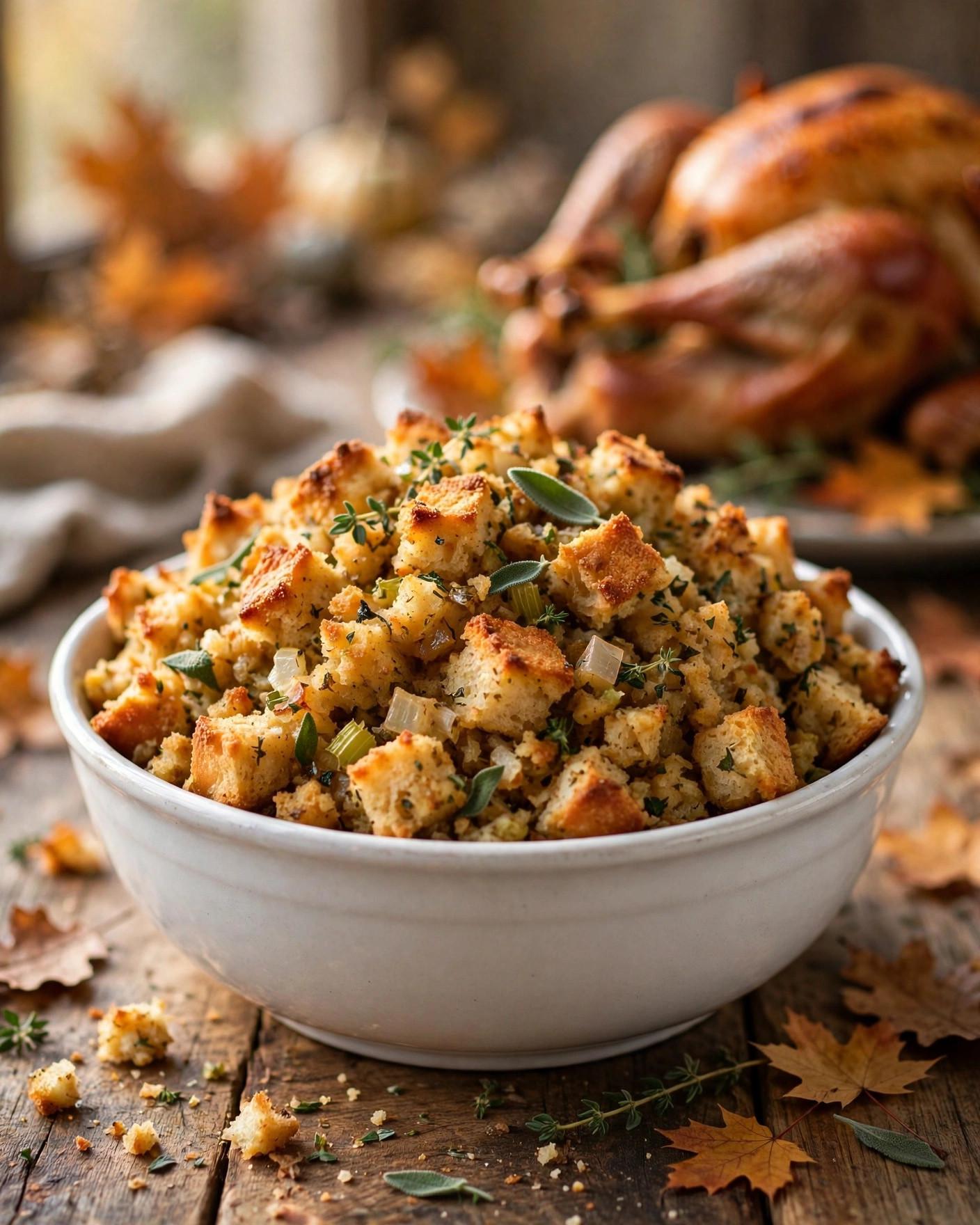
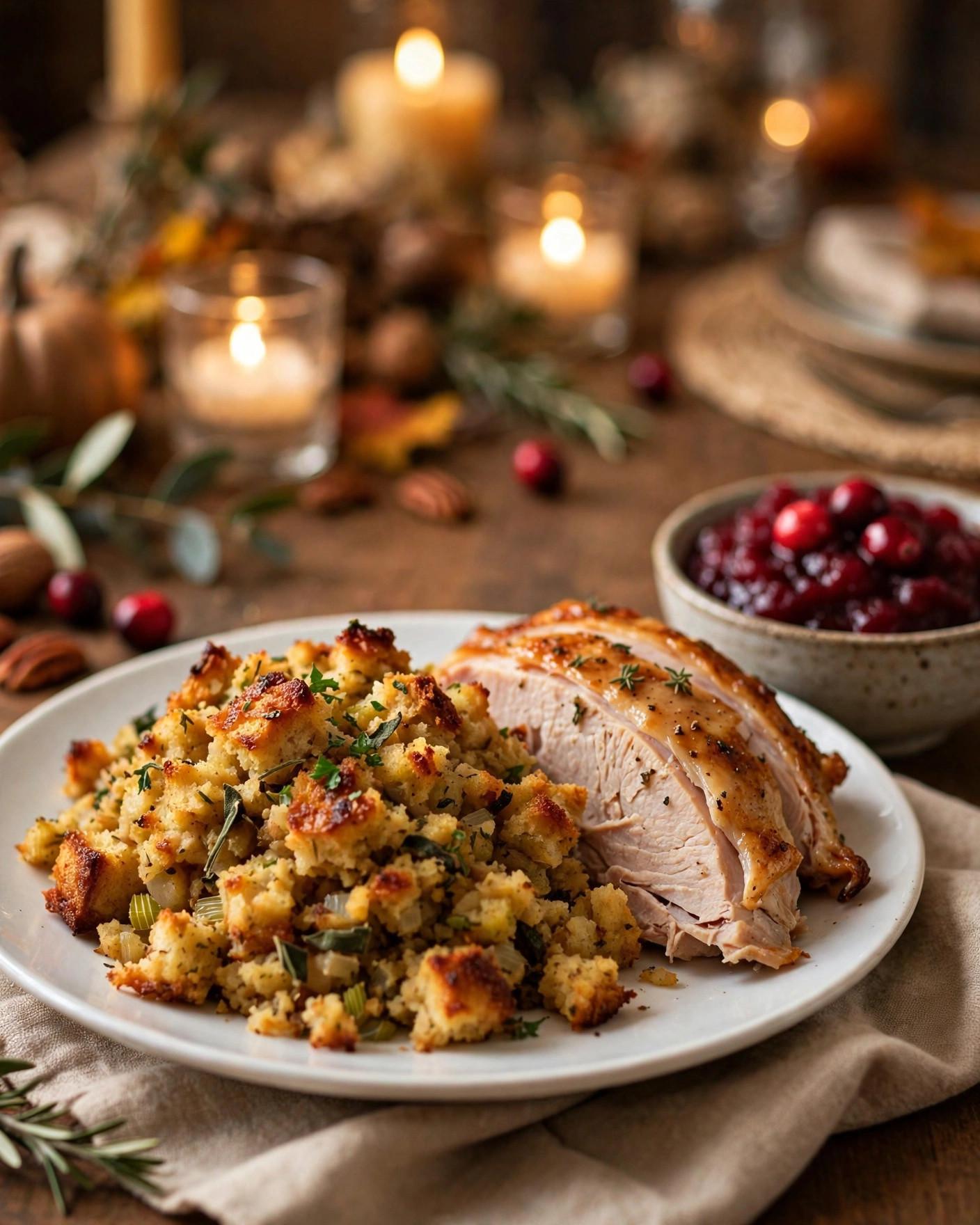
There is a reason classic Thanksgiving stuffing shows up on nearly every holiday table in America: it is the dish that tastes like Thanksgiving itself. Cubes of sturdy bread, toasted until crisp at the edges, soak up a savory custard of butter, onion, celery, and broth, then bake into a golden casserole that is crisp on top and tender underneath. Every forkful carries the familiar perfume of sage, thyme, and rosemary — the flavors that, more than any other, say the holidays have arrived.
The method here is deliberately traditional, because the classics earned their place. Day-old white bread (or a rustic country loaf) gives the stuffing structure that holds up to the broth without turning to mush. A generous amount of butter — a full stick — is non-negotiable; it carries flavor into every cube and helps the top brown to an irresistible crispness. And the vegetables are cooked slowly until completely soft and sweet, so they melt into the bread rather than sitting in crunchy chunks.
What makes this recipe dependable year after year is its balance. The bread cubes are toasted before they ever meet the liquid, so they absorb the broth like a sponge while keeping their shape. The egg in the custard binds everything into sliceable portions without making it dense. And the broth is added gradually — enough to make the mixture moist and luscious, never soggy. Follow the cues in the instructions and you will pull a pan of stuffing from the oven that is golden, fragrant, and gone within minutes.
Why You'll Love This Recipe
- True Thanksgiving flavor — sage, thyme, rosemary, butter, and onion deliver the classic holiday taste everyone expects
- Crisp top, tender center — toasted bread cubes and the right broth ratio give you the ideal texture contrast
- Make-ahead friendly — assemble the night before and bake on Thanksgiving Day for a stress-free holiday
- Feeds a crowd — a 9×13 pan serves 10–12 as a side, perfect for holiday gatherings
- Simple pantry ingredients — bread, butter, onion, celery, herbs, broth, and eggs; nothing exotic required
- Customizable — the variations below let you add sausage, apples, chestnuts, or mushrooms to make it your own

Ingredients
- 1 loaf (about 1 lb / 450 g) day-old white bread or country bread, cut into 3/4-inch cubes (about 10 cups)
- 1/2 cup (115 g) unsalted butter, plus more for greasing the dish
- 1 large yellow onion, diced (about 2 cups / 300 g)
- 4 ribs celery, diced (about 2 cups / 200 g)
- 3 cloves garlic, minced (about 1 tablespoon / 10 g)
- 1 tablespoon fresh sage, finely chopped (or 1 teaspoon dried)
- 1 tablespoon fresh thyme leaves (or 1 teaspoon dried)
- 1 tablespoon fresh rosemary, finely chopped (or 1 teaspoon dried)
- 1 teaspoon (6 g) kosher salt, plus more to taste
- 1/2 teaspoon (1 g) freshly ground black pepper
- 2 large eggs, lightly beaten
- 2 1/2 to 3 cups (590–710 ml) low-sodium chicken or turkey broth
- 1/4 cup (10 g) fresh parsley, chopped (for garnish, optional)
Instructions
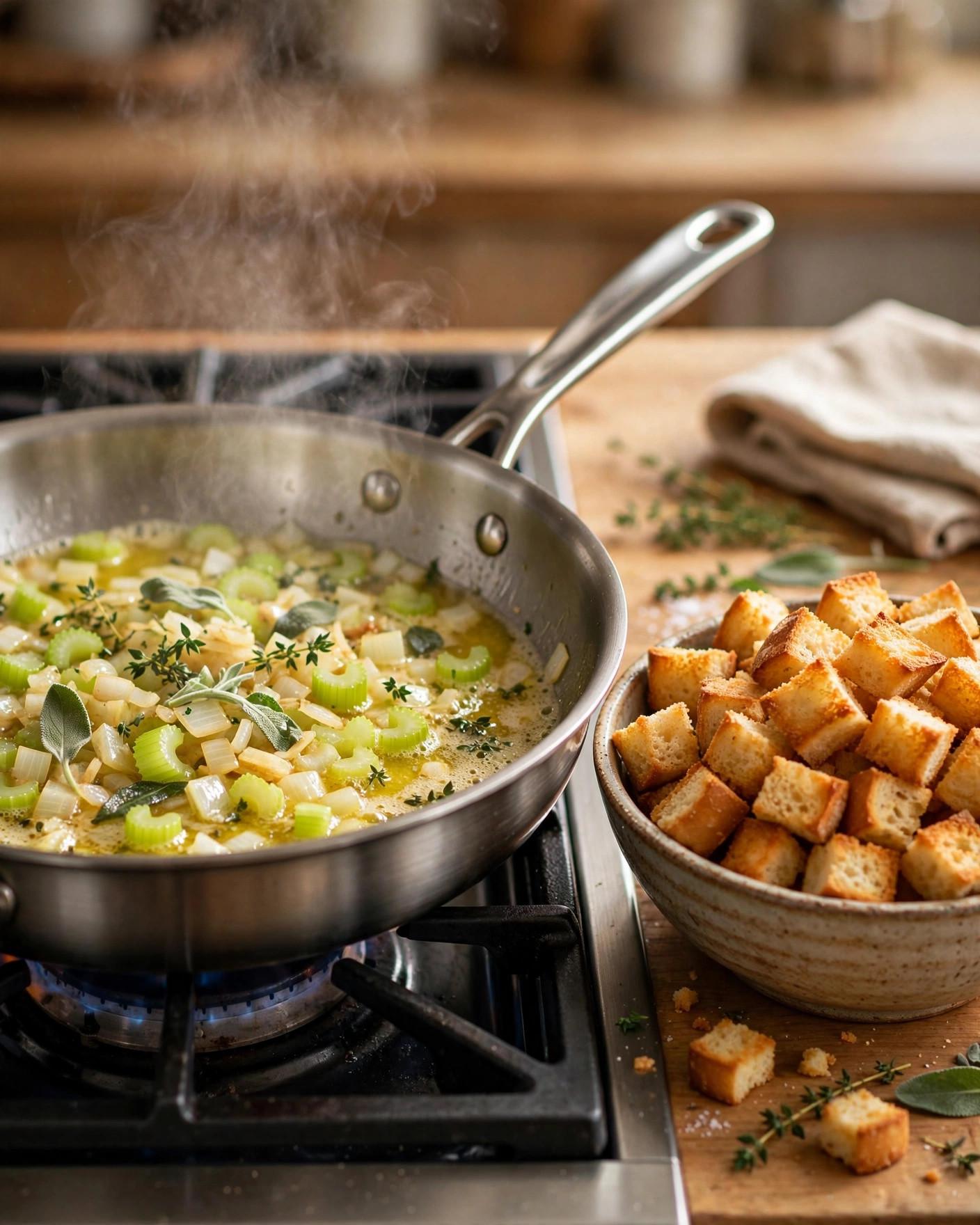
- Toast the bread cubes. Preheat the oven to 300°F (150°C). Spread the bread cubes in a single layer on two large rimmed baking sheets. Toast for 25–30 minutes, stirring once or twice, until the cubes are dry and lightly golden at the edges. Transfer to a very large mixing bowl and set aside. Increase the oven temperature to 350°F (175°C).
- Cook the vegetables. In a large skillet over medium heat, melt the butter. Add the diced onion and celery with a pinch of salt and cook, stirring occasionally, for 10–12 minutes, until completely soft and translucent but not browned. Stir in the garlic, sage, thyme, and rosemary and cook for 1 minute more, until fragrant. Remove from the heat.
- Combine the mixture. Scrape the buttery vegetable mixture over the toasted bread cubes. Sprinkle with the kosher salt and black pepper and toss gently to distribute. In a medium bowl, whisk the eggs with 2 1/2 cups of broth. Pour the egg-broth mixture evenly over the bread and toss gently until every cube is moistened. If the mixture looks dry, add more broth a splash at a time — the bread should be saturated but not swimming in liquid.
- Transfer to the baking dish. Butter a 9×13-inch (3-quart) baking dish generously. Transfer the stuffing mixture to the dish and spread it into an even layer without packing it down — a loose fill bakes up lighter. Dot the top with a few small pieces of butter if you like an extra-crisp crust.
- Bake covered, then uncovered. Cover the dish tightly with foil and bake at 350°F (175°C) for 30 minutes. Remove the foil and continue baking for 20–25 minutes more, until the top is deeply golden and crisp and the center is set (a knife inserted in the middle should come out with moist crumbs, not wet batter).
- Rest and serve. Let the stuffing rest for 10 minutes before serving — this helps it set so it portions neatly. Garnish with chopped fresh parsley if desired and serve warm.


Tips for Success
- Use stale bread. Day-old bread is drier and absorbs the broth without disintegrating. If your bread is fresh, the toasting step is essential — do not skip it.
- Do not over-soak. Add the broth gradually. The bread should be thoroughly moistened but there should be no puddle of liquid in the bottom of the bowl.
- Cook the vegetables fully. Onion and celery need a full 10–12 minutes to turn sweet and tender. Undercooked vegetables stay crunchy in the finished stuffing.
- Season assertively. Bread cubes need more salt than you think. Taste the mixture before baking (the raw egg is fine in a tiny taste) and adjust.
- Do not pack the dish. A loosely filled dish bakes up light and fluffy; packing it down makes dense, gummy stuffing.
- Bake covered first. The foil cover steams the center so it cooks through; uncovering at the end crisps the top. Both steps matter.
Variations
- Sausage stuffing: brown 1 lb of breakfast sausage, crumble it, and fold it into the bread cubes with the vegetables for a heartier, savory version.
- Apple and walnut stuffing: add 2 diced tart apples and 1 cup toasted chopped walnuts to the mixture for sweetness and crunch.
- Mushroom stuffing: sauté 12 oz of sliced cremini mushrooms with the onion and celery for an earthy, umami-rich stuffing.
- Chestnut stuffing: fold in 1 cup of roasted, peeled chestnuts (jarred are fine) for a traditional European touch.
- Cornbread stuffing: replace half the white bread with crumbled cornbread for a Southern-style stuffing with a slightly sweet crumb.
Storage
Cool leftover stuffing to room temperature within 2 hours, then cover tightly or transfer to an airtight container and refrigerate for up to 4 days. Reheat individual portions in the microwave, or warm the whole dish covered with foil in a 350°F oven for 20–25 minutes, until heated through — uncover for the last 5 minutes to re-crisp the top. For longer storage, freeze the baked stuffing in portion-sized airtight containers for up to 3 months; thaw overnight in the refrigerator before reheating.
To make ahead for Thanksgiving: assemble the stuffing completely (through step 4), cover tightly, and refrigerate unbaked for up to 24 hours. On Thanksgiving Day, let the dish sit at room temperature for 30 minutes, then bake as directed, adding 5–10 minutes to the covered baking time since it is starting cold. Leftover stuffing also makes excellent next-day sandwiches — pile it with turkey, cranberry sauce, and gravy on toasted bread.
FAQ
Can I make Thanksgiving stuffing ahead of time? Yes — this is one of the best make-ahead Thanksgiving dishes. Assemble the stuffing through step 4 (transfer to the baking dish), cover tightly with plastic wrap or foil, and refrigerate unbaked for up to 24 hours. On baking day, let it stand at room temperature for 30 minutes, then bake as directed, adding 5–10 extra minutes to the covered bake since it starts cold.
What is the best bread for classic stuffing? Sturdy, day-old white bread is the classic choice — it has a neutral flavor and a crumb that toasts well and absorbs broth without falling apart. A rustic country loaf, challah, or brioche also work beautifully. Avoid soft sandwich bread, which turns gummy, and very dense whole-grain loaves, which can make the stuffing heavy.
How do I keep stuffing from getting soggy? Three things prevent soggy stuffing: toast the bread cubes until dry before mixing, add the broth gradually rather than all at once (the bread should be moist but not swimming), and do not pack the baking dish tightly. Baking covered then uncovered also helps — the covered phase cooks the center through while the uncovered finish crisps the top and drives off excess moisture.
Can I cook stuffing inside the turkey? You can, but baking it separately in a dish is safer and gives better texture. Stuffing cooked inside the bird must reach 165°F (74°C) at its center to be food-safe, which often means overcooking the turkey breast while you wait. Baking it in a dish gives you a crisp golden top that in-bird stuffing never achieves, and it frees up oven timing on Thanksgiving Day.
Recipe Card
- Prep time: 20 minutes
- Cook time: 45 minutes
- Total time: 1 hour 5 minutes
- Servings: 10
- Estimated calories per serving: ~230 per serving
Can I make Thanksgiving stuffing ahead of time?
Yes — this is one of the best make-ahead Thanksgiving dishes. Assemble the stuffing through step 4 (transfer to the baking dish), cover tightly with plastic wrap or foil, and refrigerate unbaked for up to 24 hours. On baking day, let it stand at room temperature for 30 minutes, then bake as directed, adding 5–10 extra minutes to the covered bake since it starts cold.
What is the best bread for classic stuffing?
Sturdy, day-old white bread is the classic choice — it has a neutral flavor and a crumb that toasts well and absorbs broth without falling apart. A rustic country loaf, challah, or brioche also work beautifully. Avoid soft sandwich bread, which turns gummy, and very dense whole-grain loaves, which can make the stuffing heavy.
How do I keep stuffing from getting soggy?
Three things prevent soggy stuffing: toast the bread cubes until dry before mixing, add the broth gradually rather than all at once (the bread should be moist but not swimming), and do not pack the baking dish tightly. Baking covered then uncovered also helps — the covered phase cooks the center through while the uncovered finish crisps the top and drives off excess moisture.
Can I cook stuffing inside the turkey?
You can, but baking it separately in a dish is safer and gives better texture. Stuffing cooked inside the bird must reach 165°F (74°C) at its center to be food-safe, which often means overcooking the turkey breast while you wait. Baking it in a dish gives you a crisp golden top that in-bird stuffing never achieves, and it frees up oven timing on Thanksgiving Day.

Hi, I’m Emma! I’m the cook and recipe developer behind Sizzle & Sage. From my sunny home kitchen, I share easy, flavor-packed recipes for real life — quick breakfasts, cozy weeknight dinners, and simple bakes anyone can make. Pull up a chair and stay a while!