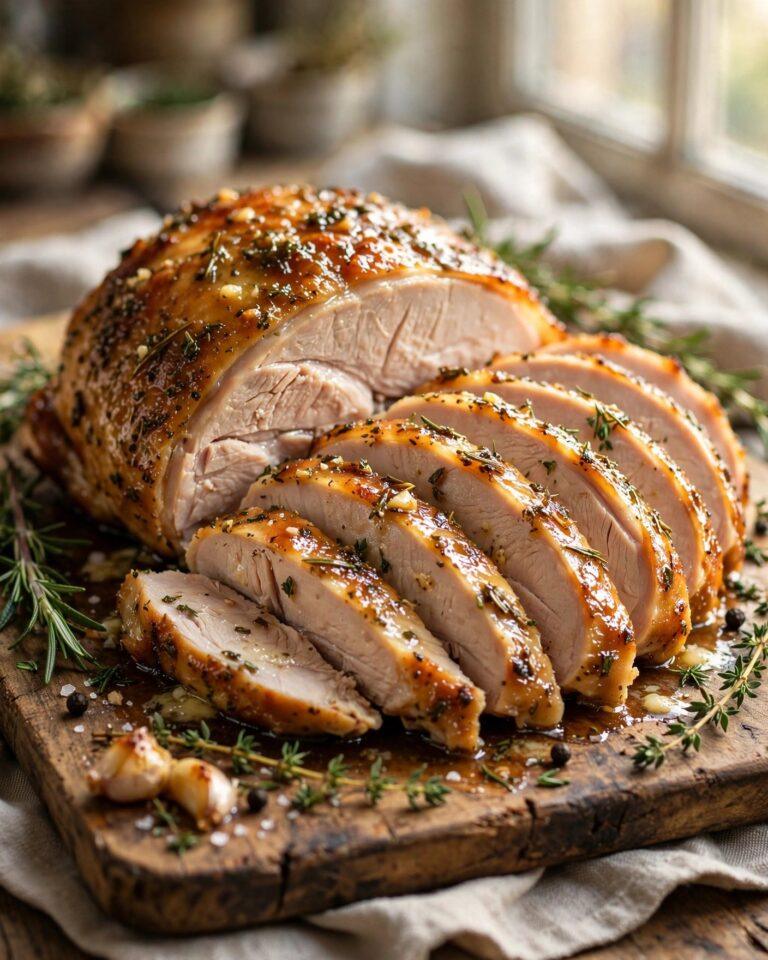
Spatchcock Turkey with Dry Brine (Juiciest Roast Turkey)
How long should a turkey dry brine?
A minimum of 24 hours is needed for the salt to penetrate the meat; 48 hours is the sweet spot for a 12–14 lb turkey, giving deeply seasoned, juicy meat and very dry skin. Up to 72 hours is fine and can produce even crispier skin — beyond that the texture can start to feel hammy. Always brine uncovered in the refrigerator, never at room temperature.
What is spatchcocking, and why do it?
Spatchcocking means removing the turkey’s backbone with kitchen shears and pressing the bird flat so it roasts in one even layer. The thighs and drumsticks, which need more heat, sit closer to the hot pan while the breast cooks more gently above — so everything finishes at the same time. It also cuts the roasting time nearly in half compared to a traditional whole bird.
Can I dry brine a frozen or partially frozen turkey?
No — the salt needs direct contact with the skin and meat to work, and ice or frost blocks it. Thaw the turkey completely first (about 24 hours of refrigerator time per 4–5 lbs, so roughly 3 days for a 12–14 lb bird). Once thawed, pat the bird dry, apply the brine, and refrigerate uncovered.
Do I need to rinse off the dry brine before roasting?
No, do not rinse. Rinsing raw poultry splashes bacteria around the sink and washes away the seasoning. The salt, baking powder, and pepper layer is thin and stays on through roasting — it becomes part of the crisp, seasoned skin. Simply add the herb butter and roast as directed.
A spatchcock turkey with dry brine is the Thanksgiving centerpiece that solves the two biggest problems of roast turkey: dry breast meat and a bird that takes all afternoon in the oven. Spatchcocking — also called butterflying — means cutting out the backbone with kitchen shears and flattening the turkey so it roasts in a single even layer. The legs and thighs, which need more time, end up closer to the heat of the pan, while the breast stays a little higher and cooks more gently. The result is a bird that finishes in about 90 minutes, with every part of it done at the same time.
The dry brine is the other half of the magic. Instead of wrestling a giant bird into a bucket of salt water, the turkey is seasoned all over with a simple mix of kosher salt, baking powder, and black pepper, then left uncovered in the refrigerator for one to three days. During that time the salt draws out moisture and then pulls it back in, seasoning the meat deeply and helping it hold onto its juices. The uncovered rest dries the surface of the skin, which is exactly what you want — dry skin browns faster and gets shatteringly crisp in a hot oven, with no wet-brine splashing, no giant cooler, and no extra refrigerator Tetris.
Before roasting, a compound herb butter with garlic, rosemary, and thyme goes over and under the skin, adding rich flavor and helping the breast meat stay succulent. High heat — 450°F — does the rest: the flattened shape means hot air reaches every surface, so the skin turns deep golden-brown while the meat cooks through quickly and evenly. Pull the bird when the breast reads 160°F and the thighs read 175°F on an instant-read thermometer, rest it well, and carve. The whole process is more forgiving than a traditional whole roast, and the payoff is the juiciest, crispest turkey the Thanksgiving table has ever seen.
Why You'll Love This Recipe
- Cools faster in the oven — a flattened turkey roasts in about 90 minutes instead of 3–4 hours, freeing the oven for side dishes
- Even cooking, every time — the breast and thighs finish together, so no more dry breast or underdone legs
- No wet-brine hassle — dry brining needs nothing more than salt, a roasting pan, and refrigerator space, with far more flavor payoff
- Crackly golden skin — the uncovered overnight rest dries the skin so it browns deeply and crisps up beautifully in a hot oven
- Juicy, seasoned meat — the salt penetrates deep during the brine, so every bite is flavorful, not just the surface
- Make-ahead friendly — the turkey brines in the fridge for 1–3 days, so Thanksgiving Day is just butter, roast, and rest

Ingredients
- For the dry brine:
- 3 tablespoons (54 g) Diamond Crystal kosher salt (see notes for other salt types)
- 1 tablespoon (12 g) baking powder
- 2 teaspoons (4 g) coarsely ground black pepper
- For the turkey:
- 1 whole turkey, 12–14 lbs (5.4–6.4 kg), thawed if frozen
- 8 tablespoons (115 g) unsalted butter, softened to room temperature
- 4 cloves garlic, minced
- 2 tablespoons fresh rosemary leaves, finely chopped
- 2 tablespoons fresh thyme leaves, finely chopped
- 1 tablespoon fresh lemon juice
- 1 teaspoon fine sea salt
- Optional, for the roasting pan:
- 1 lemon, quartered
- 6–8 fresh rosemary and thyme sprigs
- 1 cup (240 ml) low-sodium chicken broth
Instructions
- Remove the backbone. Place the thawed turkey breast-side down on a large cutting board. Using sharp kitchen shears, cut along one side of the backbone from the tail end to the neck end, cutting through the ribs as you go. Repeat on the other side of the backbone, then lift out the whole backbone piece and set it aside (save it for stock or gravy).
- Flatten the bird. Flip the turkey breast-side up. Place the heel of your hand over the breastbone and press down firmly until you hear and feel a crack — the turkey should now lie flat. Tuck the wing tips behind the breast so they do not burn.
- Mix the dry brine. In a small bowl, stir together the kosher salt, baking powder, and black pepper until evenly combined.
- Season all over. Set the flattened turkey on a rimmed sheet pan or in a large roasting pan. Sprinkle the dry-brine mixture evenly over every surface of the bird — top, sides, and underside — rubbing it gently into the skin and into the crevices where the legs meet the breast.
- Brine uncovered in the fridge. Slide the pan into the refrigerator, uncovered, for at least 24 hours and up to 72 hours (3 days). The longer rest seasons the meat more deeply and dries the skin for the crispest result. If fridge space is tight, the turkey can also brine on a wire rack set inside the roasting pan.
- Make the herb butter. About 1 hour before roasting, combine the softened butter, minced garlic, chopped rosemary, chopped thyme, lemon juice, and fine sea salt in a bowl and stir until smooth and evenly flecked with herbs.
- Butter the turkey. Remove the turkey from the fridge — do not rinse off the brine. Gently loosen the skin over the breast and thighs with your fingers, and push about two-thirds of the herb butter directly under the skin, spreading it as evenly as possible. Rub the remaining butter all over the outside of the skin.
- Roast at high heat. Position an oven rack in the middle and preheat to 450°F (230°C). Scatter the lemon quarters and herb sprigs in the roasting pan around the turkey and pour in the chicken broth. Roast until the skin is deep golden-brown and crisp, the breast registers 160°F (71°C), and the thickest part of the thigh registers 175°F (79°C) on an instant-read thermometer — about 1 hour 20 minutes to 1 hour 40 minutes for a 12–14 lb bird. If the skin browns too fast, tent loosely with foil.
- Rest before carving. Transfer the turkey to a carving board and rest for at least 30 minutes (up to 45). The internal temperature will rise a few degrees as it rests — this is expected, and it is why the breast is pulled at 160°F. Resting lets the juices redistribute so they stay in the meat instead of running out on the board.
- Carve and serve. Separate the legs and thighs, slice the breast meat against the grain into even slices, and arrange everything on a warm platter. Spoon any pan juices over the carved meat and serve hot.


Tips for Success
- Use the right salt. The recipe is written for Diamond Crystal kosher salt. If using Morton kosher salt, reduce to 2 tablespoons — its crystals are denser, so the same volume is much saltier. Never use table salt for a dry brine; it is far too concentrated and can make the bird taste harsh.
- Do not rinse the turkey. Rinsing poultry spreads bacteria around the sink without removing any, and it washes away the brine you just applied. The dry brine stays on from fridge to oven.
- Keep it uncovered while brining. Covering the turkey traps moisture against the skin and defeats the drying step that makes the skin crisp. An uncovered rest in a cold fridge is safe and is the key to crackly skin.
- Start with a fully thawed turkey. A 12–14 lb turkey needs about 3 days to thaw in the refrigerator (roughly 24 hours per 4–5 lbs). Plan the thaw, then the 1–3 day brine, so the bird is seasoned and ready on roasting day.
- Trust the thermometer, not the clock. Ovens vary and turkeys vary — the only reliable doneness test is temperature: 160°F in the thickest part of the breast and 175°F in the thigh. Pull the breast at 160°F; carryover heat finishes it to a safe 165°F during the rest.
- Save the backbone. Do not throw it away — roast it alongside the turkey or simmer it with the neck, giblets, and aromatics for a quick stock that becomes the best gravy base.
Variations
- Citrus-herb version: add the zest of 2 oranges and 1 tablespoon of chopped sage to the herb butter, and scatter orange slices in the roasting pan for a bright, fragrant twist.
- Smoky paprika version: swap the black pepper in the dry brine for 2 teaspoons of smoked paprika and add 1 teaspoon of garlic powder — the skin takes on a deep amber color and gentle smokiness.
- Garlic-and-herb overload: double the garlic in the compound butter and tuck whole crushed garlic cloves plus extra thyme sprigs into the pan; the broth becomes a ready-made basting liquid.
- Spatchcock turkey breast only: use a 6–8 lb bone-in turkey breast instead of a whole bird, brine with half the salt mixture for 24 hours, and roast at 425°F for about 60–75 minutes — ideal for smaller gatherings.
- Gravy-ready drippings: roast the backbone, neck, and giblets on a separate sheet pan at the same time as the turkey, then simmer them in water with an onion and bay leaf for a quick stock to build gravy while the bird rests.
Storage
Carved leftover turkey keeps for 3–4 days in the refrigerator in airtight containers — store the breast slices and dark meat separately if possible, since the dark meat stays juicier and the breast dries out faster. For longer storage, freeze carved meat in portion-sized freezer bags with as much air pressed out as possible for up to 3 months; thaw overnight in the refrigerator. Leftover herb butter freezes beautifully too: roll it into a log in parchment, freeze, and slice off rounds for vegetables, dinner rolls, or the next roast chicken.
Reheat gently to keep the meat moist — warm slices in a covered skillet over low heat with a splash of chicken broth, or in a 300°F oven covered with foil until just heated through. Avoid the microwave on high, which makes turkey rubbery; short bursts at medium power work better if the microwave is the only option. The crisp skin will not stay crisp after storage, so use reheated meat in turkey sandwiches, grain bowls, soups, and casseroles where the juicy seasoned meat shines.
FAQ
How long should a turkey dry brine? A minimum of 24 hours is needed for the salt to penetrate the meat; 48 hours is the sweet spot for a 12–14 lb turkey, giving deeply seasoned, juicy meat and very dry skin. Up to 72 hours is fine and can produce even crispier skin — beyond that the texture can start to feel hammy. Always brine uncovered in the refrigerator, never at room temperature.
What is spatchcocking, and why do it? Spatchcocking means removing the turkey's backbone with kitchen shears and pressing the bird flat so it roasts in one even layer. The thighs and drumsticks, which need more heat, sit closer to the hot pan while the breast cooks more gently above — so everything finishes at the same time. It also cuts the roasting time nearly in half compared to a traditional whole bird.
Can I dry brine a frozen or partially frozen turkey? No — the salt needs direct contact with the skin and meat to work, and ice or frost blocks it. Thaw the turkey completely first (about 24 hours of refrigerator time per 4–5 lbs, so roughly 3 days for a 12–14 lb bird). Once thawed, pat the bird dry, apply the brine, and refrigerate uncovered.
Do I need to rinse off the dry brine before roasting? No, do not rinse. Rinsing raw poultry splashes bacteria around the sink and washes away the seasoning. The salt, baking powder, and pepper layer is thin and stays on through roasting — it becomes part of the crisp, seasoned skin. Simply add the herb butter and roast as directed.

Recipe Card
- Prep time: 30 minutes
- Cook time: 1 hour 30 minutes
- Total time: 26 hours (includes overnight dry brine)
- Servings: 12
- Estimated calories per serving: ~450 per serving

Hi, I’m Emma! I’m the cook and recipe developer behind Sizzle & Sage. From my sunny home kitchen, I share easy, flavor-packed recipes for real life — quick breakfasts, cozy weeknight dinners, and simple bakes anyone can make. Pull up a chair and stay a while!