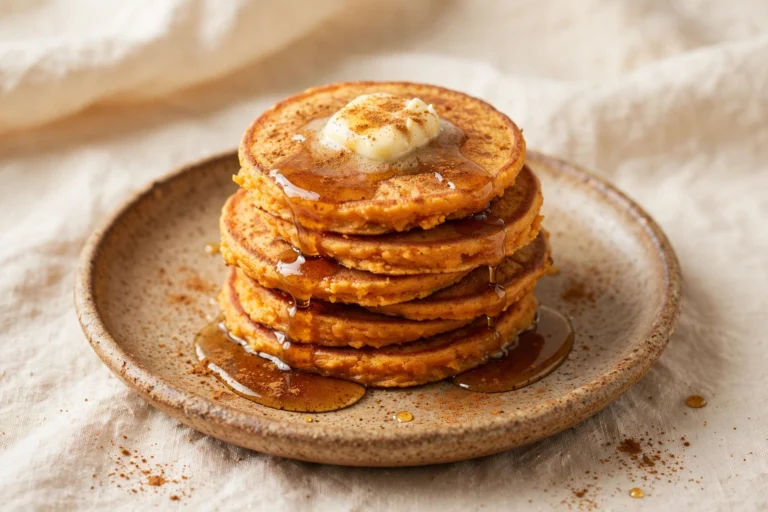
3-Ingredient Apple Oat Pancakes
There is a particular kind of morning that calls for pancakes but not for a project. The kind where the kitchen is cold, the light is still gray, and you want something warm, sweet, and homemade on the table in twenty minutes — without measuring out flour, sugar, baking powder, and half the pantry. These 3-Ingredient Apple Oat Pancakes are that breakfast. Rolled oats, one fresh apple, and two eggs come together in a blender and turn into soft, golden, flourless pancakes that taste like apple pie decided to become breakfast. A little cinnamon and vanilla, if you have them, make the whole kitchen smell like a bakery, but they are seasoning, not a requirement — the recipe truly needs just three things.
What makes these pancakes so good is how the apple does double duty. Grated or finely diced, it brings sweetness, moisture, and little pockets of tender fruit in every bite, so there is no need for added sugar at all. The oats bring body and a gentle, nutty flavor, plus the kind of fiber that keeps you full long after the plate is empty. The eggs bind everything together and give the pancakes their lift and their golden color. There is no flour, no sugar, no baking powder, and no milk to measure — just a blender, a bowl, and a skillet. If you have ever wished for a pancake recipe you could make half asleep, this is the one.
This is also a winter breakfast in the best sense of the word. Apples are at their sweetest and most plentiful in the cold months, and a warm stack of apple pancakes with maple syrup is the kind of thing that makes a frosty morning feel like a treat rather than a chore. They are sturdy enough for a weekday, special enough for a slow weekend, and simple enough that kids can help make them — grating the apple, cracking the eggs, and pressing the blender button are all jobs a small cook can handle with supervision. The batter comes together in about five minutes, the pancakes cook in about twelve, and the whole batch is on the table before the coffee has finished brewing.
One of the things I love most about this recipe is how forgiving it is. The batter is thick and scoopable rather than pourable, which means the pancakes hold their shape in the pan and are hard to mess up. If your apple is very juicy, the batter loosens a little; if your oats are old-fashioned and hearty, the pancakes come out a little more rustic. Both versions are delicious. There is no exact pour, no worry about lumps, and no risk of a flat, gummy stack if you follow the few simple cues in the instructions below — small bubbles at the edges, a matte top, and a gentle flip.
These pancakes sit in good company on the site, too. If you love a minimal-ingredient pancake, the 3-Ingredient Pumpkin Pancakes bring the same easy spirit to fall flavors, and the 3-Ingredient Banana Oat Pancakes are the closest cousin to this recipe — same oat base, different fruit, equally simple. For a bigger weekend spread, Sheet Pan Buttermilk Pancakes feed a crowd with almost no standing at the stove. And if you want to prep breakfast the night before, High Protein Overnight Oats use the same humble rolled oats in a make-ahead form.
Serve these apple oat pancakes warm, straight from the skillet, with a drizzle of maple syrup, a spoonful of yogurt, or a scatter of extra diced apple on top. They are sweet enough on their own, hearty enough to carry you to lunch, and simple enough to become a regular in your winter breakfast rotation. Once you have made them once, you will know the rhythm by heart — and you will probably find yourself reaching for an apple and the oats on more mornings than you planned.
Why You'll Love This Recipe
- Only three real ingredients. Rolled oats, a fresh apple, and eggs — that is the whole recipe. Cinnamon and vanilla are optional seasoning, not a fourth and fifth ingredient you have to buy.
- Flourless and naturally sweet. There is no flour, no added sugar, and no baking powder. The apple sweetens the batter all by itself, and the oats give the pancakes real staying power.
- Ready in about 20 minutes. Five minutes in the blender, twelve minutes at the stove, and breakfast is on the table. No resting time, no complicated technique.
- Blender batter, no whisking required. Everything goes into the blender at once, which means one dirty appliance, no lumps to worry about, and a batter that is ready in under a minute.
- A true winter breakfast. Apples are at their best in the cold months, and warm apple pancakes with cinnamon taste like the season itself. This is cozy food that happens to be healthy.
- Kid-friendly to make and to eat. Kids can crack the eggs, press the blender button, and watch the pancakes puff in the pan. The pancakes are soft, sweet, and easy to cut — a great first pancake recipe for little cooks.
- Naturally gluten-free when you use certified oats. With certified gluten-free rolled oats, the whole recipe is gluten-free with no substitutions at all, which makes it easy to serve to guests with different needs.
- Easy to scale and to make ahead. Double the batch for a crowd, or cook a big batch on Sunday and reheat the leftovers all week. The batter and the cooked pancakes both keep well, so breakfast is never far away.

Ingredients
- 1 cup (90 g) old-fashioned rolled oats
- 1 medium apple (about 180 g), any sweet variety
- 2 large eggs
- 1/2 teaspoon ground cinnamon, optional
- 1/2 teaspoon vanilla extract, optional
- 1 pinch fine sea salt, optional
- 1 tablespoon (14 g) unsalted butter or neutral oil, for the pan
- Maple syrup, yogurt, or extra diced apple, for serving, optional
Why these ingredients matter
Old-fashioned rolled oats. Rolled oats are the flour in this recipe — they give the pancakes their structure, their gentle nutty flavor, and the fiber that makes a small stack feel like a real breakfast. Old-fashioned rolled oats are the right choice because they blend into a batter that is thick and scoopable but still tender; quick oats blend into something smoother and a little denser, which works in a pinch but gives a softer, less interesting texture. Steel-cut oats will not work here, because they do not soften enough in the short blend and cook time and will leave the pancakes gritty. If you need the recipe to be gluten-free, use certified gluten-free rolled oats — oats are naturally gluten-free, but they are often processed in facilities that handle wheat, so the certification is what makes the claim safe. Measure the oats by weight if you can, since a cup of oats can vary by 10 grams or more depending on how it is scooped, and that variation changes the batter thickness.
Fresh apple. The apple is the star of this recipe, and it does more work than any other ingredient. It sweetens the batter so no sugar is needed, it adds moisture so the pancakes stay tender, and it leaves little pockets of soft, warm fruit in every bite. A sweet, crisp variety is best — Honeycrisp, Fuji, Gala, or Pink Lady all bring plenty of natural sweetness and hold their shape when cooked. Granny Smith works too if you like a tarter pancake, though you may want a drizzle of maple syrup at the table to balance the tartness. Use a medium apple, about 180 grams, which is roughly one cup once grated or finely diced. You can peel it or leave the peel on; peeling gives a smoother pancake, while leaving the peel on adds a little fiber and a rustic fleck of color. Either way, core it first, and grate it on the large holes of a box grater or dice it very finely so the pieces cook through in the short time the pancakes spend in the pan.
Eggs. Two large eggs are the glue and the lift in this recipe. They bind the oats and apple into a batter that holds together in the pan, they give the pancakes their rich golden color, and they add protein that keeps the breakfast satisfying. Because there is no baking powder and no flour, the eggs are doing real structural work, so do not reduce them or swap in a substitute without expecting a different result. Use large eggs, and let them come to room temperature for a few minutes before blending if you can — cold eggs can make the batter seize slightly and cook less evenly, though the difference is small. If you are making a double batch, use four eggs rather than trying to stretch three; the ratio matters more than the total.
Ground cinnamon. Cinnamon is optional, but it is the ingredient that turns these pancakes from good into unmistakably wintery. Half a teaspoon is enough to perfume the whole batch with warm spice without overwhelming the apple, and it pairs so naturally with apple that most people will assume it was always part of the recipe. Ceylon cinnamon is a little sweeter and more delicate; cassia cinnamon is bolder and more familiar. Either works. If you do not have cinnamon, a pinch of nutmeg or apple pie spice is a good substitute, or you can leave the spice out entirely and let the apple speak for itself.
Vanilla extract. Vanilla is also optional, and it plays a supporting role — a half teaspoon rounds out the flavor, adds a little warmth, and makes the pancakes taste more like a bakery treat and less like a health food. Real vanilla extract is best, but imitation vanilla works fine in a pancake that is cooked quickly. If you are skipping both cinnamon and vanilla, the pancakes will still be sweet and good, just a little simpler and more purely apple-flavored, which some people prefer.
Fine sea salt. A pinch of salt is a small thing that makes a real difference, and it is worth including even in a three-ingredient recipe. Salt does not make the pancakes taste salty; it makes the apple taste sweeter and the oats taste nuttier, the way salt sharpens flavor in almost any baked good. A pinch — about 1/8 teaspoon — is enough. If you are watching sodium closely, you can skip it, but the pancakes will taste a touch flatter without it.
Butter or oil for the pan. A little fat in the pan is what gives the pancakes their golden, lightly crisped edges and keeps them from sticking. Unsalted butter adds flavor and helps the pancakes brown beautifully, while a neutral oil like avocado oil or light olive oil works just as well and handles higher heat without browning too fast. Use about a tablespoon for the whole batch, adding a little more between rounds if the pan starts to look dry. A well-seasoned cast-iron skillet or a good nonstick pan needs very little fat; a stainless steel pan needs a bit more and a little patience to heat evenly.
Maple syrup, yogurt, or extra diced apple for serving. These pancakes are sweet enough to eat plain, but toppings turn them into a proper breakfast. Real maple syrup is the classic choice — a thin drizzle is enough, since the apple already sweetens the batter. A spoonful of Greek yogurt adds cool creaminess and protein, and it pairs beautifully with the warm pancakes. A scatter of extra diced apple, a few chopped walnuts, or a dusting of cinnamon on top makes the plate look as good as it tastes. Honey works in place of maple syrup, and a smear of peanut butter or almond butter turns the stack into a heartier, more filling meal.
Instructions
- Gather and measure everything. Measure 1 cup (90 g) of old-fashioned rolled oats into a small bowl or straight into the blender jar. Set out 2 large eggs, a medium apple, and the cinnamon, vanilla, and salt if you are using them. Put a large skillet — cast iron or nonstick — on the stove, but do not turn on the heat yet. Having everything measured and within reach before you start matters more than it seems, because once the batter is blended it is best used right away, and you do not want to be hunting for the butter while the pan is already hot.
- Prepare the apple. Core the apple and decide whether to peel it. For the smoothest pancakes, peel it; for a more rustic pancake with extra fiber, leave the peel on. Grate the apple on the large holes of a box grater into a small bowl, or dice it very finely with a knife — the pieces should be no bigger than a pea so they cook through in the short time the pancakes spend in the pan. You should have about 1 cup of grated or diced apple. If the apple releases a lot of juice as you grate it, pour off the excess liquid so the batter does not get too thin, but do not squeeze the apple dry — that juice is flavor and moisture the pancakes need.
- Blend the oats into a flour. Pour the rolled oats into the blender and pulse 4 to 5 times, then blend on high for about 20 seconds, until the oats look like a coarse flour with no large flakes remaining. This step matters because whole oats do not soften fast enough in a quick-cooking pancake, and unblended oats will leave the pancakes gritty and crumbly. You do not need a perfectly fine flour — a slightly coarse, sandy texture is ideal — but there should be no recognizable oat flakes left. If your blender is large and the oats are rattling around without catching the blades, add the eggs first and then the oats, so the liquid helps pull the oats down.
- Add the apple, eggs, and seasonings. Add the grated or diced apple, the 2 eggs, the cinnamon, vanilla, and salt to the blender with the oat flour. Blend on high for 20 to 30 seconds, stopping once to scrape down the sides with a spatula, until the batter is thick, smooth, and scoopable. It should look like a thick porridge or a soft cookie dough — it will not pour like a traditional pancake batter, and that is exactly right. If the batter looks too thick to scoop easily, add a tablespoon of water or milk and blend again for a few seconds. If it looks too thin, blend in another tablespoon of oats.
- Let the batter rest for 2 to 3 minutes. This short rest is the easiest step in the recipe and one of the most important. While the batter sits, the oat flour absorbs moisture from the eggs and the apple, the batter thickens slightly, and the pancakes hold together better in the pan. Use the time to put the butter or oil in the skillet and start warming it over medium-low heat. The batter will look a little thicker after the rest than it did straight out of the blender — that is the oats doing their job, and it is a good sign.
- Heat the pan and add the fat. Set the skillet over medium-low heat and add about half the butter or oil. Let it melt and coat the pan, then give the pan a moment to reach an even temperature — a drop of water flicked into the pan should sizzle gently, not spit violently. Medium-low is the right heat for these pancakes: too hot and the outsides will brown before the middles cook through; too cool and the pancakes will sit pale and absorb oil. If you are using butter, let it foam and just barely start to turn golden, then start cooking before it browns.
- Scoop and shape the pancakes. Use a 1/4-cup measure or a large spoon to scoop the batter into the pan, making pancakes about 3 inches across. The batter is thick, so use the back of the spoon to gently nudge each scoop into a round about 1/2 inch thick. Do not press them flat or spread them thin — a slightly thick pancake cooks up soft and tender in the middle, while a thin one dries out. Cook 3 or 4 pancakes at a time, leaving at least an inch between them so you can slide a spatula underneath without disturbing the neighbors. This batch makes about 8 small pancakes.
- Cook the first side until set, about 2 to 3 minutes. Let the pancakes cook undisturbed on medium-low heat. You will see the edges start to look set and dry, and the tops will turn from glossy to matte, with a few small bubbles appearing near the edges. Do not rush this step and do not peek underneath too early — lifting a pancake before it is set will tear it. When the edges look dry and the pancake feels firm enough to slide a thin spatula underneath without bending, it is ready to flip. The first side should be a warm golden brown.
- Flip once and finish the second side, about 2 minutes. Slide a thin spatula under each pancake and flip it in one confident motion. The second side cooks faster than the first, usually in about 2 minutes, because the pancake is already mostly cooked through. The finished pancakes should be golden on both sides, firm to a gentle press in the center, and steaming when you lift them. If a pancake looks pale on the second side, give it another 30 seconds; if it looks too dark, lower the heat a notch for the next round. Transfer the finished pancakes to a plate and cover them loosely with a clean kitchen towel to keep them warm.
- Cook the remaining batter and serve warm. Add a little more butter or oil to the pan if it looks dry, let it melt, and repeat with the remaining batter. The second round often cooks a little faster because the pan is fully heated, so watch it closely. Serve the pancakes warm, stacked on plates, with maple syrup, yogurt, or extra diced apple on top. They are at their best in the first few minutes after cooking, when the edges are still lightly crisp and the centers are soft and steamy. A dusting of cinnamon over the finished stack is a lovely final touch.


Tips for Success
- Blend the oats first, before adding the wet ingredients. Giving the oats a head start in the blender is what turns them into a flour rather than a porridge. If you blend everything at once, the oats stay in flakes and the pancakes come out gritty.
- Keep the heat at medium-low. These pancakes have no baking powder to lift them, so they rely on gentle, even heat to cook through without burning. A pan that is too hot will brown the outsides while the centers stay raw; a pan that is too cool will make pale, floppy pancakes.
- Do not skip the short rest. Two to three minutes of rest lets the oat flour absorb moisture and thicken the batter, which is what keeps the pancakes from falling apart when you flip them. It is the single easiest way to improve the texture.
- Grate the apple, do not chunk it. Large chunks of apple will not cook through in two minutes and will make the pancakes fall apart around them. Grated apple or very fine dice disappears into the batter and leaves tender, sweet pockets instead.
- Pour off excess apple juice, but do not squeeze the apple dry. A very juicy apple can thin the batter and make the pancakes spread too much. Pouring off the liquid that pools in the bowl is enough; the apple still carries plenty of moisture into the batter.
- Use a thin, flexible spatula for flipping. A thick spatula will push the soft pancakes around the pan instead of sliding underneath them. A thin fish spatula or a flexible silicone turner works best, and a confident, quick flip beats a slow, careful one.
- Flip only once. Every extra flip risks breaking a soft pancake and squeezes out moisture. Wait until the first side is truly set, flip once, and let the second side finish the job.
- Keep finished pancakes warm under a towel. A loose cover of a clean kitchen towel keeps the first batch warm and soft while the second batch cooks, without trapping steam the way a tight lid would. A low oven — 200°F (95°C) — works too.
- Measure the oats by weight if you can. A cup of rolled oats can weigh anywhere from 80 to 100 grams depending on how it is scooped, and that difference changes the batter thickness. Ninety grams is the target, and a kitchen scale removes all the guesswork.
- Make the first pancake a test. Cook one pancake first and check it before committing the whole batch. If it is too thick, thin the batter with a tablespoon of water; if it spreads too much, blend in another tablespoon of oats; if it browns too fast, lower the heat. One test pancake saves the whole breakfast.
Variations
- Apple cinnamon raisin pancakes. Stir 2 tablespoons of raisins and an extra 1/4 teaspoon of cinnamon into the batter after blending. The raisins plump up as the pancakes cook and add little bursts of sweetness that taste like oatmeal cookies. Soak the raisins in warm water for 5 minutes first if they are very dry, and pat them dry before adding so they do not thin the batter.
- Apple walnut pancakes. Fold 3 tablespoons of finely chopped walnuts into the batter after blending, and scatter a few more on top at serving time. The walnuts add crunch and a warm, nutty flavor that pairs beautifully with apple, and they make the pancakes a little more filling. Toast the walnuts in a dry skillet for 2 minutes first if you want a deeper flavor. Pecans work just as well, and chopped almonds are a good choice too.
- Apple pie spice pancakes. Replace the cinnamon with 3/4 teaspoon of apple pie spice, and add a pinch of nutmeg if you like. Apple pie spice usually contains cinnamon, nutmeg, and allspice, and it gives the pancakes a flavor that is unmistakably apple pie. Serve them with a spoonful of yogurt and a drizzle of maple syrup for a breakfast that tastes like dessert.
- Apple peanut butter pancakes. Add 2 tablespoons of smooth peanut butter to the blender with the eggs and apple. The peanut butter makes the batter a little thicker and the pancakes a little richer, with a flavor that is almost like an apple and peanut butter sandwich in pancake form. You may need to add a tablespoon of water or milk to loosen the batter, and almond butter or sunflower seed butter work just as well.
- Apple blueberry oat pancakes. Fold 1/3 cup (50 g) of fresh or frozen blueberries into the batter after blending, and cook as directed. The blueberries burst as the pancakes cook and leave little pockets of jammy fruit next to the apple. If you are using frozen blueberries, do not thaw them first — add them frozen so they do not bleed color into the batter. A few extra blueberries scattered on top at serving time make the plate look lovely.
- Apple carrot oat pancakes. Add 1/4 cup (30 g) of finely grated carrot to the blender with the apple. The carrot disappears into the batter and adds sweetness, moisture, and a little extra nutrition, along with a warm golden color. This is a good variation for using up a carrot that is lingering in the fridge, and it pairs well with a pinch of nutmeg and a spoonful of yogurt.
- Savory-sweet apple cheddar pancakes. Leave out the cinnamon and vanilla, and fold 1/4 cup (30 g) of finely shredded sharp cheddar into the batter after blending. The cheddar melts into the pancakes and adds a salty, savory note that plays beautifully against the sweet apple — it is the same combination that makes apple pie with cheddar so good. Serve these with a drizzle of maple syrup and a few extra shreds of cheddar on top.
- Double batch for a crowd. Double every ingredient exactly — 2 cups (180 g) of oats, 2 medium apples, and 4 large eggs — and blend in two batches if your blender is small, so the oats catch the blades properly. Cook the pancakes in rounds and keep the finished ones warm in a 200°F (95°C) oven on a baking sheet. A double batch makes about 16 small pancakes, which serves 6 to 8 people, and it is a good choice for a weekend brunch or a holiday morning.
Storage
These apple oat pancakes are best eaten warm, straight from the skillet, when the edges are still lightly crisp and the centers are soft and steamy — but they store and reheat well enough that a big batch is worth making. Let any leftover pancakes cool completely to room temperature before storing them, so trapped steam does not make them soggy. Stack them with a small square of parchment paper between each pancake if you have it, which keeps them from sticking together in the container, then place them in an airtight container and refrigerate for up to 4 days. They will firm up as they chill, which is normal — they soften again as soon as they are reheated.
To reheat, the toaster is the best method: pop a pancake or two into the toaster on a medium setting, just as you would a slice of bread, and they come out warm with lightly crisped edges. A skillet works well too — warm them over medium-low heat for about a minute per side with a tiny bit of butter. The microwave is the fastest option, but use it gently: 20 to 30 seconds per pancake on medium power, covered loosely, is enough. Any longer and the pancakes can turn rubbery. Whichever method you choose, serve them warm with fresh toppings, since the maple syrup and yogurt are best added after reheating rather than before storing.
Cooked pancakes also freeze well, which makes them a genuinely useful make-ahead breakfast. Lay the cooled pancakes in a single layer on a baking sheet and freeze them for about an hour, until firm, then transfer them to a freezer bag or airtight container with parchment between the layers. They keep in the freezer for up to 2 months. Reheat them straight from frozen in the toaster or in a 350°F (175°C) oven for 8 to 10 minutes, until hot all the way through. There is no need to thaw them first.
The uncooked batter is a different story: it does not keep well, because the oats continue to absorb moisture and the batter thickens into something too stiff to scoop after an hour or so. If you want to prep ahead, measure the dry ingredients and grate the apple the night before and store them separately in the fridge — the grated apple in a sealed container with a squeeze of lemon juice to keep it from browning, and the oats in a jar. In the morning, blend everything together in under a minute and cook as directed. That is the closest this recipe gets to a make-ahead, and it works beautifully.
FAQ
Can I make 3-ingredient apple oat pancakes without a blender?
Yes, you can make them without a blender, though the texture will be a little more rustic. Grind the oats into a coarse flour using a food processor, a coffee grinder, or a spice grinder, working in small batches. If you have none of those, use oat flour, which is sold in most grocery stores — 1 cup (90 g) of oat flour replaces the rolled oats exactly. Grate the apple finely, whisk the eggs in a bowl, then stir in the oat flour, apple, cinnamon, and vanilla until the batter is thick and well combined. Let it rest for 3 minutes, then cook as directed. The pancakes will be a little heartier and less smooth than the blended version, but they will still be soft, sweet, and delicious.
What kind of apple is best for apple oat pancakes?
A sweet, crisp apple is best, because it brings enough natural sweetness that the recipe needs no added sugar. Honeycrisp, Fuji, Gala, and Pink Lady are all excellent choices — they are sweet, they hold their shape when cooked, and they grate easily. Braeburn and Jonagold work well too. Granny Smith is the one variety to think twice about: it is tart and firm, which some people love, but it can make the pancakes taste sharp rather than sweet, especially if you skip the maple syrup. If Granny Smith is what you have, use it, but add a little extra cinnamon and plan on serving the pancakes with maple syrup or honey to balance the tartness.
Why are my apple oat pancakes falling apart when I flip them?
Pancakes that fall apart usually come down to one of three things: the batter was too thin, the rest was skipped, or the flip came too early. If the batter looks pourable rather than scoopable, blend in another tablespoon or two of oats and let it rest for 3 minutes — the oats need time to absorb moisture and thicken the batter. If you skipped the rest, the batter was still loose when it hit the pan. And if the pancake tears when you slide the spatula underneath, it simply was not set yet — the edges should look dry and the top should look matte before you flip. Use a thin, flexible spatula, flip in one confident motion, and flip only once. Making the pancakes a little smaller, about 3 inches across, also makes them easier to turn.
Are 3-ingredient apple oat pancakes healthy?
They are a genuinely wholesome breakfast, especially compared with a traditional pancake made from white flour and sugar. The oats bring fiber and slow-digesting carbohydrates, the apple brings natural sweetness, fiber, and vitamin C, and the eggs bring protein and healthy fats — and there is no added sugar, no refined flour, and no baking powder in the recipe at all. A serving of two pancakes is roughly 150 calories, with about 6 grams of protein and 3 grams of fiber, before toppings. That said, toppings matter: a heavy pour of maple syrup or a thick smear of butter will add sugar and fat quickly. For the lightest version, serve the pancakes plain or with Greek yogurt and fresh fruit, and keep the syrup to a thin drizzle.

Recipe Card
3-Ingredient Apple Oat Pancakes
- Prep Time: 10 minutes (PT10M)
- Cook Time: 12 minutes (PT12M)
- Total Time: 22 minutes (PT22M)
- Servings: 4 servings
- Calories: 150 kcal per serving (estimated)
Rolled oats, one fresh apple, and two eggs blend into a thick batter and cook into soft, golden, flourless pancakes — naturally sweet with no added sugar. These 3-Ingredient Apple Oat Pancakes are a cozy winter breakfast, ready in about 20 minutes and best served warm with maple syrup, yogurt, or extra diced apple.
Nutrition (estimated): 150 kcal per serving (estimated, for one of 4 servings, 2 pancakes each, before toppings), 22 g carbohydrates, 6 g protein, 5 g fat, 3 g fiber, 9 g sugar, 75 mg sodium. Nutrition is estimated and will vary with the size of the apple and the eggs used.

Hi, I’m Emma! I’m the cook and recipe developer behind Sizzle & Sage. From my sunny home kitchen, I share easy, flavor-packed recipes for real life — quick breakfasts, cozy weeknight dinners, and simple bakes anyone can make. Pull up a chair and stay a while!