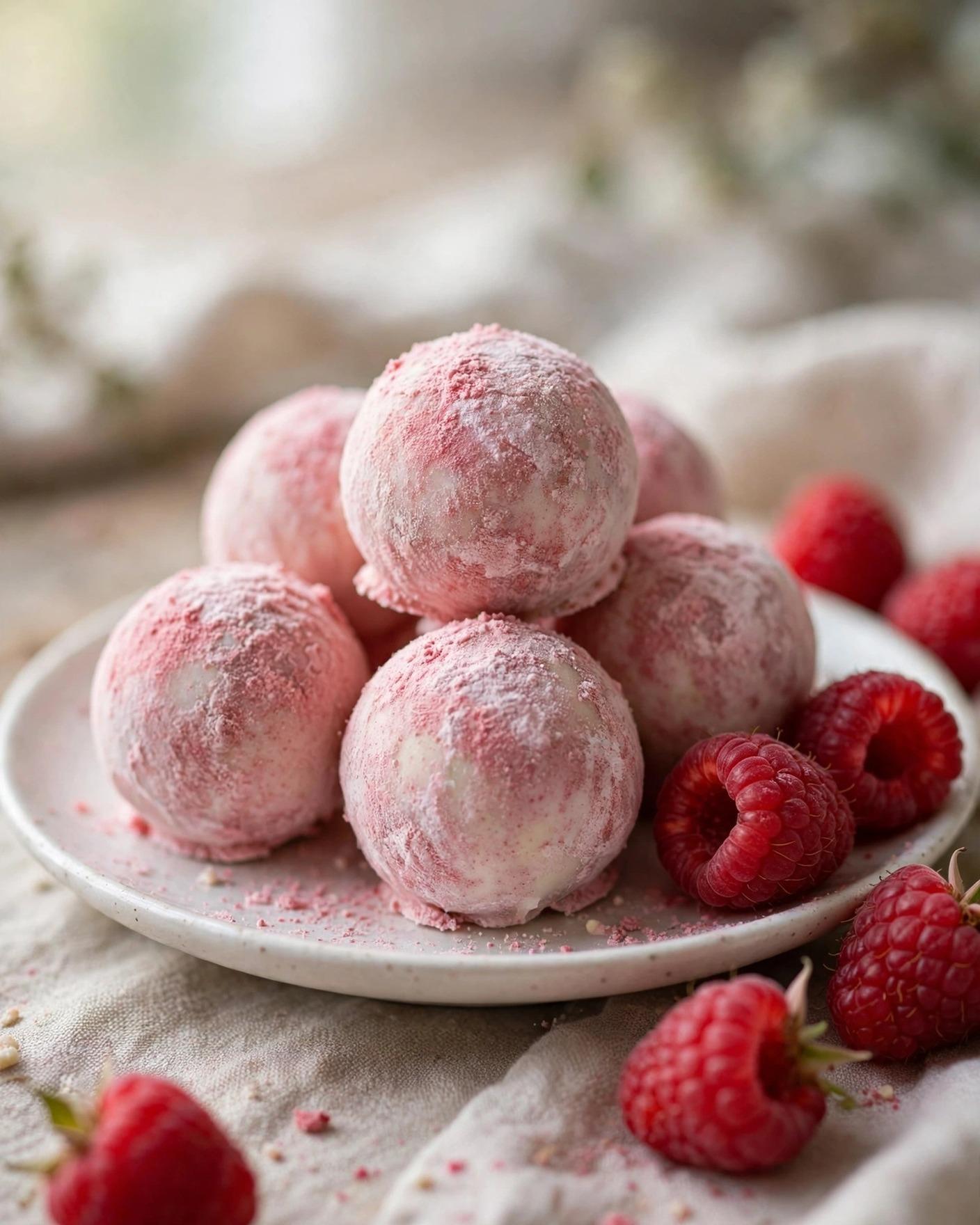
Raspberry White Chocolate Truffles
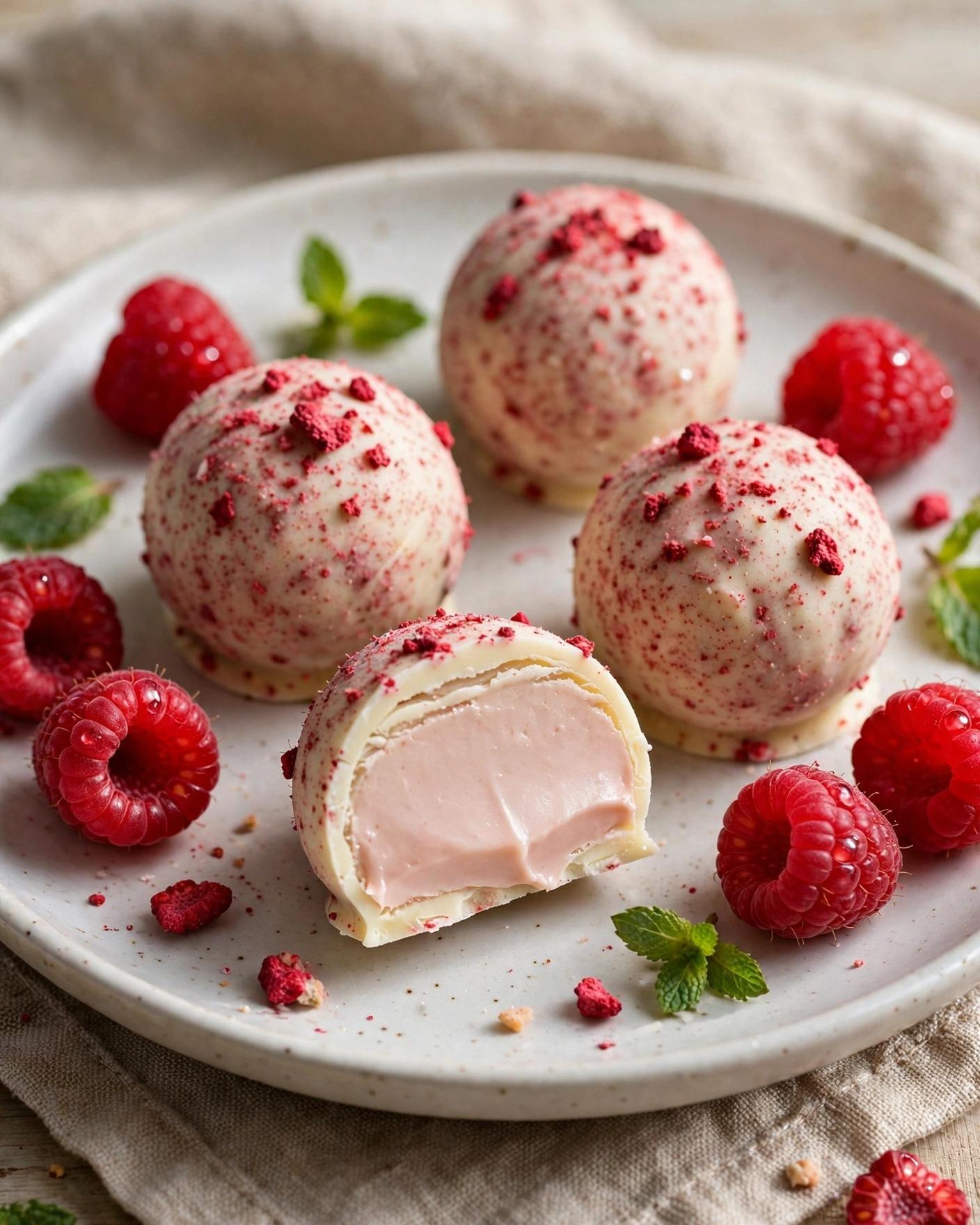
There is something quietly lovely about a truffle. It is small enough to hold between two fingers, pretty enough to set out on your nicest little plate, and rich enough that one or two feel like a complete dessert. These raspberry white chocolate truffles are built on that simple idea: a smooth white chocolate ganache center, flavored with real raspberry, chilled until it rolls cleanly, and then dipped in a thin white chocolate coating that sets with a gentle snap. A dusting of raspberry powder over the top gives them their soft pink finish and one more whisper of berry flavor before you even take a bite.
The raspberry matters here, and not just for the color. White chocolate on its own is sweet, creamy, and mellow — all comfort, no contrast. Raspberry brings the contrast. Its natural tartness cuts through that sweetness, its fruitiness lifts the creaminess, and its color turns the ganache the palest, prettiest pink without a drop of food coloring. The secret to getting that much berry flavor into a ganache without ruining its texture is freeze-dried raspberries, ground to a powder. They deliver concentrated fruit with almost no added liquid, and liquid is exactly what white chocolate ganache cannot spare. Fresh berries are wonderful for serving alongside, but in the ganache itself they would add water, loosen the set, and make rolling a sticky negotiation. The powder keeps everything smooth, firm, and intensely raspberry.
This is also, happily, a no-bake recipe in the truest sense. There is no oven to preheat, no water bath, no candy thermometer, and no moment where you stand over a pan wondering if you have gone too far. You warm cream, you stir chocolate, you chill, you roll, you dip. Most of the time in the recipe is hands-off chilling, which means these truffles fit easily around a real day: make the ganache in the morning, roll and dip in the afternoon, and set out a plate in the evening that looks like it came from a chocolate shop window. They are a natural choice for Valentine’s Day, bridal showers, Mother’s Day, holiday cookie trays that need something a little different, and any occasion where a small, elegant, homemade treat says more than a big production would.
Why You’ll Love This Recipe
- Real raspberry flavor, no coloring needed. Freeze-dried raspberry powder flavors and tints the ganache at the same time, so the pale pink color comes straight from the fruit itself.
- A smooth, melt-in-the-mouth center. A classic cream-and-white-chocolate ganache, chilled properly and rolled by hand, gives you that soft, silky middle that makes a truffle a truffle.
- A thin coating with a gentle snap. Dipping the chilled centers in melted white chocolate adds a delicate shell that contrasts beautifully with the soft ganache inside, without overwhelming it.
- Completely no-bake. No oven, no thermometer, no baking time to judge — just warming, stirring, chilling, rolling, and dipping, all at a calm, unhurried pace.
- Make-ahead friendly by design. The ganache, the rolled centers, and the finished truffles all keep well, so you can spread the work over two days or finish them well before you need them.
- Pretty enough to gift. Packed into a small box or tin with a little tissue paper, these look genuinely special — soft pink, neatly round, and clearly homemade in the best way.
Ingredients
For the raspberry ganache centers
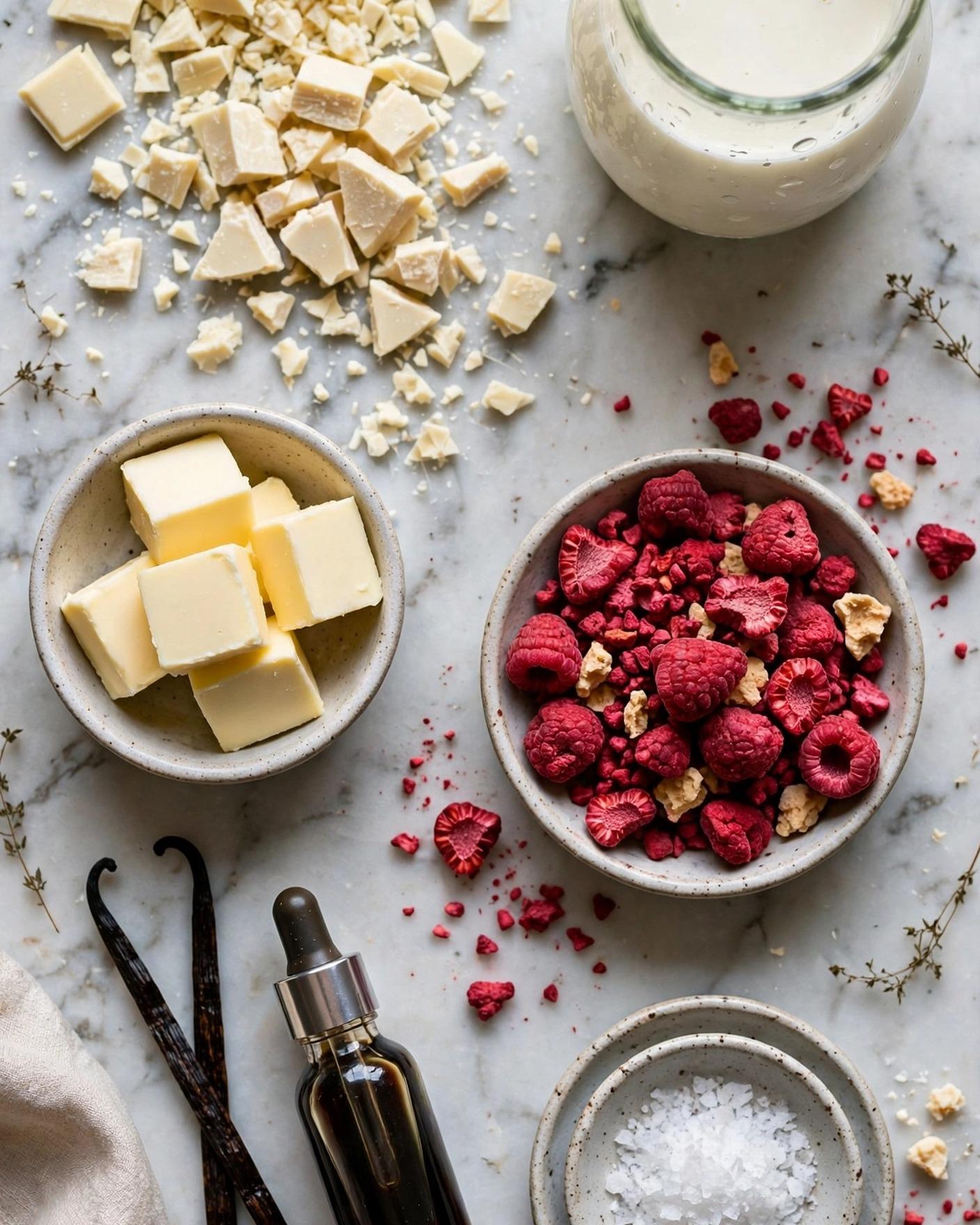
- 12 ounces (340 g) white chocolate, finely chopped (choose bars with cocoa butter listed as an ingredient)
- 1/3 cup (80 ml) heavy cream
- 2 tablespoons (28 g) unsalted butter, at room temperature, cut into small pieces
- 3/4 cup (about 20 g) freeze-dried raspberries, plus more below
- 1/2 teaspoon vanilla extract
- 1/8 teaspoon fine sea salt
For the white chocolate coating
- 10 ounces (285 g) white chocolate, finely chopped
- 1 teaspoon coconut oil or melted cocoa butter (optional, for a thinner, glossier coating)
- 2 to 3 tablespoons freeze-dried raspberries, ground to a fine powder, for dusting
- Fresh raspberries, for serving (optional)
Why these ingredients matter
White chocolate. This is the whole foundation, in both the ganache and the coating, so its quality decides the finished flavor. Look for white chocolate made with real cocoa butter rather than palm oil or other vegetable fats — it melts more smoothly, tastes creamier and less waxy, and sets with a better snap. Bars chop and melt more evenly than chips, which contain stabilizers meant to help them hold their shape. Chop everything fine and fairly uniform, because small pieces melt at the same rate and you will not be left stirring stubborn lumps while the rest overheats.
Heavy cream. Cream is what turns chopped white chocolate into ganache. Its fat and water together create that glossy emulsion that chills into a sliceable, rollable solid and then melts softly on the tongue. The amount here is deliberately modest: white chocolate is softer than dark chocolate, so it needs less liquid to reach a firm set. Do not swap in milk or half-and-half — both add water without enough fat, and the centers will stay too soft to roll and dip.
Unsalted butter. A little butter stirred into the warm ganache adds gloss, a rounder flavor, and a slightly softer bite at room temperature, so the center feels silky rather than firm and fudgy. Room-temperature butter melts into the ganache quickly and evenly; cold butter can cool the mixture and leave small unmelted flecks. Unsalted butter keeps the salt level where you want it in a recipe where a pinch truly counts.
Freeze-dried raspberries. This is the ingredient doing the most work per spoonful. Freeze-drying removes the water from the berries while leaving their flavor and color concentrated, so a small amount of powder perfumes the entire batch of ganache and tints it a natural pale pink. Ground fine and sifted, it disappears into the ganache texturally, leaving only an occasional tiny seed. You will find freeze-dried raspberries in the dried fruit or snack aisle of most larger grocery stores, and a single small bag is more than enough for the ganache, the dusting, and a second batch later.
Vanilla extract. Half a teaspoon sounds minor, but vanilla rounds the edges of white chocolate and makes the raspberry taste more like itself. It sits quietly in the background — nobody will bite into a truffle and announce vanilla — yet without it the flavor reads flatter and sweeter. Use real extract if you have it.
Fine sea salt. A small pinch — an eighth of a teaspoon — is the difference between sweet and flavorful. Salt sharpens the berry, deepens the creaminess, and keeps two truffles from tasting cloying. It dissolves completely in the warm ganache, so there is never a salty bite, just balance.
Coconut oil or cocoa butter for the coating. This is optional but genuinely helpful. A teaspoon stirred into the melted coating chocolate makes it a touch thinner and glossier, so it flows over the chilled centers in a neat, even layer instead of landing thick and streaky. Cocoa butter keeps the flavor purely chocolate; coconut oil is easier to find and works just as well. Either way, use only a teaspoon — more will keep the coating from setting firmly.
Instructions
- Grind the freeze-dried raspberries. Put the freeze-dried raspberries for the ganache in a small food processor, a spice grinder, or a zip-top bag and crush them with a rolling pin until you have a fine powder. Sift the powder through a small fine-mesh strainer into a bowl to catch the larger seeds and any stubborn pieces; press the pieces through with a spoon or discard them. You should have about 1/4 cup of fine powder. Do the same with the extra raspberries for dusting and set that powder aside separately. This step is quick, but do not skip the sifting — large seed pieces in the ganache make the centers feel gritty instead of smooth.
- Chop the white chocolate finely. Chop the 12 ounces (340 g) of white chocolate for the ganache into small, roughly even pieces, no larger than a pea, and place them in a medium heatproof bowl. Fine, even chopping is not fussiness for its own sake: it lets the hot cream melt everything at the same speed, which is how you get a ganache that is glossy and unified rather than streaky or grainy. Set the bowl aside while you warm the cream.
- Warm the cream. Pour the heavy cream into a small saucepan and warm it over medium heat until it is steaming and small bubbles appear around the edges, about 2 to 3 minutes. Do not let it come to a full boil — boiling cream can scorch, and overly hot cream can cause white chocolate to seize or turn oily. If you like precision, you are aiming for roughly 180 degrees F (82 degrees C), hot to the touch and steaming steadily.
- Pour, rest, and stir the ganache. Pour the hot cream over the chopped white chocolate and let the bowl sit undisturbed for 2 full minutes. This quiet rest does most of the melting for you. Then stir slowly with a small spatula or spoon, starting with tight circles in the center and gradually widening, until the chocolate is completely melted and the mixture looks smooth and glossy. If a few small pieces refuse to melt, set the bowl over a pan of barely simmering water for 20 to 30 seconds, or microwave it for 10 seconds, and stir again. Patience here beats heat — overheated white chocolate turns thick and grainy and cannot be rescued.
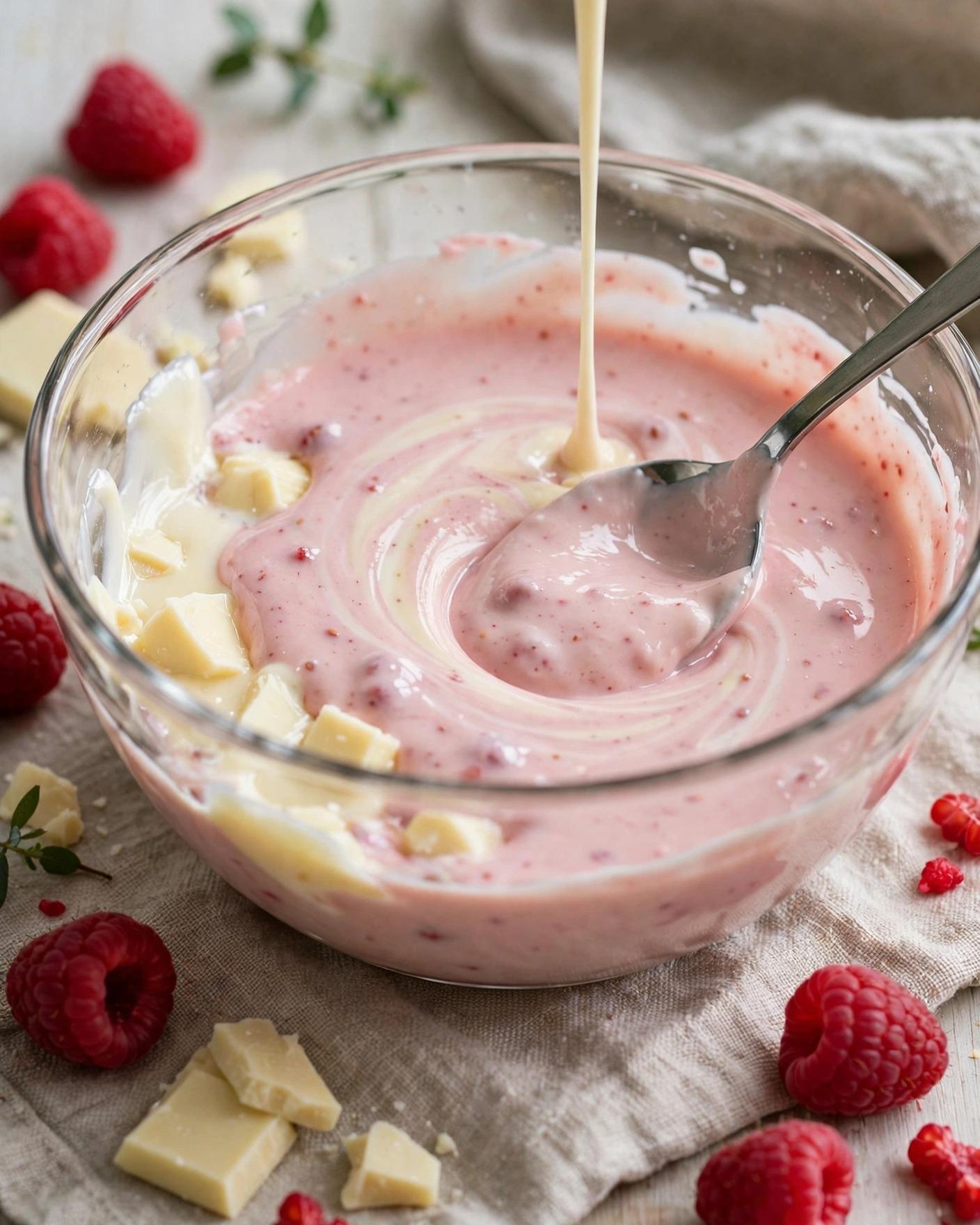
- Finish the ganache with butter, raspberry, and flavorings. Add the room-temperature butter pieces and stir until fully melted and blended in. Sprinkle the sifted raspberry powder evenly over the surface, then add the vanilla and salt, and stir until the ganache is a uniform pale pink with no dry pockets of powder. It should look thick, glossy, and pourable, similar to a very thick frosting. Taste a small amount on a spoon if you like — this is your one easy moment to notice the balance; the flavor will mellow slightly as it chills, so it should taste bright and distinctly raspberry now.
- Chill the ganache until firm. Press a piece of plastic wrap directly against the surface of the ganache so it does not form a skin, and refrigerate for at least 2 hours, until the ganache is firm all the way through and holds the mark of a spoon. In a shallow bowl it may firm in about 90 minutes; in a deep bowl, give it the full 2 hours or even overnight. Properly firm ganache is the whole secret to clean rolling, so if the center still feels soft and sticky when you press it, chill it longer rather than pushing ahead.
- Scoop and roll the centers. Line a baking sheet or large plate with parchment paper. Using a small cookie scoop or a teaspoon, portion the chilled ganache into roughly 24 equal mounds of about 1 tablespoon each. Roll each mound quickly between your palms into a ball about 1 inch (2.5 cm) across. Work gently and quickly — your hands are warm, and over-handling melts the surface. If the ganache softens as you work, return the tray to the refrigerator for 10 minutes and continue. A light dusting of raspberry powder or powdered sugar on your palms can help if the balls feel sticky, though cold, dry hands usually do the job on their own.
- Chill the rolled centers again. Refrigerate the rolled balls for at least 30 minutes, until they feel firm and cold to the touch. This second chill is not optional decoration on the recipe — cold centers are what make dipping work. A firm, cold ball holds its shape in warm coating chocolate, picks up a thin, even shell, and sets quickly afterward. A room-temperature center will slump, slide off the fork, and thicken your coating bowl with melted ganache.
- Melt the coating chocolate. Place the chopped white chocolate for the coating in a clean, completely dry, heatproof bowl — even a few drops of water can make melted chocolate seize into a grainy paste. Melt it gently in the microwave in 20-second bursts, stirring well after each, until about three-quarters melted, then stir until the residual heat melts the rest. Alternatively, melt it in a bowl set over barely simmering water, making sure the bowl does not touch the water. Stir in the coconut oil or cocoa butter if using. The coating should be fluid and pourable, warm rather than hot; if it feels thick, let it stand and stir for a minute, since it often loosens as it evens out. If it is genuinely too thick, stir in another 1/2 teaspoon of oil.
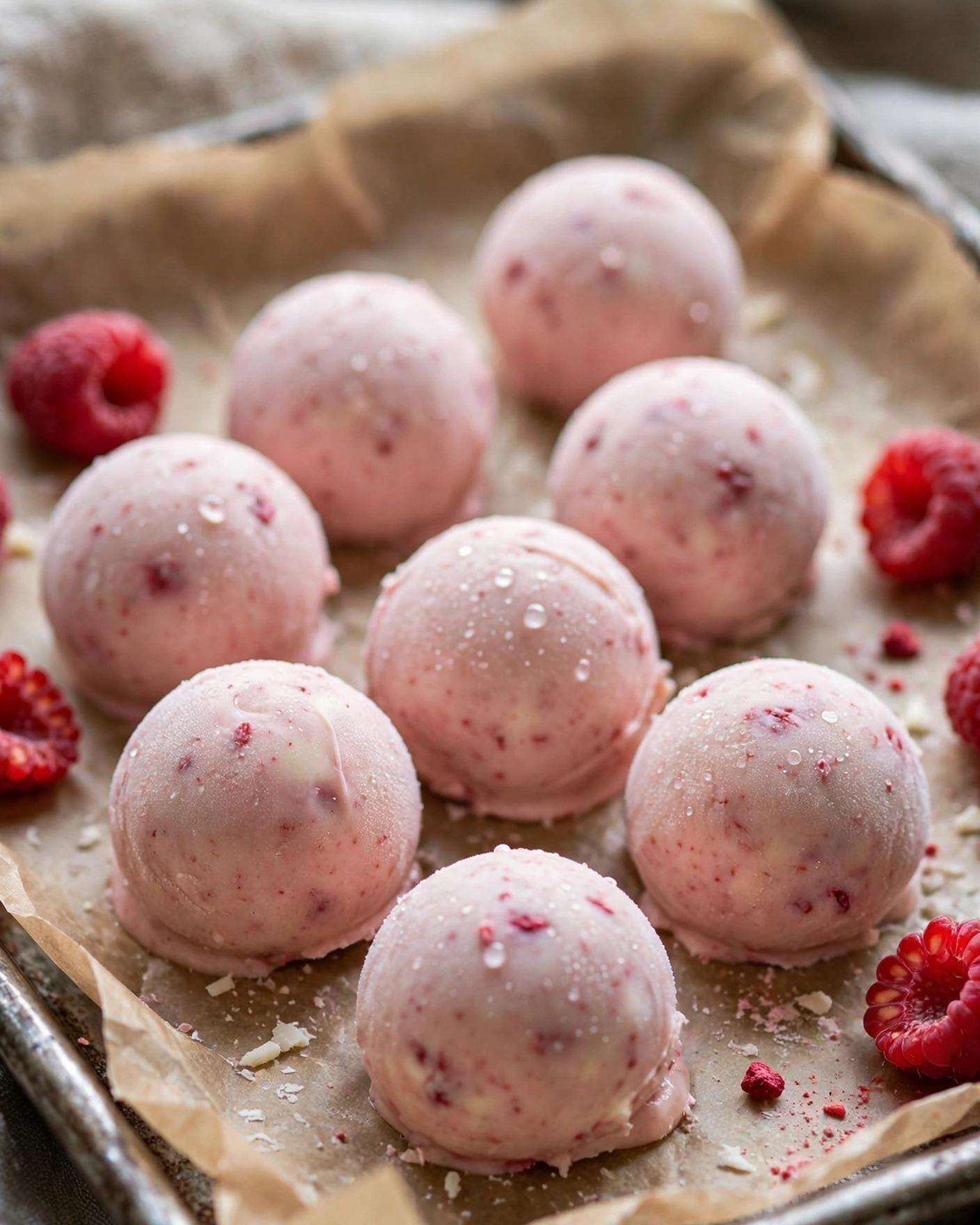
- Dip each truffle. Working with one cold center at a time and keeping the rest refrigerated, drop a ball into the melted coating and turn it with two forks, or a fork and a spoon, until completely covered. Lift it out on a fork, tap the fork gently against the rim of the bowl so excess coating drips back, and slide the truffle onto a parchment-lined baking sheet using the second fork or a toothpick. Work at a steady, unhurried pace, and if the centers begin to soften or the coating begins to thicken, pause: re-chill the centers for 10 minutes, and warm the coating with one 10-second burst in the microwave and a good stir.
- Dust before the coating sets. While each truffle’s coating is still wet and glossy — which means working in small batches of three or four if you are dipping alone — sprinkle a pinch of the reserved raspberry powder over the top. A small strainer or your fingertips both work; a light, uneven dusting looks prettier than a heavy blanket. The powder will darken slightly as it settles into the coating, deepening from pale pink to a soft rose. Once all the truffles are dipped and dusted, refrigerate the tray for 15 to 20 minutes, until the coating is completely set and matte-firm to a light touch.

- Serve and enjoy. Arrange the truffles on a small plate or in paper candy cups and let them stand at room temperature for 10 to 15 minutes before serving — cold straight from the refrigerator, the centers are firm; given those few minutes, they soften into that smooth, creamy bite that makes a truffle worth making. Serve fresh raspberries alongside if you like, for color and a bright, juicy contrast. Return any truffles that will not be eaten within a few hours to the refrigerator, covered, and simply give them the same short rest at room temperature next time.
Tips for Success
- Choose real cocoa butter white chocolate. This single shopping decision decides most of the result. Bars labeled with cocoa butter as the first or second ingredient melt smoothly, taste creamy, and set properly. White baking chips and candy melts made with vegetable oils can work in a pinch for the coating, but they make a ganache that tastes waxy and may not set as cleanly — if chips are all you have, use them for dipping and buy a bar for the centers.
- Keep water away from the chocolate. Dry bowls, dry spatulas, dry hands for dipping. Water is melted chocolate’s oldest enemy, and white chocolate is especially unforgiving — a splash can turn a bowl of smooth coating grainy in seconds. If you melt over simmering water, keep the heat low so steam does not curl up into the bowl.
- Respect the two chills. Chilling the ganache until truly firm, then chilling the rolled balls before dipping, is the difference between a calm, tidy process and a sticky one. If you are short on time, spread the ganache in a shallow dish so it firms faster, and use the freezer for the rolled centers in 10-minute bursts — but do not skip the firming altogether.
- Stir ganache gently, never whisk it hard. Vigorous whisking beats air into ganache and can make the texture feel spongy rather than dense and silky. Slow circles with a spatula, starting from the center, build the smooth emulsion you want. The same gentle hand applies when you stir the coating.
- Work in small dipping batches. Keep most of the centers in the refrigerator and bring out four or five at a time. Cold centers give you a thin, neat shell and keep the coating bowl clean. Warm centers melt as they dip, and each one makes the next one harder.
- Fix a too-soft ganache with patience, then chocolate. If your ganache will not firm after several hours, it likely got a little too much cream or the kitchen is warm. Stir in 1 to 2 ounces (30 to 55 g) of extra melted white chocolate, then chill again for an hour. It will almost always come around.
Variations
- Dark chocolate raspberry truffles. Replace the white chocolate in the ganache with 10 ounces (285 g) of semisweet or bittersweet chocolate (around 60 percent), increase the cream to 1/2 cup (120 ml), and keep the raspberry powder exactly the same. Dip in melted dark chocolate for a deeper, less sweet truffle where the raspberry reads even brighter.
- Rolled instead of dipped. Skip the coating entirely and roll the chilled balls in raspberry powder, powdered sugar, finely shredded coconut, or finely chopped pistachios. Rolled truffles are softer on the outside and should be re-rolled lightly before serving, since the coating absorbs moisture in the refrigerator — but they are faster and just as pretty.
- Lemon raspberry truffles. Add 1 teaspoon of finely grated lemon zest to the ganache along with the vanilla. The lemon lifts the berry and adds a gentle brightness that suits spring gatherings especially well. A tiny pinch of lemon zest over the finished truffles, alongside the raspberry dusting, looks lovely.
- Raspberry truffles with a jam heart. Before rolling, press a small indentation into each ganache mound and tuck in about 1/4 teaspoon of thick seedless raspberry jam, then close the ganache around it and roll smooth. Chill very well before dipping. The jam center stays soft and jammy, a small surprise inside the creamy ganache — use a thick jam, as a runny one will leak.
- White chocolate truffles with other berries. The same method works beautifully with freeze-dried strawberries or blueberries ground to powder. Strawberry gives a sweeter, more familiar pink truffle; blueberry makes a dusky lavender-grey ganache with a milder berry note. Keep the amounts identical and sift the powder just the same.
Storage
Finished truffles keep very well, which is part of their charm as a make-ahead treat. Store them in an airtight container in the refrigerator, in a single layer or layered between sheets of parchment paper, for up to 2 weeks. The raspberry powder dusting may absorb a little moisture and deepen in color over time — that is normal and purely cosmetic; you can refresh it with a tiny extra sprinkle just before serving if you like. Let refrigerated truffles sit at room temperature for 10 to 15 minutes before eating so the centers soften back to silky.
At room temperature, the truffles are fine for a day of serving — a party afternoon, a dessert table, a gift box on its way across town — as long as the room is cool and they are out of direct sun. In a warm kitchen, the white chocolate coating softens and the centers lose their shape, so the refrigerator is home base.
For longer keeping, freeze the finished truffles in a single layer on a parchment-lined tray until solid, then transfer them to a freezer container or bag with parchment between layers. They freeze well for up to 2 months. Thaw them overnight in the refrigerator, still covered — thawing them covered keeps condensation off the coating — then give them their usual short rest at room temperature before serving. Un-dipped ganache centers also freeze well for up to 1 month, so you can roll a double batch of centers and dip half now and half later.
FAQ
Can I use fresh or frozen raspberries instead of freeze-dried? Not directly in the ganache, and the reason is water. Fresh and frozen raspberries are mostly juice, and that juice loosens white chocolate ganache so much that the centers may never firm enough to roll. Freeze-dried berries give you the fruit’s flavor and color with the water already removed, which is why they work so neatly here. If fresh berries are what you have, save them for serving alongside the finished truffles, where they are genuinely lovely. In a pinch, you can stir 1 to 2 tablespoons of very thick, reduced raspberry puree into the ganache — simmer pureed, strained berries until halved in volume — but expect a softer set and chill it thoroughly, ideally overnight.
Why is my ganache soft, split, or grainy? Each problem has its own usual cause. Soft ganache almost always means too much liquid or too little chilling — chill it longer first, and if it still will not firm, stir in an ounce or two of extra melted white chocolate and chill again. A split, oily look usually means the cream was boiling hot or the ganache was overheated, which breaks the emulsion; try stirring in a tablespoon of cold cream, a little at a time, while the ganache is still warm. Graininess comes from overheated white chocolate, which scorches easily — melt low and slow, rely on the resting time in hot cream, and remember that white chocolate should never be pushed with high heat.
Do the truffles need to be dipped, or can I serve them rolled? Rolled is a completely respectable finish, and many classic truffles are served exactly that way. Roll the well-chilled balls in raspberry powder, powdered sugar, cocoa powder, shredded coconut, or finely chopped nuts, and they are ready. Dipping adds two things: a thin shell with a gentle snap that contrasts with the soft center, and a protective coating that makes the truffles sturdier for gifting, stacking, and storing. If you are making them to give away or to keep for more than a few days, dip them. If they are for tonight’s dessert plate, rolled is faster and every bit as good to eat.
How far ahead can I make raspberry white chocolate truffles for a party or gift? Comfortably several days, and up to two weeks if they stay refrigerated. The ganache itself can be made and refrigerated, well covered, for up to 3 days before rolling, or the rolled centers can wait a day in the refrigerator before dipping. Finished, dipped truffles keep for up to 2 weeks refrigerated and 2 months frozen, so you can finish them a full week before a party with no loss of quality. For gifting, pack them cold into their box or tin, keep them refrigerated until handover if you can, and let the recipient know they are happiest stored in the refrigerator and rested at room temperature for a few minutes before eating.
Recipe Card
Raspberry White Chocolate Truffles
- Prep Time: 30 minutes (PT30M)
- Cook Time: 10 minutes (PT10M)
- Total Time: 2 hours 50 minutes (PT2H50M)
- Servings: 12 servings (24 truffles, 2 per serving)
- Calories: 310 kcal per serving (estimated)
Smooth white chocolate ganache truffles flavored and tinted with freeze-dried raspberry powder, rolled by hand, dipped in a thin white chocolate coating, and dusted with more raspberry. No-bake, make-ahead, and pretty enough to gift.
Nutrition (estimated): 310 kcal per serving (estimated), 34 g carbohydrates, 3 g protein, 20 g fat, 1 g fiber, 31 g sugar, 45 mg sodium. Nutrition is estimated and will vary with the white chocolate used, the coating thickness, and any variations or substitutions.
Can I use fresh or frozen raspberries instead of freeze-dried?
Not directly in the ganache, and the reason is water. Fresh and frozen raspberries are mostly juice, and that juice loosens white chocolate ganache so much that the centers may never firm enough to roll. Freeze-dried berries give you the fruit’s flavor and color with the water already removed, which is why they work so neatly here. If fresh berries are what you have, save them for serving alongside the finished truffles, where they are genuinely lovely. In a pinch, you can stir 1 to 2 tablespoons of very thick, reduced raspberry puree into the ganache — simmer pureed, strained berries until halved in volume — but expect a softer set and chill it thoroughly, ideally overnight.
Why is my ganache soft, split, or grainy?
Each problem has its own usual cause. Soft ganache almost always means too much liquid or too little chilling — chill it longer first, and if it still will not firm, stir in an ounce or two of extra melted white chocolate and chill again. A split, oily look usually means the cream was boiling hot or the ganache was overheated, which breaks the emulsion; try stirring in a tablespoon of cold cream, a little at a time, while the ganache is still warm. Graininess comes from overheated white chocolate, which scorches easily — melt low and slow, rely on the resting time in hot cream, and remember that white chocolate should never be pushed with high heat.
Do the truffles need to be dipped, or can I serve them rolled?
Rolled is a completely respectable finish, and many classic truffles are served exactly that way. Roll the well-chilled balls in raspberry powder, powdered sugar, cocoa powder, shredded coconut, or finely chopped nuts, and they are ready. Dipping adds two things: a thin shell with a gentle snap that contrasts with the soft center, and a protective coating that makes the truffles sturdier for gifting, stacking, and storing. If you are making them to give away or to keep for more than a few days, dip them. If they are for tonight’s dessert plate, rolled is faster and every bit as good to eat.
How far ahead can I make raspberry white chocolate truffles for a party or gift?
Comfortably several days, and up to two weeks if they stay refrigerated. The ganache itself can be made and refrigerated, well covered, for up to 3 days before rolling, or the rolled centers can wait a day in the refrigerator before dipping. Finished, dipped truffles keep for up to 2 weeks refrigerated and 2 months frozen, so you can finish them a full week before a party with no loss of quality. For gifting, pack them cold into their box or tin, keep them refrigerated until handover if you can, and let the recipient know they are happiest stored in the refrigerator and rested at room temperature for a few minutes before eating.

Hi, I’m Emma! I’m the cook and recipe developer behind Sizzle & Sage. From my sunny home kitchen, I share easy, flavor-packed recipes for real life — quick breakfasts, cozy weeknight dinners, and simple bakes anyone can make. Pull up a chair and stay a while!