Christmas Morning Breakfast Casserole (Make-Ahead Overnight)
Christmas morning has a way of arriving all at once — wrapping paper on the floor, coffee brewing, and a house full of people who are suddenly, urgently hungry. The last thing anyone wants to do at that moment is stand at the stove flipping eggs or nursing a complicated recipe. That is exactly why this Christmas morning breakfast casserole exists: you assemble it on Christmas Eve, slide it into the refrigerator overnight, and on Christmas morning all you do is put it in the oven and pour the coffee.
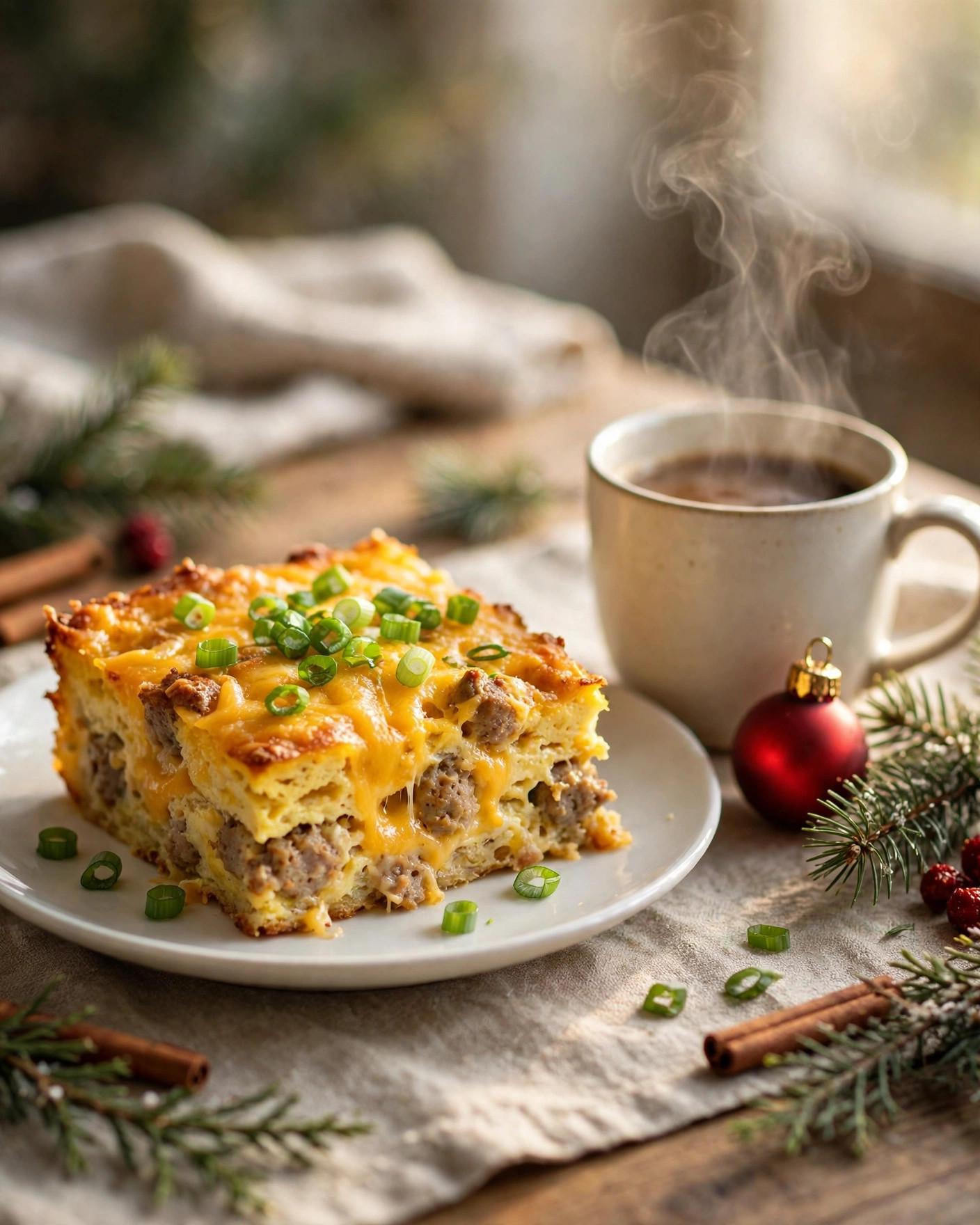
This casserole is built from the breakfast classics everyone already loves — savory breakfast sausage, fluffy bread cubes soaked in a seasoned egg custard, sweet bell peppers, green onions, and a generous blanket of melted cheddar. As it bakes, the bread soaks up the custard and turns custardy-soft in the center while the top goes puffy and golden, and the cheese melts into every layer. It feeds a crowd from a single 9×13 dish, which makes it ideal for holiday house guests, family brunch, or the morning after a Christmas party.
The overnight rest is not just a convenience trick; it is the secret to the texture. Bread that has soaked for 8 to 12 hours absorbs the egg mixture completely, so the casserole bakes up evenly with no dry pockets and no soggy spots. In the morning, the dish goes straight from fridge to oven (with a short countertop rest while the oven heats), bakes for under an hour, and emerges ready to slice. Pair it with fresh fruit, cinnamon rolls, or a simple fruit salad, and Christmas morning breakfast is handled before anyone has even finished opening stockings.
Why You'll Love This Recipe
- True Christmas Eve prep. Everything is assembled the night before and rests in the refrigerator, so Christmas morning cooking is exactly one step: bake. You get a hot, homemade holiday breakfast with about five minutes of active morning effort.
- Feeds a crowd from one dish. A single 9×13 pan serves 8 to 10 generous portions, which covers the whole family plus overnight guests without doubling anything or juggling multiple skillets.
- The overnight soak makes it better. Resting the bread in the egg custard overnight produces a creamy, even texture that a same-day casserole cannot match — soft in the middle, crisp and golden on top.
- Savory holiday flavor that pleases everyone. Breakfast sausage, sharp cheddar, bell peppers, and green onions are crowd-pleasing classics; there is nothing polarizing here, and kids eat it as happily as adults.
- Flexible and forgiving. Swap the sausage for ham or bacon, change up the cheese, add mushrooms or spinach — the structure of the recipe handles substitutions gracefully, so you can use what you have on hand.
- Reheats like a dream. Leftovers warm up beautifully in the oven or microwave, which means the morning after Christmas is handled too.

Ingredients
For the casserole base
- 1 pound (450 g) breakfast sausage, bulk or links with casings removed
- 8 cups (about 400 g) day-old bread cubes, cut from sturdy white, sourdough, or French bread (roughly 3/4-inch cubes)
- 2 cups (200 g) shredded sharp cheddar cheese, divided
- 1 medium red bell pepper, diced (about 1 cup / 150 g)
- 1 medium green bell pepper, diced (about 1 cup / 150 g)
- 4 green onions, thinly sliced, plus extra for garnish
For the egg custard
- 8 large eggs
- 2 cups (480 ml) whole milk
- 1/2 cup (120 ml) heavy cream
- 1 teaspoon fine sea salt
- 1/2 teaspoon freshly ground black pepper
- 1 teaspoon dry mustard powder
- 1/2 teaspoon garlic powder
- 1/4 teaspoon smoked paprika (optional, for a little warmth)
Choosing your bread
Day-old or slightly stale bread is the right choice here because drier cubes absorb the egg custard without turning gummy. If your bread is fresh, cube it and toast the cubes on a sheet pan at 300°F (150°C) for 10 to 15 minutes, stirring once, until dry to the touch but not browned. A sturdy loaf — sourdough, French bread, Italian loaf, or a firm sandwich bread — holds its structure best. Avoid very soft, airy breads, which can collapse into a dense layer during the long soak.
Instructions
- Cook the sausage. Heat a large skillet over medium heat. Add the breakfast sausage, breaking it into crumbles with a wooden spoon, and cook for 8 to 10 minutes, until fully browned and no pink remains. Use a slotted spoon to transfer the sausage to a paper-towel-lined plate to drain off excess fat. If your sausage released a lot of grease, you can leave about a tablespoon in the skillet to soften the peppers; otherwise, wipe the skillet clean.
- Soften the peppers. In the same skillet over medium heat, add the diced red and green bell peppers and cook, stirring occasionally, for 4 to 5 minutes, until just softened and bright. They will finish cooking in the oven, so you want them tender-crisp here, not fully soft. Remove from the heat and set aside.
- Layer the casserole. Lightly grease a 9×13-inch baking dish with butter or nonstick spray. Spread half of the bread cubes evenly across the bottom of the dish. Scatter half of the cooked sausage, half of the softened peppers, and half of the sliced green onions over the bread, then sprinkle with 1 cup of the shredded cheddar. Repeat with the remaining bread, sausage, peppers, and green onions, and finish with the remaining 1 cup of cheddar on top.
- Whisk the custard. In a large mixing bowl, whisk the eggs until the yolks and whites are fully blended and slightly frothy. Whisk in the milk, heavy cream, salt, black pepper, dry mustard, garlic powder, and smoked paprika (if using) until smooth and uniform. The dry mustard may look like it resists dissolving at first — keep whisking and it will blend in.

- Pour and soak. Slowly pour the egg custard evenly over the layered casserole, pausing to let it seep down between the bread cubes. Use the back of a spoon or your hands to gently press the top layer of bread down so every cube gets moistened. There will be a fair amount of liquid; that is correct — the bread absorbs it during the overnight rest.
- Refrigerate overnight. Cover the dish tightly with plastic wrap or foil and refrigerate for at least 8 hours and up to 12 hours. This long soak is what gives the casserole its signature creamy, even texture, so do not shorten it if you can avoid it.
- Bring to room temperature and preheat. On Christmas morning, remove the casserole from the refrigerator and let it sit on the counter for 20 to 30 minutes while the oven heats — a cold dish going into a hot oven can bake unevenly and may stress a glass baking dish. Preheat the oven to 350°F (175°C) with a rack in the center position.
- Bake until golden and set. Uncover the casserole and bake for 45 to 55 minutes, until the top is puffed and deep golden brown and the center is set. To check doneness, insert a knife into the center: it should come out clean with no visible liquid egg. If the top is browning too quickly before the center sets, tent the dish loosely with foil for the last 15 minutes.
- Rest, garnish, and serve. Let the casserole rest on a wire rack for 10 minutes before slicing — this brief rest lets the custard finish setting so the squares hold their shape. Sprinkle with the extra sliced green onions, cut into squares, and serve warm.


Tips for the Best Christmas Morning Casserole
- Do not skip the overnight rest. Eight to twelve hours of soaking is what separates a great breakfast casserole from a merely good one. If you are truly pressed for time, a minimum 4-hour rest will work, but the texture will not be quite as creamy.
- Drain the sausage well. Excess grease pools at the bottom of the dish and makes the base soggy. A paper-towel drain after browning keeps the casserole rich without being heavy.
- Shred your own cheddar. Pre-shredded cheese is coated with anti-caking starch that prevents it from melting as smoothly. A block of sharp cheddar and a box grater take two minutes and melt noticeably better.
- Press the bread down when pouring. Dry cubes floating on top of the custard will bake into hard croutons instead of soft, custardy bites. A gentle press ensures every cube is in contact with the liquid.
- Watch the bake, not just the clock. Ovens vary, and a deep 9×13 dish in a cold kitchen can need the full 55 minutes. Start checking at 45 minutes and trust the knife test over the timer.
- Let it rest before slicing. Ten minutes on the counter lets the egg custard finish setting. Slicing straight from the oven gives you sloppy squares that fall apart on the spatula.
Variations
- Ham and Swiss. Replace the breakfast sausage with 2 cups of diced cooked ham and swap the cheddar for shredded Swiss or Gruyère for a milder, classic flavor.
- Bacon and pepper jack. Use 12 ounces of cooked, crumbled bacon instead of sausage and pepper jack instead of cheddar for a smoky casserole with a gentle kick.
- Vegetarian. Skip the meat entirely and double the vegetables: add 8 ounces of sliced mushrooms (sautéed until golden) and 2 cups of fresh baby spinach (wilted and squeezed dry) along with the peppers.
- Southwest style. Use spicy chorizo-style breakfast sausage, add a 4-ounce can of diced green chiles (drained) to the layers, and swap the cheddar for a Mexican cheese blend. Serve with salsa and sour cream.
- Lighter version. Use turkey breakfast sausage, 2% milk in place of the whole milk and cream, and reduce the cheddar to 1 1/2 cups. The casserole will be a touch less rich but still satisfying.
- Everything-bagel twist. Add 2 tablespoons of everything bagel seasoning to the custard and top the finished casserole with a little extra seasoning and a drizzle of sour cream or cream cheese dollops.
Storage
Cover leftover casserole tightly with foil or transfer slices to an airtight container and refrigerate for up to 4 days. Reheat individual portions in the microwave for 1 to 2 minutes, or warm the whole dish (covered with foil) in a 325°F (165°C) oven for 15 to 20 minutes, until heated through.
For longer storage, freeze baked and cooled squares individually on a sheet pan until firm, then transfer to a freezer bag or container with parchment between layers. Frozen portions keep for up to 2 months. Thaw overnight in the refrigerator and reheat as above.
You can also assemble the unbaked casserole and freeze it instead of refrigerating overnight: wrap the dish tightly in two layers of plastic wrap plus foil and freeze for up to 1 month. Thaw in the refrigerator for 24 hours before baking as directed. Note that the texture will be very slightly denser than the overnight-refrigerated version, but still delicious.
Nutrition
Estimated per serving (1 square, casserole cut into 10 servings):
- Calories: 385
- Total Fat: 25 g
- Saturated Fat: 11 g
- Cholesterol: 235 mg
- Sodium: 720 mg
- Total Carbohydrates: 20 g
- Dietary Fiber: 1 g
- Total Sugars: 4 g
- Protein: 20 g
Nutrition values are estimates calculated from the listed ingredients and will vary with the exact sausage, bread, and cheese used, as well as portion size.
FAQ
Can I assemble this casserole the morning of instead of overnight?
You can, but the texture will not be as good. The overnight rest lets the bread fully absorb the egg custard, which is what makes the casserole creamy and even. If you must assemble same-day, give it at least 4 hours in the refrigerator and press the bread down well so it soaks as much as possible.
Can I use a different meat instead of breakfast sausage?
Yes. Diced cooked ham, crumbled cooked bacon, or turkey breakfast sausage all work as one-to-one swaps for the 1 pound of sausage. Make sure any meat you use is fully cooked and well drained before layering, since raw meat will not cook through reliably in the custard.
How do I know when the casserole is done baking?
Look for a puffed, deep golden top and a center that no longer jiggles when you gently shake the dish. The most reliable test is a knife inserted into the center: it should come out clean with no liquid egg clinging to it. Start checking at 45 minutes and tent with foil if the top browns too fast.
Can I make this casserole ahead and freeze it?
Yes. You can freeze the assembled unbaked casserole for up to 1 month (thaw 24 hours in the fridge before baking), or freeze baked leftover squares for up to 2 months. Both reheat well; the baked-and-frozen squares are especially convenient for quick breakfasts after the holidays.

Hi, I’m Emma! I’m the cook and recipe developer behind Sizzle & Sage. From my sunny home kitchen, I share easy, flavor-packed recipes for real life — quick breakfasts, cozy weeknight dinners, and simple bakes anyone can make. Pull up a chair and stay a while!