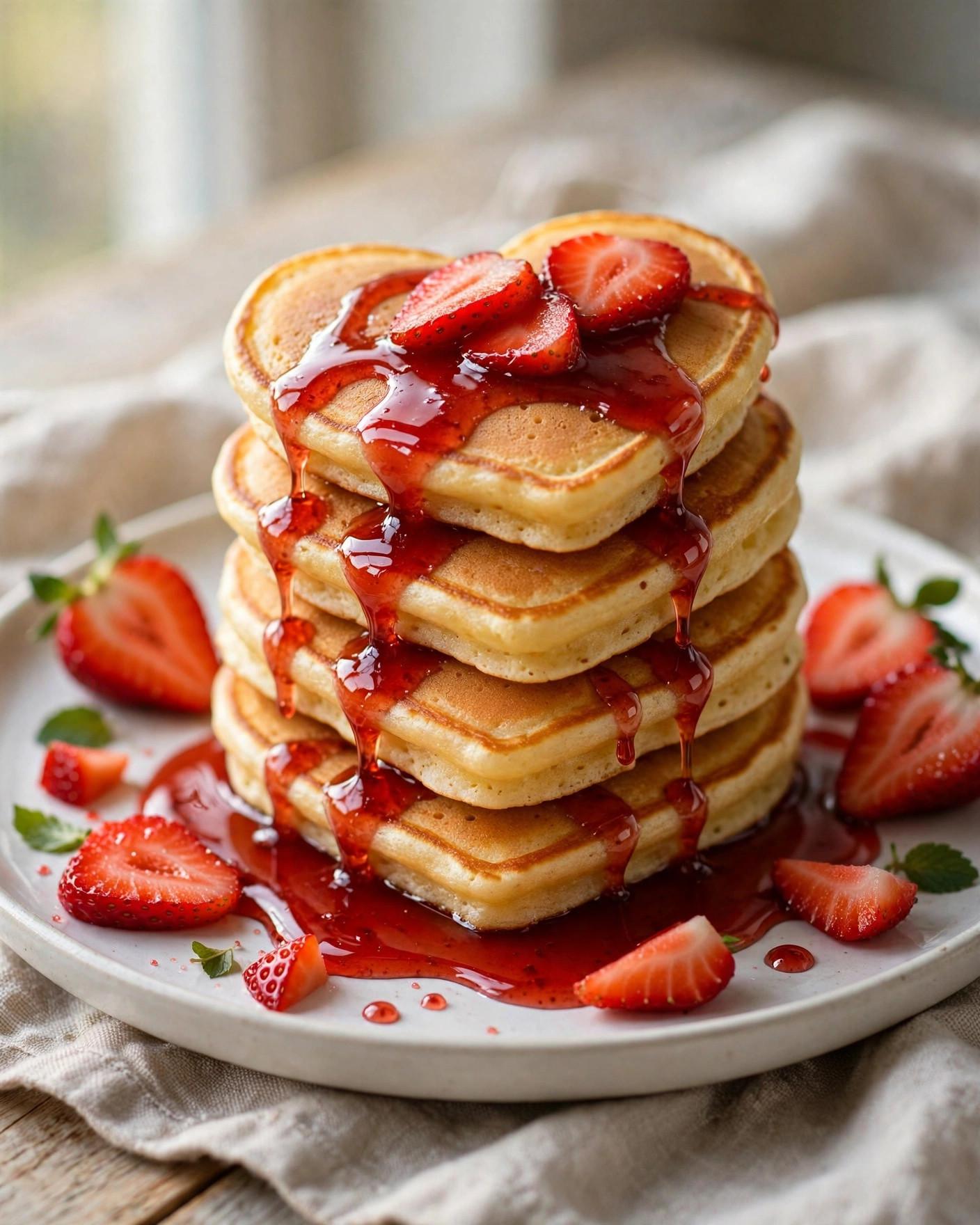
Heart-Shaped Pancakes with Strawberry Syrup for a Sweet Valentine’s Breakfast
There is something about a heart shape that turns an ordinary breakfast into a small celebration, and these Heart-Shaped Pancakes with Strawberry Syrup do exactly that. The pancakes themselves are everything a good pancake should be — fluffy in the middle, tender at the edges, and golden from a hot griddle — while the syrup is made from real strawberries simmered just long enough to turn glossy, jammy, and pourable. Together they make a plate that looks special enough for Valentine’s morning but is simple enough for any slow weekend when you want breakfast to feel a little more thoughtful.
The heart shape is easier than it looks, and that is part of the charm of this recipe. You do not need to be an artist at the griddle. A squeeze bottle filled with batter gives you steady control to outline and fill each heart, and a heart-shaped mold works beautifully if you prefer a guide. Even hearts that come out a little lopsided are welcome at the table — they still taste wonderful, and the strawberry syrup poured over the top has a way of making every plate look intentional and pretty.
This recipe is built for a relaxed morning for two to four people — a Valentine’s breakfast in bed, a family breakfast, or a small brunch with coffee alongside. The syrup simmers while you mix the batter, the pancakes cook in quick batches, and a low oven keeps finished hearts warm so everyone can sit down together.
If you have ever worried that shaped pancakes are only for experienced cooks, let this recipe change your mind. The batter is classic and forgiving — mixed just until combined, rested briefly, and cooked over steady medium heat — and the result is a stack of soft, golden hearts with a bright berry syrup.
Why You’ll Love This Recipe
- A shape that makes the morning feel special. The heart outline takes only seconds per pancake once you get the rhythm, yet it completely changes the plate — breakfast suddenly looks like it was planned with love, even on an ordinary Saturday.
- Real strawberry syrup, not a bottled shortcut. Fresh or frozen strawberries, a little sugar, lemon juice, and a brief simmer make a syrup that is bright, fruity, and just thick enough to cling to the pancakes instead of pooling thinly underneath them.
- Fluffy, tender pancakes every time. Baking powder, a short rest for the batter, and gentle mixing give you a tall, soft crumb with lightly crisp, golden edges — the classic pancake texture everyone hopes for.
- Two easy ways to shape the hearts. Use a squeeze bottle for freehand hearts with a charming handmade look, or pour the batter into a greased heart-shaped mold or cookie cutter for neat, uniform hearts. Both methods are covered step by step.
- Made for sharing, sized for real life. The recipe makes about eight medium hearts, perfect for two generous Valentine’s stacks or a family breakfast for four, and it doubles cleanly if your table is bigger.
- Warm-batch cooking built in. A low oven holds finished pancakes while the rest cook, so everyone sits down to a warm stack at the same time.

Ingredients
For the pancakes
- 2 cups (250 g) all-purpose flour, spooned and leveled
- 2 tablespoons granulated sugar
- 2 teaspoons baking powder
- 1/2 teaspoon baking soda
- 1/2 teaspoon fine sea salt
- 1 1/4 cups (300 ml) whole milk, at room temperature if possible
- 2 large eggs, at room temperature if possible
- 4 tablespoons (55 g) unsalted butter, melted and slightly cooled, plus more for the griddle
- 2 teaspoons pure vanilla extract
- 1 teaspoon lemon zest, optional but lovely with the strawberries
For the strawberry syrup
- 1 pound (450 g) fresh strawberries, hulled and sliced, or frozen strawberries, thawed slightly (about 3 cups sliced)
- 1/3 cup (65 g) granulated sugar, plus more to taste
- 1/4 cup (60 ml) water
- 1 tablespoon fresh lemon juice
- 1 teaspoon cornstarch mixed with 1 tablespoon cold water, optional, for a thicker syrup
- Pinch of fine sea salt
- 1/2 teaspoon pure vanilla extract, optional
For serving
- Extra sliced fresh strawberries
- Powdered sugar, for dusting, optional
- Soft butter, for the table
- Whipped cream, optional
- Warm maple syrup, optional, for anyone who wants both
Why these ingredients matter
All-purpose flour. Flour gives the pancakes their structure, and all-purpose flour strikes the right balance — sturdy enough to hold a piped heart shape without spreading into a blob, yet tender enough to stay soft and fluffy inside. Spoon it into the measuring cup and level it off rather than scooping, because a packed cup can add enough extra flour to make the pancakes dense and dry.
Baking powder and baking soda. These two leaveners share the lifting work. Baking powder provides most of the rise and those little bubbles that make the crumb light, while a small amount of baking soda reacts with the gentle acidity in the batter to add tenderness and help the pancakes brown evenly. Check that your baking powder is fresh — if it has been open for many months, the hearts will still taste good but will not rise as tall.
Sugar. Two tablespoons is a modest amount, and that is deliberate. The pancakes themselves should taste like pancakes — lightly sweet, ready to carry the syrup — rather than like cake. The sugar also helps the edges turn a deeper golden color on the griddle. You can reduce it slightly if your strawberries are very sweet, but do not leave it out entirely or the browning will suffer.
Fine sea salt. Salt does not make pancakes taste salty; it makes everything else taste more like itself. It sharpens the vanilla, balances the sugar, and keeps the crumb from tasting flat. In the syrup, a tiny pinch does the same quiet work, making the strawberries taste brighter and more fully strawberry.
Whole milk. Milk brings the batter together and keeps the crumb moist and tender. Whole milk gives the richest result, though 2 percent milk works well too. Room-temperature milk blends more smoothly with melted butter — very cold milk can make the butter seize into little flecks — so if you remember, set the milk and eggs out while you slice the strawberries.
Eggs. Eggs bind the batter, add richness, and help the pancakes set into a soft, sliceable crumb that holds the heart shape when you cut into the stack. Two large eggs is the right amount for this batch: enough for structure and a gentle lift, not so many that the pancakes turn eggy or rubbery.
Butter. Melted butter in the batter brings flavor that oil simply cannot match, and a little extra butter on the griddle gives the edges their golden color and delicate crispness. Let the melted butter cool for a minute or two before whisking it in so it does not scramble the eggs on contact. If your butter is salted, simply reduce the added salt in the batter a touch.
Vanilla extract. Vanilla is the background note that makes a pancake taste like a treat rather than plain griddled batter. It pairs beautifully with strawberries in both the batter and the syrup. A teaspoon of lemon zest in the batter is optional, but it adds a fresh brightness that makes the berry flavor pop without tasting lemony.
Fresh strawberries. Strawberries are the heart of the syrup, in every sense. Ripe, fragrant berries make a syrup that tastes naturally sweet and vividly fruity, so choose berries that are red all the way through and smell sweet at the stem end. Frozen strawberries are a genuinely good alternative, especially in February when Valentine’s Day arrives long before local strawberry season — they are picked ripe and simmer into a syrup that is just as flavorful.
Lemon juice. A tablespoon of lemon juice keeps the syrup bright and balanced. Strawberries and sugar alone can taste one-note and jammy-sweet; the lemon lifts the fruit flavor, helps the syrup keep its pretty red color, and adds the gentle tang that makes you want another bite. It also helps the syrup thicken slightly as it cools.
Cornstarch slurry, optional. If you like a syrup that sits on the stack in glossy ribbons, whisk a teaspoon of cornstarch with cold water and stir it in at the end of simmering to thicken it just enough to coat a spoon. Skip it for a looser syrup that soaks into the pancakes — both are lovely.
Instructions
- Start the strawberry syrup first. Place the sliced strawberries, sugar, water, lemon juice, and pinch of salt in a medium saucepan over medium heat. Stir gently as the sugar dissolves and the berries begin to release their juices, about 2 to 3 minutes. The mixture will turn a vivid pink-red and start to bubble around the edges. Starting the syrup first means it can simmer and cool slightly while you make the pancakes, and slightly cooled syrup thickens to the perfect pouring consistency.
- Simmer the syrup until glossy and slightly thickened. Reduce the heat to medium-low and let the syrup simmer gently for 8 to 10 minutes, stirring occasionally and lightly mashing a few berries with the back of a spoon if you like a mix of sauce and soft fruit pieces. The berries should be completely soft and the syrup should coat the back of a spoon. If you want a thicker syrup, stir in the cornstarch slurry and simmer 1 minute more until glossy. Remove from the heat, stir in the vanilla if using, taste, and add a little more sugar or lemon if needed. Set aside — it will thicken a bit more as it stands.
- Mix the dry ingredients for the batter. In a large mixing bowl, whisk together the flour, sugar, baking powder, baking soda, and salt until evenly combined and no streaks of leavener remain. Whisking the dry ingredients first distributes the baking powder and soda so every pancake rises evenly, with no bitter pockets. Make a shallow well in the center of the flour mixture to receive the wet ingredients.
- Whisk the wet ingredients and combine the batter gently. In a medium bowl or large measuring jug, whisk the milk, eggs, melted butter, vanilla, and lemon zest if using until smooth. Pour the wet mixture into the well in the dry ingredients and stir with a spatula or wooden spoon just until combined — about 10 to 12 strokes. The batter should be thick and a little lumpy; small lumps are good and will disappear as the pancakes cook. Overmixing is the most common reason pancakes turn tough, so stop as soon as no dry flour remains visible.
- Rest the batter and prepare your shaping tool. Let the batter rest for 5 to 10 minutes while you heat the griddle. The rest lets the flour hydrate and the leaveners start working, which makes fluffier pancakes and a batter that pipes more smoothly. Meanwhile, transfer the batter to a large squeeze bottle or a zip-top bag with a corner snipped off (about 1/2 inch / 1.25 cm opening) if you are piping freehand hearts. If you are using heart-shaped molds or metal cookie cutters, have them ready beside the stove along with cooking spray or extra melted butter for greasing, a thin spatula for flipping, and a rimmed baking sheet for keeping finished pancakes warm.

- Heat the griddle and set up the warming oven. Preheat the oven to 200°F (95°C) and place the baking sheet inside. Heat a large nonstick skillet or griddle over medium heat for 2 to 3 minutes, then add a small knob of butter and swirl to coat. The pan is ready when a drop of water flicked onto the surface sizzles and dances. Too hot and the hearts will brown before they cook through and lose their neat outline; too cool and they will spread and turn pale. Medium, steady heat is the goal, and the first pancake is always the test — adjust the burner after it.
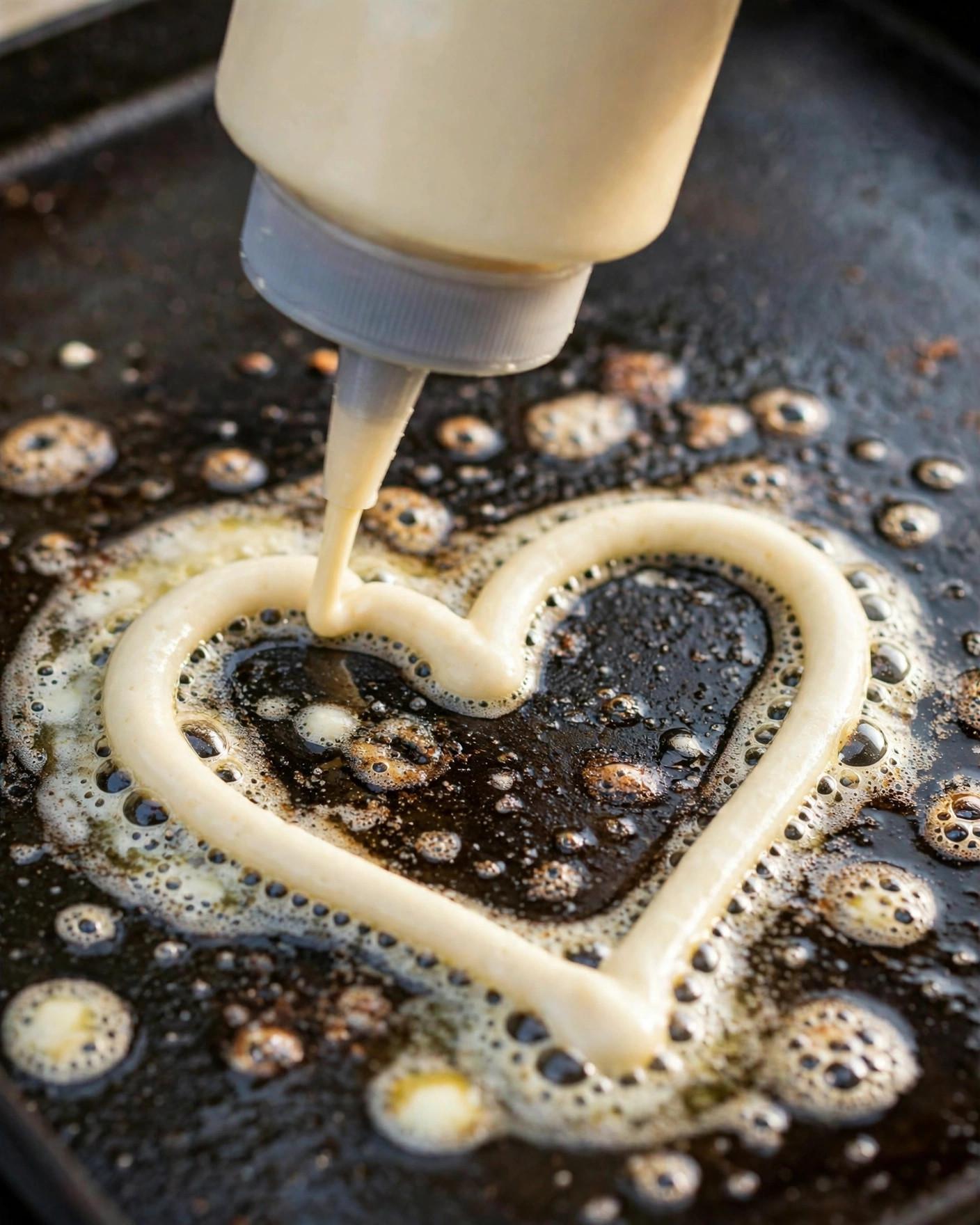
- Pipe or mold the heart shapes. For squeeze-bottle hearts: hold the bottle close to the griddle and pipe a heart outline first — start at the top center, curve out and down one side to the bottom point, then mirror it up the other side — then quickly fill the outline with batter in a zigzag, using about 1/3 cup (80 ml) of batter per heart. Work steadily; the batter begins to set as soon as it touches the pan, which actually helps the outline hold. For mold hearts: grease the inside of a heart-shaped mold or metal cookie cutter generously, set it on the griddle, and pour or pipe batter inside to about 1/3 inch (8 mm) thick, spreading it into the curves with the back of a spoon. Leave a little space between hearts so you have room to flip.
- Cook until bubbles appear, then flip once. Cook the pancakes for 2 to 3 minutes on the first side, until the edges look set and matte, bubbles rise to the surface and begin to pop and stay open, and the underside is a deep golden color when you peek with the spatula. If you used a mold, run a thin knife around the inside edge and lift the mold off with tongs before flipping. Slide a thin, wide spatula fully under each heart and flip in one confident motion. Cook the second side for 1 to 2 minutes more, until golden and cooked through. Resist pressing down with the spatula — that squeezes out the air you worked to create.
- Keep finished pancakes warm while you cook the rest. Transfer each finished batch to the baking sheet in the low oven, arranging the hearts in a single layer so they stay warm without steaming or going soggy. Continue with the remaining batter, adding a tiny bit more butter to the griddle between batches and wiping out any browned butter bits with a folded paper towel if they start to darken. Adjust the heat as you go — griddles often run hotter by the third batch, so nudge the burner down slightly if the hearts are coloring too fast.
- Warm the syrup and prepare the toppings. While the last pancakes cook, return the syrup to low heat for 1 to 2 minutes just until warm and pourable, or warm it briefly in the microwave. Slice the extra fresh strawberries for serving, set out the soft butter and whipped cream if using, and give the powdered sugar a place in a small sieve or shaker if you plan to dust the plates. Having everything ready means the warm stacks go straight to the table at their best.

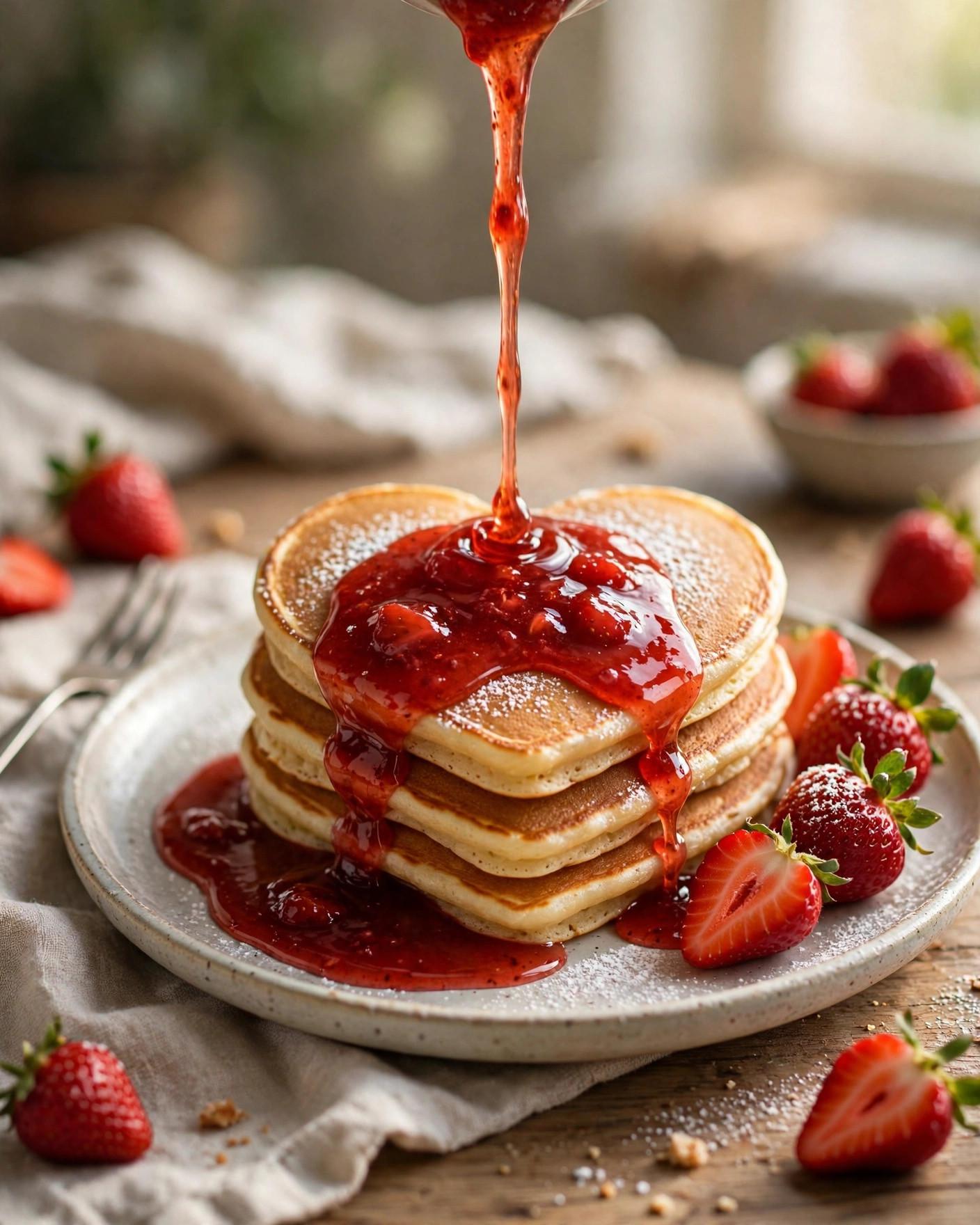
- Stack, sauce, and serve right away. Place two warm heart-shaped pancakes on each plate, slightly overlapping or stacked straight, as you like. Spoon the warm strawberry syrup generously over the top so it spills down the curves of the hearts, then finish with extra sliced strawberries, a small pat of butter if you like, and a light dusting of powdered sugar. Serve immediately, with extra syrup in a small jug for the table, because pancakes are fluffiest in the first few minutes.
Tips for Success
- A squeeze bottle gives you the steadiest hearts. It controls the flow of batter far better than a spoon or ladle, so your outlines stay smooth and your hearts keep their shape. If the batter feels too thick to pipe, whisk in milk a tablespoon at a time; if it runs too freely, let it rest a few minutes longer to thicken.
- Outline first, fill second, work quickly. Piping the heart outline and filling it right away means the outline is still wet enough to fuse with the filling, leaving no gaps. If a curve goes wobbly, do not chase it — a slightly handmade heart looks charming under syrup and strawberries.
- Grease molds generously, every time. Heart molds and metal cookie cutters only release cleanly when they are well greased, and batter loves to stick in the top curves of the heart. Spray or brush the inside before every pancake, and lift the mold straight up with tongs once the surface looks set.
- Medium heat is the heart-shape secret. A griddle that is too hot sets the outline before you finish piping and browns the bottom before the center cooks. Keep the heat at a steady medium, let the pan recover for a few seconds between batches, and treat the first pancake as your temperature test.
- Do not overmix, and do rest the batter. Stir only until the flour disappears, lumps and all, then give the batter 5 to 10 minutes to rest. Those two habits together are the difference between tall, tender pancakes and flat, chewy ones — more than any special ingredient.
- Serve syrup warm and pancakes immediately. Warm syrup pours in glossy ribbons and soaks in just enough, while cold syrup sits heavily on top. Keep the pancakes in the low oven only until the last batch is done, then plate and serve without delay for the best texture.
Variations
- Chocolate chip hearts. Fold 1/2 cup (85 g) mini chocolate chips into the batter after mixing, or sprinkle a few chips over each heart right after piping, before it sets. Mini chips distribute more evenly than regular ones and melt into little pockets that pair beautifully with the strawberry syrup — a combination that feels made for Valentine’s Day.
- Red velvet style hearts. Whisk 1 tablespoon of cocoa powder into the dry ingredients and add a few drops of red food coloring to the wet ingredients for a soft pink-red crumb. Serve with the strawberry syrup and a spoonful of whipped cream cheese topping — 4 ounces (115 g) softened cream cheese whisked with 2 tablespoons powdered sugar and a splash of milk — for a playful bakery-style plate.
- Whole wheat and honey hearts. Replace half the all-purpose flour with whole wheat flour (1 cup / 125 g each) and swap the sugar in the batter for 2 tablespoons of honey whisked into the wet ingredients. The pancakes will be a shade heartier and a little more golden, with a gentle wheat flavor that stands up nicely to the bright berry syrup.
- Lemon-ricotta hearts. Replace 1/2 cup (120 ml) of the milk with 3/4 cup (185 g) whole-milk ricotta and add the lemon zest plus an extra teaspoon of lemon juice to the batter. The hearts come out exceptionally tender and rich, almost custardy in the center, and they need nothing more than the strawberry syrup and a dusting of powdered sugar.
- Mixed berry syrup. Make the syrup with half strawberries and half raspberries or blueberries — 8 ounces (225 g) of each — keeping the sugar, lemon, and method the same. Raspberries deepen the color and add a gentle tartness, while blueberries make the syrup a little jammier. Strain half the syrup if you prefer a smoother pour.
- Mini hearts for little hands or a brunch board. Pipe small hearts using about 2 tablespoons of batter each and cook them 1 to 2 minutes per side. Piled on a warm platter with the syrup in a bowl for dipping, plus extra berries and whipped cream, they make a sweet centerpiece for a family Valentine’s breakfast or a small brunch gathering.
Storage
Pancakes and syrup store best separately, each in its own airtight container in the refrigerator. The pancakes keep well for up to 3 days; let them cool completely before sealing the container so trapped steam does not make them soggy, and slip a small sheet of parchment between layers if you stack them. The strawberry syrup keeps for up to 5 days refrigerated and will thicken as it chills — that is normal, and it loosens again as soon as it warms. Give it a stir before serving, and taste it cold, since chilled syrup sometimes wants a tiny extra squeeze of lemon to wake it back up.
To reheat, arrange the hearts in a single layer on a baking sheet, cover loosely with foil, and warm at 325°F (165°C) for 6 to 8 minutes, or pop individual hearts into the toaster on a light setting until just crisped at the edges. The microwave works in a pinch — 20 to 30 seconds per pancake, covered with a damp paper towel — though the texture will be softer. Warm the syrup separately and pour it over just as you would fresh ones.
For longer storage, these pancakes freeze very well. Freeze the cooled hearts in a single layer on a parchment-lined baking sheet until firm, about 1 hour, then transfer them to a freezer bag or container with parchment between the layers and freeze for up to 2 months. Reheat from frozen in a 325°F (165°C) oven for 8 to 10 minutes or in the toaster until warm and lightly crisp. The syrup also freezes, in a small jar or ice cube tray, for up to 2 months; thaw it overnight in the refrigerator and warm gently before serving.
FAQ
Can I make heart-shaped pancakes without a squeeze bottle or a mold? Yes, you have a couple of good options. A zip-top bag with a corner snipped off works almost exactly like a squeeze bottle — fill it no more than two-thirds full, twist the top closed, and pipe the outline and filling the same way. You can also use a ladle or large spoon to pour round pancakes and then shape them after cooking: let the pancakes cool for just a minute, then cut a small V from the top center and trim the bottom into a gentle point with a knife or kitchen scissors. The trimmed scraps are the cook’s treat, and under warm syrup no one will ever know the hearts were shaped after the fact.
Can I make the batter or the syrup ahead of time? The syrup is an excellent make-ahead — in fact, it may be even better the next day, once the flavors have had time to mingle. Make it up to 5 days ahead, refrigerate it in a jar, and warm it gently before serving. The batter is best made fresh, because the baking powder begins working as soon as it meets liquid and loses some lift if it sits too long. If mornings are tight, whisk the dry ingredients together the night before and measure the wet ingredients separately, then combine them in the morning and let the batter rest while the griddle heats.
Why did my pancakes spread out and lose their heart shape? Spreading usually comes down to batter consistency or griddle temperature. If the batter is too thin — from measuring the flour lightly or adding extra milk — it runs outward before it can set, and the heart softens into a round. The batter should be thick enough to hold a piped outline for a few seconds; if yours runs, whisk in an extra tablespoon or two of flour. A griddle that is too cool has the same effect, because the batter spreads before the bottom sets. Aim for a steady medium heat where the batter sizzles gently on contact, and pipe the outline fairly quickly so it sets as one shape.
Can I use frozen strawberries for the syrup, and do I need to thaw them first? Frozen strawberries work beautifully in the syrup and are often the sweetest, ripest choice in midwinter. You do not need to thaw them fully — add them to the saucepan straight from frozen with the sugar, water, and lemon juice, and give the syrup an extra 2 to 3 minutes of simmering time as they release their juices. The syrup may be a touch looser at first because frozen berries release more liquid, so simmer it a little longer or use the optional cornstarch slurry if you like it thicker. Save your freshest berries for slicing over the finished stacks.
Recipe Card
Heart-Shaped Pancakes with Strawberry Syrup
- Prep Time: 20 minutes
- Cook Time: 15 minutes
- Total Time: 35 minutes
- Servings: 4 servings (8 medium heart-shaped pancakes)
- Calories: 420 kcal per serving (estimated)
Fluffy, golden heart-shaped pancakes piped or molded on a hot griddle, served warm with a glossy homemade strawberry syrup made from real berries, lemon, and a touch of vanilla, plus fresh strawberries on top.
Nutrition (estimated): 420 kcal per serving (estimated, for 2 pancakes with strawberry syrup), 68 g carbohydrates, 9 g protein, 12 g fat, 3 g fiber, 28 g sugar, 520 mg sodium. Nutrition is estimated and will vary with the exact size of the pancakes, the sweetness and ripeness of the strawberries, the amount of syrup served, and any variations or substitutions. Whipped cream, butter, and other toppings served alongside will add further calories.
Can I make heart-shaped pancakes without a squeeze bottle or a mold?
Yes, you have a couple of good options. A zip-top bag with a corner snipped off works almost exactly like a squeeze bottle — fill it no more than two-thirds full, twist the top closed, and pipe the outline and filling the same way. You can also use a ladle or large spoon to pour round pancakes and then shape them after cooking: let the pancakes cool for just a minute, then cut a small V from the top center and trim the bottom into a gentle point with a knife or kitchen scissors. The trimmed scraps are the cook’s treat, and under warm syrup no one will ever know the hearts were shaped after the fact.
Can I make the batter or the syrup ahead of time?
The syrup is an excellent make-ahead — in fact, it may be even better the next day, once the flavors have had time to mingle. Make it up to 5 days ahead, refrigerate it in a jar, and warm it gently before serving. The batter is best made fresh, because the baking powder begins working as soon as it meets liquid and loses some lift if it sits too long. If mornings are tight, whisk the dry ingredients together the night before and measure the wet ingredients separately, then combine them in the morning and let the batter rest while the griddle heats.
Why did my pancakes spread out and lose their heart shape?
Spreading usually comes down to batter consistency or griddle temperature. If the batter is too thin — from measuring the flour lightly or adding extra milk — it runs outward before it can set, and the heart softens into a round. The batter should be thick enough to hold a piped outline for a few seconds; if yours runs, whisk in an extra tablespoon or two of flour. A griddle that is too cool has the same effect, because the batter spreads before the bottom sets. Aim for a steady medium heat where the batter sizzles gently on contact, and pipe the outline fairly quickly so it sets as one shape.
Can I use frozen strawberries for the syrup, and do I need to thaw them first?
Frozen strawberries work beautifully in the syrup and are often the sweetest, ripest choice in midwinter. You do not need to thaw them fully — add them to the saucepan straight from frozen with the sugar, water, and lemon juice, and give the syrup an extra 2 to 3 minutes of simmering time as they release their juices. The syrup may be a touch looser at first because frozen berries release more liquid, so simmer it a little longer or use the optional cornstarch slurry if you like it thicker. Save your freshest berries for slicing over the finished stacks.
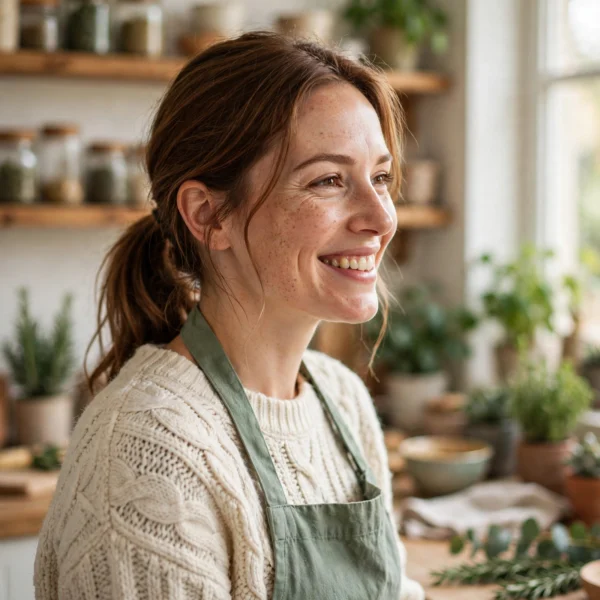
Hi, I’m Emma! I’m the cook and recipe developer behind Sizzle & Sage. From my sunny home kitchen, I share easy, flavor-packed recipes for real life — quick breakfasts, cozy weeknight dinners, and simple bakes anyone can make. Pull up a chair and stay a while!