Perfect Prime Rib Roast for Christmas (With Garlic-Herb Crust)
A prime rib roast is the undisputed centerpiece of the Christmas table — the one dish that makes the whole dining room go quiet when it arrives. This recipe delivers exactly that showstopper: a bone-in standing rib roast coated in a garlicky rosemary-thyme crust, roasted low and slow for an edge-to-edge pink interior, then finished with a high-heat blast for a deeply browned, savory crust. The method is called reverse sear, and it is the most reliable way to get a perfectly even medium-rare from center to edge.
What makes this approach so dependable is temperature control rather than guesswork. The roast goes into a low oven first, where it cooks gently and evenly, so you never end up with a gray overcooked ring around a rare center. Then a short rest lets the juices settle, and a final blast of high heat builds the crust right before serving. An instant-read thermometer guides every stage, so the roast comes out right whether you are cooking your first prime rib or your fiftieth. Plan ahead, bring the meat to room temperature, and follow the visual cues and temperatures below for a Christmas roast worth remembering.
Why You'll Love This Recipe
- Edge-to-edge pink perfection. The low-and-slow reverse-sear method cooks the roast gently and evenly, so every slice is rosy medium-rare with no gray, overcooked band around the outside.
- A crust that earns the name. The garlic-rosemary-thyme paste, finished with a 500°F blast, forms a deeply browned, savory, aromatic crust that contrasts beautifully with the tender interior.
- Thermometer-driven, not guesswork. Pull temperatures and rest times are spelled out, so the biggest holiday roast of your year comes out exactly as planned — no cutting into it and hoping.
- Mostly hands-off cooking. After seasoning and getting the roast into the oven, the long slow roast needs nothing from you — perfect for finishing sides, setting the table, or actually enjoying the day.
- True holiday showpiece. Served on a carving board with fresh herbs, this roast looks as impressive as it tastes, and the make-ahead-friendly timeline fits a Christmas cooking schedule.

Ingredients
For the roast
- 1 bone-in standing rib roast, 3 bones (about 7 pounds / 3.2 kg), fat cap trimmed to about 1/4 inch
- 2 tablespoons (30 ml) olive oil
- 2 tablespoons (35 g) coarse kosher salt
- 2 teaspoons (4 g) coarsely ground black pepper
For the garlic-herb crust
- 8 cloves garlic, finely minced (about 1/4 cup)
- 2 tablespoons fresh rosemary leaves, finely chopped
- 2 tablespoons fresh thyme leaves, finely chopped
- 1 tablespoon finely chopped fresh sage leaves (optional but recommended)
- 1/4 cup (57 g) unsalted butter, softened to room temperature
- 1 teaspoon Dijon mustard
- 1 teaspoon Worcestershire sauce
For serving
- Creamy horseradish sauce, au jus, or pan drippings, warmed
- Fresh rosemary sprigs and flaky sea salt, for garnish
Choosing your roast
Ask the butcher for a bone-in standing rib roast cut from the small end (ribs 10–12) if you have the choice — it has a larger eye of meat and slightly less fat than the large end, which makes for cleaner slices. Look for good marbling, a bright red color, and a fat cap of about 1/4 inch; anything thicker can be trimmed down. A 3-bone roast serves roughly 6 to 8 people generously, and 4 bones serve 8 to 10. The bones act as a natural roasting rack and add flavor, so keep them attached and cut them off after roasting if you prefer easier slicing.
Instructions
- Bring the roast to room temperature. Remove the roast from the refrigerator 2 to 3 hours before cooking and set it on a cutting board. Pat it completely dry with paper towels — dry surfaces season better and brown better. Cold meat in the oven cooks unevenly, so do not skip this rest.
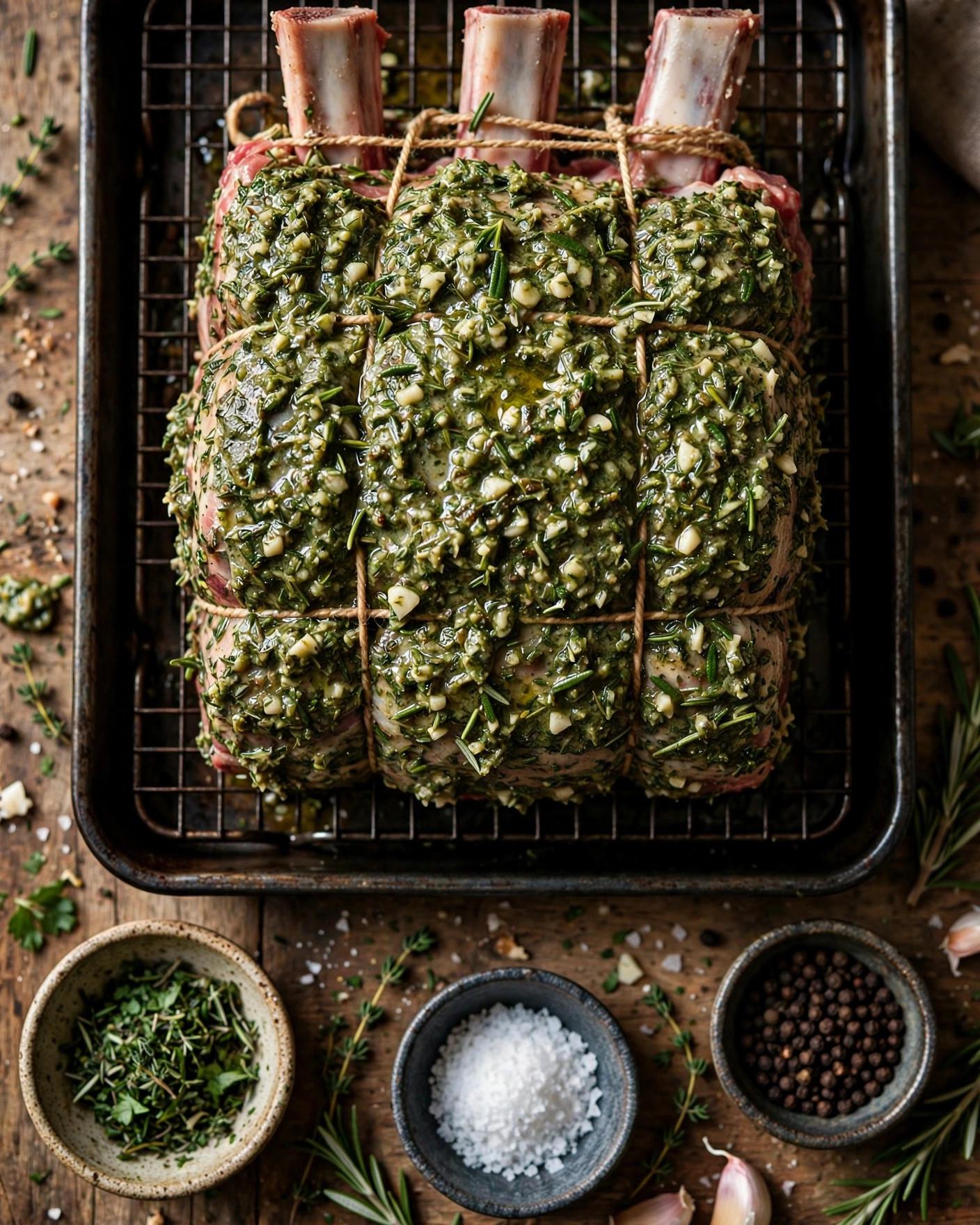
- Make the garlic-herb paste. In a small bowl, mash together the minced garlic, chopped rosemary, thyme, and sage (if using), softened butter, Dijon mustard, and Worcestershire sauce until you have a thick, spreadable paste. It should smell intensely aromatic; this paste becomes the crust.
- Season the roast. Rub the olive oil all over the roast, then season generously with the kosher salt and black pepper on every side, including the ends. Spread the garlic-herb paste thickly and evenly over the top and sides of the roast (not the cut ends), pressing it on so it adheres. Tie the roast with butcher's twine between the bones if the butcher has not already done so — this helps it hold a compact shape for even cooking.
- Set up for the slow roast. Place an oven rack in the lower third of the oven and preheat to 250°F (120°C). Set the roast bone-side down in a roasting pan fitted with a rack, fat cap facing up so the rendered fat bastes the meat as it cooks. Insert an oven-safe probe thermometer into the thickest part of the eye of the meat, keeping the tip away from any bone.
- Roast low and slow. Roast at 250°F until the internal temperature reads 115°F (46°C) for medium-rare, about 3 to 3 1/2 hours for a 7-pound roast. Timing varies with your oven and the roast's shape, so trust the thermometer, not the clock. The roast will look pale at this stage — the browning comes later.
- Rest before the final sear. Transfer the roast to a cutting board, tent it loosely with foil, and rest it for 30 to 40 minutes. The internal temperature will rise about 8 to 10 degrees during this rest, and the juices will redistribute through the meat instead of running out on the board. Meanwhile, increase the oven to 500°F (260°C).
- Sear at high heat. Return the rested roast to the oven, bones down, and roast at 500°F for 8 to 10 minutes, until the exterior is deeply browned and the herb crust is crisp and fragrant. Watch it closely — the butter in the paste browns fast. Pull the roast when the internal temperature reads 125–130°F (52–54°C) for medium-rare.
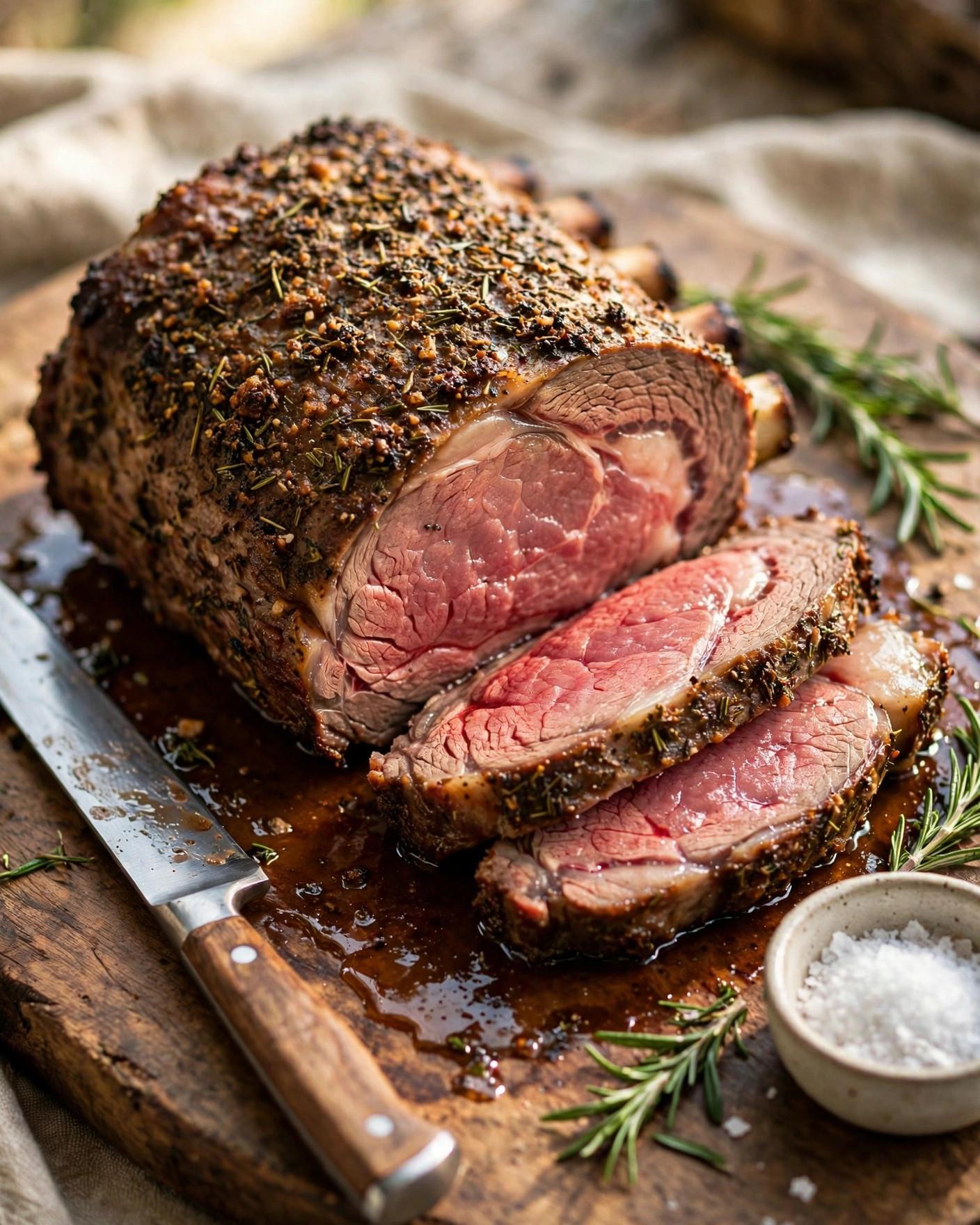
- Carve and serve. Rest the roast 10 to 15 minutes more, then run a sharp carving knife along the bones to release the rack (save it — the bones are a cook's treat). Slice the eye of the meat against the grain into 1/2- to 3/4-inch-thick slices. Arrange on a warmed platter or carving board, garnish with rosemary sprigs and flaky salt, and serve with warmed horseradish sauce or au jus.

Tips for the Perfect Prime Rib
- Trust the thermometer, not the clock. Roasts vary in shape, fat, and density, so time-per-pound rules are only rough guides. An oven-safe probe thermometer plus an instant-read thermometer to verify are the two tools that guarantee the result.
- Dry the surface before seasoning. Moisture is the enemy of a good crust. Patting the roast completely dry helps the salt stick, the paste adhere, and the final sear brown properly instead of steaming.
- Salt generously — it is a big piece of meat. Two tablespoons of coarse salt may look like a lot, but a 7-pound roast needs it. Most of the seasoning stays on the exterior, and underseasoned beef tastes flat no matter how well it is cooked.
- Do not skip the rest before the sear. The 30-to-40-minute rest between the slow roast and the high-heat blast is what keeps the meat juicy. Carving too early lets the juices run out onto the board instead of staying in the slices.
- Know your target pulls. Pull at 115°F after the slow roast for medium-rare; the rest carries it to about 125°F, and the final sear lands around 130°F. For medium, add about 10°F to each stage. For rare, pull about 5°F lower.
- Let the fat cap face up. Set fat-side up on the rack so melting fat bastes the roast as it cooks. Trim the cap to about 1/4 inch first — enough to baste, not so much that slices are all fat.
Variations
- Bone-in standing roast with red wine au jus. Deglaze the roasting pan with 1 cup of dry red wine and 2 cups of beef stock after the roast comes out, simmer 10 minutes, strain, and serve as a rich au jus alongside the slices.
- Cracked pepper and mustard crust. Swap the herb paste for a coating of 3 tablespoons whole-grain mustard mixed with 2 tablespoons coarsely cracked black pepper for a bolder, spicier exterior.
- Bone-in ribeye-style roast with compound butter. Skip the final sear and instead top each hot slice with a pat of garlic-rosemary compound butter, letting it melt over the pink meat at the table.
- Smaller 2-bone roast. Feeding fewer people? A 2-bone roast (about 4 1/2 to 5 pounds) follows the same method — just pull it about 45 minutes sooner and verify with the thermometer. Everything else stays the same.
- Herb-crusted roast with horseradish cream. Stir 3 tablespoons of prepared horseradish, 2 tablespoons of sour cream, and a pinch of salt into softened butter, and serve a quenelle of it on each slice for a sharp, creamy contrast.
Storage
Leftover prime rib keeps well in the refrigerator for up to 4 days. Wrap slices or the whole remaining roast tightly in plastic wrap or foil, or store slices in an airtight container. To reheat without overcooking, warm slices gently in a 250°F (120°C) oven for 12 to 15 minutes, until just warmed through — avoid the microwave, which turns pink slices gray and rubbery. Cold leftover prime rib is excellent sliced thin for sandwiches with horseradish sauce.
To freeze, wrap the meat tightly in plastic wrap followed by a layer of foil, and freeze for up to 3 months. Thaw overnight in the refrigerator and reheat gently as above. Freeze the bones separately for beef stock — they make an outstanding base for French onion soup or beef barley soup.

Nutrition
Estimated per serving (one 8-ounce serving, based on a 7-pound roast serving 8):
- Calories: 680
- Total Fat: 48 g
- Saturated Fat: 21 g
- Cholesterol: 205 mg
- Sodium: 980 mg
- Total Carbohydrates: 2 g
- Dietary Fiber: 0 g
- Total Sugars: 1 g
- Protein: 58 g
Nutrition values are estimates calculated from the listed ingredients and will vary with the roast's exact size, marbling, trimming, and slice size.
FAQ
How long does prime rib take per pound?
At 250°F, a standing rib roast takes roughly 30 minutes per pound to reach 115°F internal before resting and searing — so a 7-pound roast takes about 3 to 3 1/2 hours. Treat this as a rough guide only: oven accuracy, roast shape, and starting temperature all shift the timing, so an oven-safe probe thermometer is the reliable way to know when the roast is done.
What temperature is prime rib medium-rare?
Medium-rare prime rib finishes at 130–135°F (54–57°C) after resting. Because of carryover cooking, pull the roast from the oven a few degrees below your target: aim for about 125°F at the end of the slow roast, which rises to around 130°F after resting and the final high-heat sear. Resting is what lets carryover finish the job evenly.
Can I prepare prime rib ahead of time?
Yes, up to a point. You can season the roast with the salt and herb paste a day ahead, wrap it tightly, and refrigerate it — this actually deepens the flavor. On cooking day, bring it to room temperature for 2 to 3 hours before it goes in the oven. Do not partially cook it ahead; the slow roast, rest, and sear should all happen on serving day for the best texture.
Do I really need a meat thermometer for prime rib?
For a roast this size and this price, a thermometer is strongly recommended. The difference between medium-rare and medium is only about 10 degrees, and there is no reliable way to judge that by time or touch on a 7-pound roast. An inexpensive oven-safe probe thermometer left in during the roast removes all the guesswork and is the single best tool for a perfect result.

Hi, I’m Emma! I’m the cook and recipe developer behind Sizzle & Sage. From my sunny home kitchen, I share easy, flavor-packed recipes for real life — quick breakfasts, cozy weeknight dinners, and simple bakes anyone can make. Pull up a chair and stay a while!