Slow Cooker Creamy Potato Soup
There are soups that feel like a blanket you can eat, and Slow Cooker Creamy Potato Soup is exactly that kind of bowl. Tender cubes of potato simmer slowly with onion, celery, and garlic in savory chicken broth until everything softens and the broth takes on the sweet, earthy flavor of the vegetables. Then the potatoes are mashed right in the pot — just enough to turn the soup thick and creamy, while plenty of soft chunks remain for that hearty, spoonable texture everyone loves about a proper potato soup.
What makes this version so easy to love is how little it asks of you during the day. There is no roux to watch and no long list of steps at dinnertime. The slow cooker handles the gentle, hands-off cooking, and the creaminess comes from the potatoes themselves, finished with heavy cream and sour cream stirred in at the very end so they stay fresh and silky rather than tired from hours of heat.
The toppings are not an afterthought here — they are half the joy. Shredded cheddar that melts into the hot soup, crisp crumbled bacon cooked separately so it stays crisp, and bright green onions turn a humble pot of potatoes into a loaded, cozy dinner. Set the toppings out in little bowls and let everyone finish their own serving just the way they like it.
If you are new to slow cooker soups, this is a kind and forgiving place to start. The vegetables all go in together, the seasoning is simple and familiar, and the finish — mashing, stirring, and topping — takes only a few minutes. By suppertime you have a complete, warming meal that tastes like it took far more effort than it did, with very little washing up.
Why You'll Love This Recipe
- The slow cooker does the hard work. After about 20 minutes of peeling, chopping, and loading, the cooker quietly turns sturdy potatoes and simple vegetables into a tender, flavorful soup while you are free to do everything else.
- Creamy and chunky at the same time. Mashing part of the potatoes right in the pot thickens the soup naturally and gives it a rich, creamy base, while the remaining cubes stay whole and hearty — no flour, no roux, and no separate blender step required.
- Cream stirred in at the end. Heavy cream and sour cream go in off the long cook, so the soup tastes fresh and silky instead of heavy or split, with just enough tang from the sour cream to balance the richness.
- Loaded toppings in every bowl. Melted cheddar, crisp bacon crumbled over the top, and fresh green onions bring salt, smoke, and brightness to each spoonful, so the soup eats like a full, satisfying dinner.
- Gentle, reliable timing. Six to seven hours on LOW or three to four hours on HIGH gives you a wide, forgiving window, and the finished soup holds happily on warm until everyone is ready to sit down together.
- Wonderful leftovers. The flavors deepen overnight, the soup reheats smoothly with a small splash of broth or milk, and a fresh sprinkle of toppings makes the second serving taste brand-new.

Ingredients
For the soup
- 3 pounds (1.4 kg) russet or Yukon Gold potatoes, cut into 3/4-inch (2 cm) cubes (about 8 cups)
- 1 medium yellow onion (about 1 1/2 cups / 225 g), diced
- 3 celery stalks (about 1 1/4 cups / 150 g), sliced 1/4 inch (6 mm) thick
- 4 cloves garlic, minced (about 1 1/2 tablespoons)
- 2 tablespoons unsalted butter, cut into small pieces, or 2 tablespoons olive oil
- 4 cups (950 ml) low-sodium chicken broth
- 1 teaspoon dried thyme, or 1 tablespoon fresh thyme leaves
- 1 1/2 teaspoons fine sea salt, plus more to taste
- 1/2 teaspoon black pepper, freshly ground if possible, plus more to taste
- 1 cup (240 ml) heavy cream
- 1/2 cup (120 g) sour cream, at room temperature
For the toppings
- 1 1/2 cups (170 g) shredded sharp cheddar cheese
- 6 slices bacon (about 6 ounces / 170 g), cooked until crisp and crumbled (about 3/4 cup)
- 4 green onions, thinly sliced (about 1/2 cup / 50 g), white and green parts
- Extra sour cream, optional, for serving
- Fresh thyme leaves or chopped fresh parsley, optional, for serving
Why these ingredients matter
Russet or Yukon Gold potatoes. Potatoes are both the star and the thickener in this soup, so the choice matters. Russets are starchy and break down easily, which means they mash into a wonderfully creamy base with very little effort — peel them for the smoothest result. Yukon Golds are a little waxier, hold their cubes a bit better, and bring a naturally buttery flavor and golden color, and their thin skins can stay on if you scrub them well. Either way, keep the full 3 pounds (1.4 kg) and cut the cubes close to 3/4 inch (2 cm) so they cook evenly and finish very tender at the same time.
Onion. A diced yellow onion is the quiet foundation of the whole pot. Over the long, gentle cook it softens completely, sweetens, and melts into the broth, giving the soup a savory depth plain potatoes and broth could never reach on their own. A sweet onion works too and will make the base a touch milder. Dice it fairly small — by the end it should be nearly invisible, felt only as flavor.
Celery. Celery adds the savory, slightly herbal backbone that keeps a creamy soup from tasting flat. It softens during the slow cook but does not disappear, and its gentle flavor is part of what makes potato soup taste familiar and complete rather than simply rich. Slice the stalks about 1/4 inch (6 mm) thick so the pieces soften fully. If your celery has leafy tops, chop a small handful of the leaves and stir them in as well — they carry a lot of fresh flavor.
Garlic. Four cloves may sound generous, but fresh garlic mellows beautifully over hours of slow cooking, trading its raw sharpness for a sweet, rounded savoriness that fills out the broth. Because everything cooks together from the start, the flavor ends up layered through every spoonful instead of sitting on top. Mince it finely so it disperses evenly, and add it with the vegetables rather than at the end, where it would taste harsh against the cream.
Butter. Two tablespoons of butter dotted over the vegetables adds a round, homemade richness that carries through the whole pot. It is a small amount across six servings — enough to help the finished soup taste full and balanced, not enough to make it greasy. Olive oil can stand in if you prefer. Either fat also helps the thyme and pepper bloom gently as the cooker warms.
Low-sodium chicken broth. Broth is the cooking liquid and the base of the soup, so its flavor matters. Four cups (950 ml) is deliberate: enough to surround the potatoes and cook the vegetables until tender, but not so much that the finished soup turns thin after mashing. A good low-sodium broth lets the potatoes, aromatics, and thyme lead, and leaves you in control of the final salt level once the salty toppings go on.
Thyme, salt, and black pepper. This simple trio does all the seasoning work, and it is exactly right for potato soup. Thyme brings the warm, woodsy note that pairs so naturally with potatoes and cream, salt wakes up every other flavor in the pot, and black pepper adds gentle heat that keeps the richness in check. Season at the start so the potatoes absorb flavor as they cook, then taste carefully and adjust at the end — bacon and cheddar both bring salt to the bowl, so the soup itself should taste just seasoned, not salty.
Heavy cream. Cream is what turns a good potato soup into a truly cozy one, and timing is everything. It is stirred in after the long cook is done, so it stays silky and fresh-tasting and never risks splitting in the cooker. One cup (240 ml) across six servings gives the soup its pale, glossy finish. Warm it through gently rather than bringing the soup back to a rolling boil.
Sour cream. Sour cream is the quiet balancing act in this recipe. Its gentle tang lifts the potatoes and cream so the bowl tastes rich but never flat, and its thickness adds body as it melts into the hot soup. Use the full 1/2 cup (120 g), bring it to room temperature, then whisk a ladle of hot soup into it before stirring it back in — that small step keeps it smooth. Regular sour cream works best here.
Cheddar, bacon, and green onions for topping. The toppings bring everything the creamy base does not have on its own: sharp, melty saltiness from the cheddar, smoky crunch from the bacon, and fresh bite and color from the green onions. Sharp cheddar is worth choosing because its flavor still comes through against the potatoes. The bacon — about 6 slices — is cooked separately on purpose, so it stays crisp, and it is scattered on at the table rather than stirred into the pot. Finish each bowl generously; the contrast is the whole point.
Instructions
- Prepare the potatoes and vegetables. Scrub the potatoes well. Peel russets for the creamiest result; Yukon Golds can keep their thin skins if scrubbed clean. Cut the potatoes into 3/4-inch (2 cm) cubes, keeping the pieces even so they finish tender at the same time. Dice the onion, slice the celery about 1/4 inch (6 mm) thick, and mince the garlic. Set the sour cream out to come to room temperature — cold sour cream stirred straight into hot soup can look grainy.
- Load the slow cooker. Place the cubed potatoes, onion, celery, and garlic in the bottom of a 6-quart (5.7 L) slow cooker and spread them into an even layer. Dot the butter pieces over the top of the vegetables. Sprinkle the dried thyme, salt, and black pepper evenly over everything, then pour the chicken broth over all of it. The broth will not completely cover the potatoes, and that is exactly right — the vegetables release moisture as they cook, and a soup that starts too wet will finish thin even after mashing.
- Cover and cook until very tender. Put the lid on securely and cook on LOW for 6 to 7 hours or on HIGH for 3 to 4 hours, until the potatoes are very tender — a cube should collapse easily when pressed against the side of the cooker with a spoon, and a fork should slide in with no resistance at all. Do not lift the lid during cooking, as each peek lets out heat and adds time. If your cooker runs hot, begin checking toward the earlier end of the range; if it runs cool or your cubes are on the larger side, use the longer end.
- Cook the bacon separately while the soup finishes. During the last 30 minutes of cooking, cook the 6 slices of bacon until crisp, either in a skillet over medium heat or on a rimmed baking sheet in a 400°F (200°C) oven for 15 to 20 minutes. Drain on a paper towel–lined plate, let it cool slightly, then crumble it into bite-size pieces. Cooking it on its own keeps it crisp and lets you control the smoky, salty finish bowl by bowl.
- Mash part of the potatoes right in the pot. When the potatoes are very tender, turn the slow cooker to WARM or switch it off for this step. Using a potato masher, mash down into the soup in short presses, working around the pot until roughly half the potatoes have broken down and the broth has turned thick, pale, and creamy. Leave the rest of the cubes whole for that chunky, hearty texture. A few passes are usually enough — stop sooner than you think, because you can always mash a little more, and an over-mashed potato soup can turn gluey if it is worked too hard.

- Adjust the texture with a brief blend, if you like. For an even creamier base with chunks still folded through, use an immersion blender directly in the cooker alongside the masher: give the soup just 3 to 4 short pulses in different spots, then stop and stir. The goal is creamy-but-chunky, never a smooth purée, so blend in brief bursts and check after each one. Without an immersion blender, the masher alone does the job beautifully, or ladle about 2 cups of soup into a regular blender, blend until smooth, and stir it back in.
- Stir in the heavy cream and sour cream. Pour the heavy cream into the soup and stir gently until it is fully combined and the soup looks silky and evenly pale. In a small bowl, whisk the room-temperature sour cream with a ladle of the hot soup until smooth, then stir that mixture back into the pot. Adding both creams now, off the long cook, keeps them fresh and glossy. Cover and let the soup warm through on LOW or WARM for 10 to 15 minutes — it should be steaming and hot, but avoid bringing it to a hard boil once the cream is in.
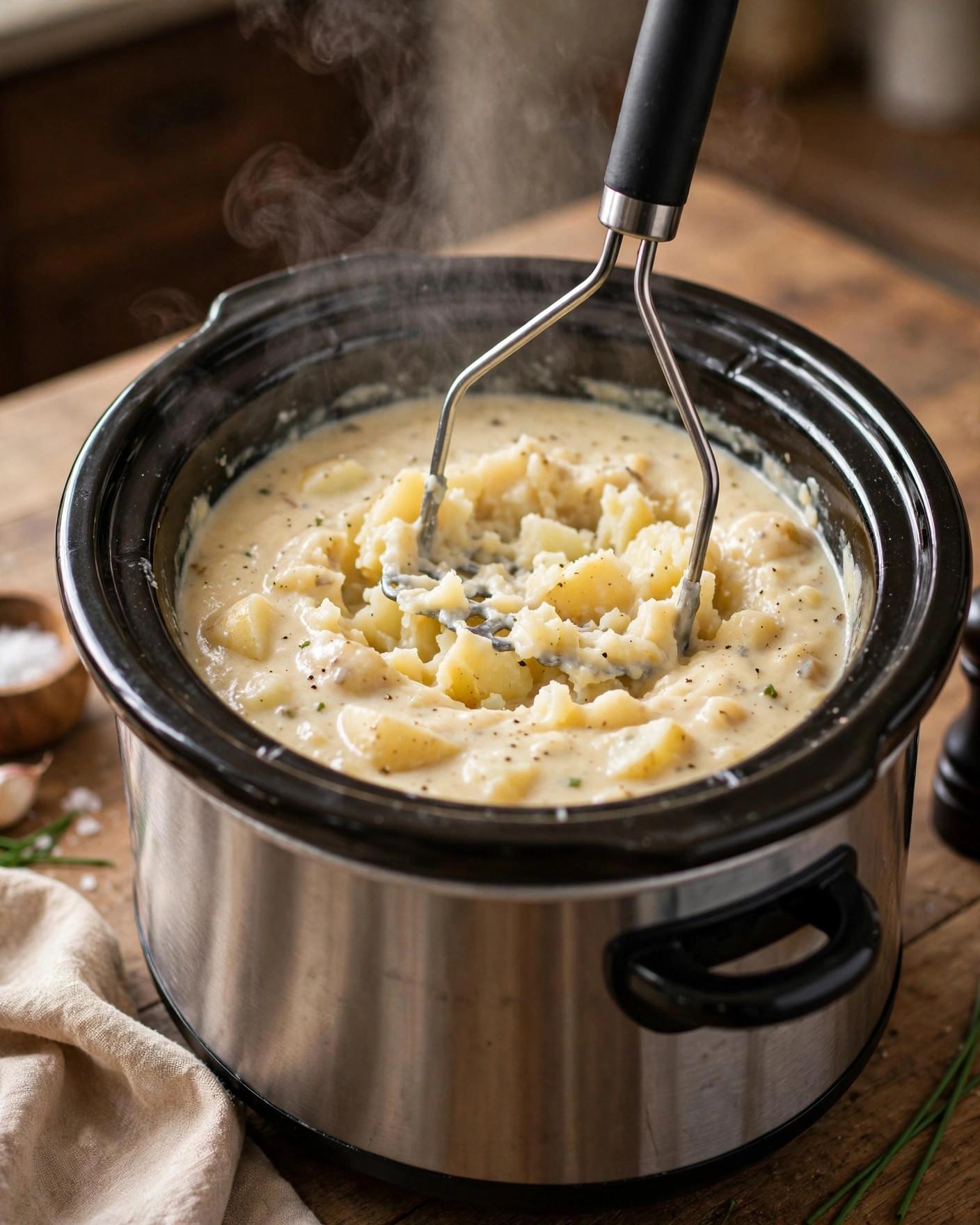
- Taste and adjust the seasoning. Stir the soup well, lifting from the bottom so the mashed potatoes are evenly distributed, then taste carefully. Add more salt and black pepper a little at a time until the potatoes taste full and savory on their own — remember that the cheddar and bacon will add salt at the table. If the soup is thicker than you like, stir in a splash of warm broth or milk, a few tablespoons at a time. If it looks a little thin, mash a few more potato cubes against the side of the pot and let it stand, covered, for 5 minutes; it will set up slightly as it sits.
- Warm the bowls and set out the toppings. While the soup rests, place the cheddar, crumbled bacon, and green onions in separate small bowls alongside the extra sour cream, if using. Warming your serving bowls — a minute filled with hot tap water, then emptied and dried — keeps a creamy soup hot to the last spoonful. Keep the slow cooker on WARM so second helpings stay ready.

- Ladle, top generously, and serve. Ladle the hot soup into the warm bowls, making sure each serving gets a good mix of creamy base and whole potato chunks. Top each bowl generously with shredded cheddar, a spoonful of crumbled bacon, and a scatter of green onions, plus a small dollop of sour cream and a few fresh thyme leaves, if you like. Serve right away while the cheddar is melting into the soup, with crusty bread alongside for anyone who wants to catch every last spoonful.
Tips for Success
- Cut the potatoes evenly, and do not skimp on the amount. Cubes close to 3/4 inch (2 cm) cook through at the same pace and mash predictably. Much larger pieces may still be firm when the smaller ones are done, and much smaller pieces can disappear entirely. The full 3 pounds (1.4 kg) is what gives the soup its body once mashed, so a smaller amount will finish noticeably thinner.
- Do not lift the lid while the soup cooks. Slow cookers lose a surprising amount of heat each time the lid comes off, and that lost heat can add 15 to 20 minutes to the cooking time. Trust the listed times, hold off on stirring, and do your tenderness checking near the end of the range rather than throughout the day.
- Mash in the pot, and stop early. The masher gives you full control over the creamy-but-chunky balance, and the soup will look a little looser in the pot than it does in the bowl. Press and stir, then pause and look before you press again. Overworking potatoes — especially with a blender left running — can turn a silky soup gummy, so brief pulses and a light hand matter here.
- Add the dairy at the end, every time. Heavy cream and sour cream that cook for hours can split, dull in flavor, and leave the soup looking curdled. Stirred in off the long cook and warmed through gently, they stay glossy and fresh. Bringing the sour cream to room temperature and tempering it with hot soup first makes the finish even smoother.
- Cook the bacon separately for real crunch. Bacon simmered in soup softens and flavors the whole pot whether everyone wants it or not. Bacon cooked on its own stays crisp, can be scattered on generously at the table, and can simply be left off individual bowls for anyone who prefers their soup without it.
- Season in two stages. Season the potatoes at the start so they absorb flavor as they cook, then taste and finish at the end once the cream is in. Cream mutes salt, and the toppings add more, so that final taste — after the dairy, before the toppings — is the one that gets the bowl exactly right.
Variations
- Vegetarian potato soup. Swap the chicken broth for 4 cups (950 ml) of vegetable broth, use olive oil in place of the butter if you like, and leave the bacon off entirely or replace it with a smoky, crunchy topping of your choice at the table. The soup itself keeps all of its creamy, hearty character, because the body comes from the potatoes and cream rather than the broth. Finish these bowls with extra cheddar and green onions so they still feel fully loaded.
- Cream cheese finish. For an extra-thick, tangy finish, replace the sour cream with 4 ounces (115 g) of cream cheese, cut into cubes and softened to room temperature. Whisk it with a ladle of hot soup until completely smooth, just as written for the sour cream, then stir it back in and let it melt through for a few extra minutes. Keep the full 1 cup (240 ml) of heavy cream as written — the soup will be noticeably richer and will set up a little firmer as it stands.
- Loaded baked potato style. Lean all the way into the toppings: increase the cheddar to 2 cups (225 g), add the bacon as written, and finish each bowl with an extra dollop of sour cream and a double scatter of green onions. A pinch of smoked paprika over the top is a pretty, gentle addition. Serve the soup a touch thicker for this version — mash a few extra cubes in step 5 — so it eats like the inside of a baked potato.
- Cheddar and broccoli potato soup. Stir 2 cups (180 g) of small broccoli florets into the soup when you add the cream, cover, and let them warm through for 15 to 20 minutes until just tender and bright green, then stir in half the cheddar directly into the pot so it melts through the soup. Top the bowls with the remaining cheddar, bacon, and green onions as written. The broccoli adds color and a fresh contrast that suits the creamy base very well.
- Ham and potato soup. Replace the bacon topping with 1 1/2 cups (210 g) of diced cooked ham stirred into the soup when you add the cream, so it warms through and flavors the whole pot, and keep the cheddar and green onions on top. This is a kind home for leftover holiday ham. Because ham can be quite salty, reduce the salt added at the start to 1 teaspoon, then taste and adjust at the end once the ham has settled in.
- Lighter, half-and-half finish. Replace the heavy cream with 1 cup (240 ml) of half-and-half stirred in off the long cook exactly as written, and use reduced-fat sour cream only as a dollop on top rather than stirred in, since it is more likely to look grainy in hot soup. The result will be a little less rich and a touch thinner, so mash a few extra potato cubes to help the body. The flavor stays cozy and classic, in a bowl that suits more frequent weeknight rotation.
Storage
Let leftover soup cool until it is no longer steaming, then transfer it to an airtight container and refrigerate promptly. Store the toppings separately — cheddar and green onions in small containers in the refrigerator, and crumbled bacon in its own container — because toppings stirred into stored soup soften, dull, and lose everything that makes them good. The soup keeps for up to 3 to 4 days, and its flavor deepens by the second day as the thyme and aromatics settle into the creamy base.
To reheat, spoon the soup into a saucepan and warm it over medium-low heat, stirring often, until it is steaming hot throughout. Potato soup thickens considerably in the refrigerator, so stir in a splash of broth, milk, or water — about 2 to 3 tablespoons per serving — as it warms, until it loosens back to a creamy, spoonable consistency. A microwave also works well for single bowls: heat at medium power in short intervals, stirring between each, and add that same splash of liquid if the soup looks tight. Avoid boiling the reheated soup hard, which can make the cream look grainy, then finish each bowl with fresh toppings.
Creamy potato soup can be frozen, with one honest note: potatoes and dairy both change a little with freezing, so the thawed soup may be slightly grainier and the chunks a bit softer. For the smoothest result, freeze it before the cream and sour cream go in, then stir them in fresh as it reheats. Cool the soup completely, pack it into freezer-safe containers leaving a little headspace, and freeze for up to 2 to 3 months. Thaw overnight in the refrigerator, then reheat gently as above.
FAQ
Can I make Slow Cooker Creamy Potato Soup with Yukon Golds instead of russets? Yes — both potatoes work beautifully, and you can use the full 3 pounds (1.4 kg) of either one, or a mix of the two. Russets are starchier, break down more easily, and mash into the creamiest base, but they should be peeled for the smoothest texture. Yukon Golds hold their cubes a little better, taste naturally buttery, and can keep their thin skins on. Whichever you choose, cut the cubes to about 3/4 inch (2 cm) and cook until they are very tender before you mash.
Why do the cream and sour cream go in at the end instead of at the start? Dairy and long, slow heat do not get along. Heavy cream and sour cream cooked for six or seven hours can split, lose their fresh flavor, and leave the soup looking curdled or thin instead of silky. Stirred in off the long cook, they stay glossy and rich, and the sour cream keeps its gentle tang. Warm the finished soup through gently for 10 to 15 minutes so it is steaming hot, but avoid bringing it back to a hard boil once the dairy is in.
What can I do if my potato soup is too thin or too thick? For a thin soup, mash more of the potatoes against the side of the pot, or give it a few more short pulses with an immersion blender, then let it stand, covered, for 5 to 10 minutes — it thickens noticeably as it sits and again as it cools slightly in the bowl. For a thick soup, stir in warm broth or milk a few tablespoons at a time until it loosens to a creamy, spoonable consistency. Adjust a little at a time in either direction; the balance shifts quickly once the potatoes start breaking down.
Can I make Slow Cooker Creamy Potato Soup ahead of time? Yes, and it is a good make-ahead dinner. You can peel and cube the potatoes a day ahead and refrigerate them submerged in cold water so they do not brown, then drain them well before loading the cooker — dice the onion and slice the celery ahead as well and refrigerate them separately. You can also cook the soup completely, refrigerate it for up to 3 to 4 days, and reheat it gently while you cook fresh bacon and prepare the toppings, so the finish still tastes crisp and new.

Recipe Card
Slow Cooker Creamy Potato Soup
- Prep Time: 20 minutes (PT20M)
- Cook Time: 6 hours 30 minutes (PT6H30M)
- Total Time: 6 hours 50 minutes (PT6H50M)
- Servings: 6 servings
- Calories: 450 kcal per serving (estimated, with toppings)
Tender potatoes, onion, celery, and garlic simmered in chicken broth with thyme, mashed right in the pot for a creamy but chunky base, then finished with heavy cream and sour cream and topped with cheddar, crumbled bacon, and green onions. Cook time reflects cooking on LOW; on HIGH the soup cooks in 3 to 4 hours.
Nutrition (estimated, with toppings): 450 kcal, 38 g carbohydrates, 12 g protein, 28 g fat, 4 g fiber, 6 g sugar, 780 mg sodium. Nutrition is estimated and will vary with the exact potato variety used, the brand of broth and bacon, how much salt your toppings carry, and any variations or substitutions.
Can I make Slow Cooker Creamy Potato Soup with Yukon Golds instead of russets?
Yes — both potatoes work beautifully, and you can use the full 3 pounds (1.4 kg) of either one, or a mix of the two. Russets are starchier, break down more easily, and mash into the creamiest base, but they should be peeled for the smoothest texture. Yukon Golds hold their cubes a little better, taste naturally buttery, and can keep their thin skins on. Whichever you choose, cut the cubes to about 3/4 inch (2 cm) and cook until they are very tender before you mash.
Why do the cream and sour cream go in at the end instead of at the start?
Dairy and long, slow heat do not get along. Heavy cream and sour cream cooked for six or seven hours can split, lose their fresh flavor, and leave the soup looking curdled or thin instead of silky. Stirred in off the long cook, they stay glossy and rich, and the sour cream keeps its gentle tang. Warm the finished soup through gently for 10 to 15 minutes so it is steaming hot, but avoid bringing it back to a hard boil once the dairy is in.
What can I do if my potato soup is too thin or too thick?
For a thin soup, mash more of the potatoes against the side of the pot, or give it a few more short pulses with an immersion blender, then let it stand, covered, for 5 to 10 minutes — it thickens noticeably as it sits and again as it cools slightly in the bowl. For a thick soup, stir in warm broth or milk a few tablespoons at a time until it loosens to a creamy, spoonable consistency. Adjust a little at a time in either direction; the balance shifts quickly once the potatoes start breaking down.
Can I make Slow Cooker Creamy Potato Soup ahead of time?
Yes, and it is a good make-ahead dinner. You can peel and cube the potatoes a day ahead and refrigerate them submerged in cold water so they do not brown, then drain them well before loading the cooker — dice the onion and slice the celery ahead as well and refrigerate them separately. You can also cook the soup completely, refrigerate it for up to 3 to 4 days, and reheat it gently while you cook fresh bacon and prepare the toppings, so the finish still tastes crisp and new.

Hi, I’m Emma! I’m the cook and recipe developer behind Sizzle & Sage. From my sunny home kitchen, I share easy, flavor-packed recipes for real life — quick breakfasts, cozy weeknight dinners, and simple bakes anyone can make. Pull up a chair and stay a while!