One-Pot Chicken Alfredo Rice
There are nights when you want the comfort of chicken Alfredo without a sink full of pots, and that is exactly where One-Pot Chicken Alfredo Rice earns its place. Tender pieces of chicken, long-grain rice, garlic, butter, broth, cream, and Parmesan all come together in a single pot, and the rice cooks right in the creamy sauce instead of in a separate pan of water. Every grain soaks up that garlic-Parmesan flavor as it simmers, so the finished dish tastes cohesive and rich in a way that rice cooked plain and stirred in afterwards never quite manages.
The details are what make it work. The chicken sears first, in the same pot, until the edges turn golden and the pan picks up savory browned bits that season everything that follows. The onion and garlic soften in the drippings and butter, the rice gets a brief toast so it stays distinct and fluffy, and then broth and cream go in and the pot simmers, covered, until the rice is tender. Parmesan stirred in at the end pulls it all together into something glossy, creamy, and deeply comforting.
There is no pasta in this version, and that is deliberate. Rice brings its own gentle, starchy comfort to an Alfredo-style sauce, and because it cooks in the sauce itself, it thickens the pot as it goes. The result sits somewhere between a creamy skillet dinner and a relaxed risotto-style bowl — spoonable, satisfying, and much less fussy than either. It is weeknight food in the best sense: one pot, familiar ingredients, and a dinner that feels generous without asking much of the cook.
This recipe makes six servings, which suits a family dinner with a little left over for lunch, or a smaller household that likes a good leftover night. The pot holds well for a short rest before serving, reheats kindly with a splash of liquid, and welcomes the easy additions covered in the variations — broccoli, peas, mushrooms, or a pinch of heat — whenever you want to steer it in a slightly different direction. If you keep chicken, rice, and Parmesan in the house most weeks, you are already most of the way to this dinner.
Why You'll Love This Recipe
- Everything cooks in one pot. The chicken sears, the aromatics soften, and the rice simmers all in the same pot, so cleanup stays small and the flavors build on each other in layers instead of being assembled at the end from separate pans.
- The rice cooks in the sauce itself. Simmering the rice directly in broth and cream means every grain absorbs garlic, butter, and Parmesan flavor as it cooks, and the rice starch gently thickens the sauce into a creamy, clinging finish.
- No pasta, no extra pans, no juggling timers. There is no pot of pasta water to watch and no colander in the sink — the timing lives in one place, which makes this an especially calm dinner to cook on a busy evening.
- Creamy Alfredo flavor, weeknight timing. You get the familiar garlic, butter, cream, and Parmesan comfort of Alfredo in about 45 minutes total, with only about 15 minutes of hands-on prep before the pot mostly takes care of itself.
- Tender chicken in every bite. Cutting the chicken into even, bite-size pieces and searing it first keeps it juicy and well seasoned, and returning it to the pot to finish in the sauce means it stays moist rather than drying out on a plate.
- Easy to adapt to what you have. Broccoli or peas fold in beautifully, chicken thighs swap in for breasts, and a lighter half-and-half version is covered in the variations — the base recipe is sturdy enough to bend without breaking.
Ingredients
For the chicken
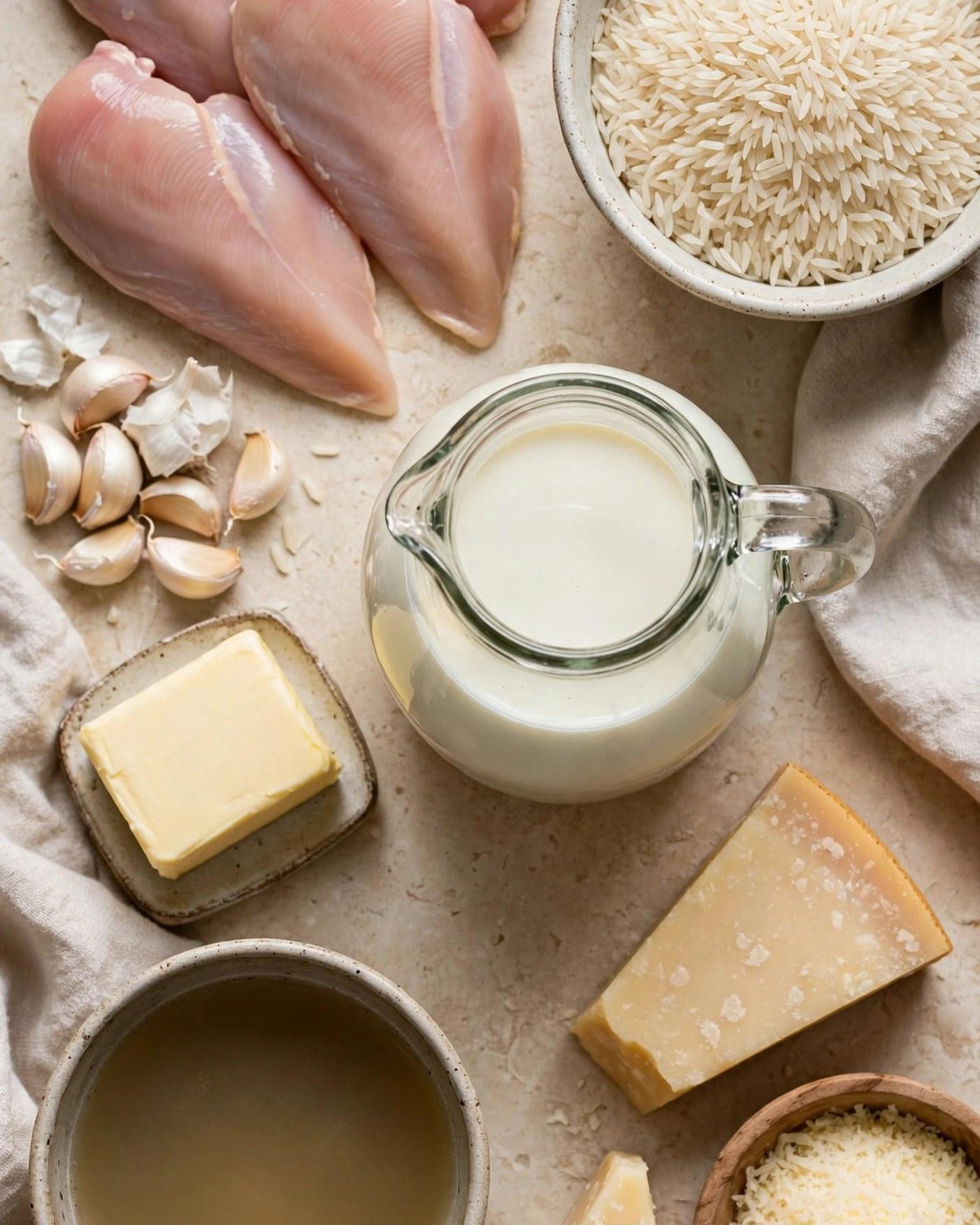
- 1 1/2 pounds (680 g) boneless, skinless chicken breasts or thighs, cut into 3/4-inch (2 cm) bite-size pieces, patted dry
- 1 teaspoon fine sea salt, divided, plus more to taste
- 1/2 teaspoon black pepper, freshly ground if possible, plus more to taste
- 1 teaspoon Italian seasoning
- 1/2 teaspoon garlic powder
- 1 tablespoon olive oil
- 1 tablespoon unsalted butter, for searing the chicken
For the rice and Alfredo-style sauce
- 2 tablespoons unsalted butter
- 1 small yellow onion (about 1 cup / 150 g), finely diced
- 5 cloves garlic, minced (about 1 1/2 tablespoons)
- 1 1/2 cups (300 g) long-grain white rice, rinsed until the water runs mostly clear and drained well
- 2 1/2 cups (600 ml) low-sodium chicken broth, at room temperature or warmed
- 1 cup (240 ml) heavy cream, at room temperature if possible
- 1/2 teaspoon fine sea salt, or to taste, depending on your broth
- 1/4 teaspoon black pepper, plus more to taste
- 1/4 teaspoon ground nutmeg, optional, for a classic creamy-sauce warmth
- 1 cup (100 g) finely grated Parmesan cheese, plus more for serving
- 2 tablespoons fresh flat-leaf parsley, finely chopped, for serving, plus more if you like
Why these ingredients matter
Chicken breasts or thighs. Either cut works beautifully here, and the choice is mostly about the texture you prefer. Breasts stay lean and slice-like in neat, tender pieces, while thighs bring a little more richness and forgive a few extra minutes in the pot without drying out. What matters most is even 3/4-inch (2 cm) pieces, which sear at the same rate and finish gently in the sauce. Pat the chicken dry first — dry chicken browns, damp chicken steams.
Salt, black pepper, Italian seasoning, and garlic powder. Seasoning the chicken itself, before it sears, means the flavor is part of the meat rather than a coating added at the end. Italian seasoning brings a balanced mix of basil, oregano, and thyme that suits both chicken and a cream sauce, and garlic powder clings to the chicken during searing in a way fresh garlic cannot — fresh garlic added this early would scorch. A final taste at the end lets you land the salt exactly where your broth and Parmesan need it.
Olive oil and butter, together. This pairing is practical as much as it is flavorful. Olive oil raises the working temperature of the pan so the chicken can brown properly, while butter brings the rich, unmistakably Alfredo flavor that oil alone cannot. Using a little of each for the sear, then fresh butter for the onion and garlic, keeps every stage tasting intentional.
Yellow onion. A small onion, diced fine, is the quiet base of the sauce. It softens in the butter until sweet and translucent, giving the cream sauce a savory depth that keeps it from tasting flat or one-note. Diced small, it practically disappears into the finished rice, so the dish stays creamy rather than chunky. Yellow onion is the reliable choice here; white onion works in a pinch.
Garlic. Five cloves is a generous amount, and Alfredo-style sauce is exactly where generosity pays off. Garlic cooked briefly in butter after the onion softens loses its raw sharpness and turns warm, fragrant, and savory — the backbone flavor of the whole pot. Adding it after the onion, and giving it only about 30 seconds before the rice goes in, protects it from burning — scorched garlic turns bitter and flavors the entire dish.
Long-grain white rice. The variety of rice is the most important choice in this recipe. Long-grain white rice — regular long-grain, basmati, or jasmine in a pinch — cooks up fluffy with separate, tender grains that hold their shape in a creamy sauce. Short-grain and arborio rice release far more starch and turn sticky, while brown rice needs much more liquid and time. Rinsing until the water runs mostly clear washes away loose surface starch, which keeps the dish creamy rather than gluey.
Chicken broth. Broth does double duty: it is the main cooking liquid for the rice and a major source of savory flavor. Because the grains absorb nearly all of it, the broth you choose genuinely flavors every bite, so a broth you like the taste of matters. Low-sodium broth is the practical pick because Parmesan is naturally salty — you can always add salt at the end, but you cannot take it back out.
Heavy cream. Cream is what turns seasoned broth into an Alfredo-style sauce: it adds body, richness, and that smooth, spoon-coating texture that makes this dinner feel like comfort food. Heavy cream is also the forgiving choice for a simmered sauce — it resists curdling far better than milk. Half-and-half and milk versions are covered in the variations.
Ground nutmeg, optional. A quarter teaspoon sounds unusual until you remember that classic cream sauces have used a whisper of nutmeg for generations. It does not make the dish taste like nutmeg; it adds a faint warmth that makes the cream and Parmesan taste fuller. It is entirely optional — the sauce stands perfectly well without it.
Parmesan cheese. Parmesan is both a seasoning and a sauce ingredient here: it brings salt, deep savoriness, and the nutty, unmistakable flavor that defines Alfredo. Finely grated Parmesan melts smoothly into the hot rice, while thick shreds can clump, so grate it fine — ideally from a wedge, which melts more cleanly than pre-grated cheese. It goes in at the end, off the fiercest heat, where it melts into the sauce instead of seizing.
Fresh parsley. Parsley is more than decoration in a dish this rich. Its clean, green, slightly peppery flavor cuts through the cream and butter and keeps each bowl tasting fresh rather than heavy, and the color alone makes the pot look finished. Save most of it for scattering over the top at serving, where it stays bright. If you have no fresh parsley, torn basil leaves or thinly sliced green onions are better stand-ins than dried parsley.
Instructions
- Prepare the chicken and ingredients. Cut the chicken into even 3/4-inch (2 cm) bite-size pieces, trimming away any excess fat, and pat the pieces very dry with paper towels. Toss the chicken in a bowl with 1/2 teaspoon of the salt, the black pepper, Italian seasoning, and garlic powder until evenly coated, then set it aside at room temperature while you work. Finely dice the onion, mince the garlic, rinse the rice until the water runs mostly clear, and grate the Parmesan finely. Having everything ready matters here, because the early steps move quickly.
- Sear the chicken in the pot. Heat the olive oil and 1 tablespoon of butter in a large, heavy pot or Dutch oven over medium-high heat until the butter melts and foams slightly. Add the chicken in a single layer, working in two batches if your pot is crowded, and sear for 3 to 4 minutes, turning once or twice, until the pieces are golden at the edges and just cooked through. Chicken is safe at 165°F (74°C), and the pieces will also finish gently in the sauce later, so aim for golden and nearly done rather than deeply dark. Transfer the chicken to a clean plate with any juices, and leave the browned drippings in the pot — they are flavor for the rice.
- Soften the onion and garlic. Reduce the heat to medium and add the remaining 2 tablespoons of butter to the same pot, letting it melt through the chicken drippings. Add the diced onion and cook, stirring often and scraping the bottom of the pot to lift the browned bits, for 3 to 4 minutes, until the onion is soft, translucent, and sweet-smelling. Stir in the minced garlic and cook for about 30 seconds, just until fragrant. Do not let the garlic color; pale and fragrant is perfect, and the rice goes in right away in the next step to protect it.
- Toast the rice briefly. Add the rinsed, well-drained rice to the pot and stir it constantly for 1 to 2 minutes, coating every grain in the butter and aromatics, until the grains look glossy and the edges turn slightly translucent. This brief toast helps the grains stay separate and distinct in the finished dish instead of clumping, and it adds a faint, warm nuttiness underneath the cream sauce. Keep the rice moving so nothing sticks or browns against the bottom of the pot — you want toasted and glossy, not colored.
- Add the broth and cream. Pour in the chicken broth and heavy cream, then add the remaining 1/2 teaspoon of salt, the extra black pepper, and the nutmeg if using. Stir well, scraping the bottom of the pot one more time so no toasted rice or browned bits are left stuck there, and bring the liquid just to a gentle boil over medium-high heat. The mixture will look quite loose at this point, more like a soup than a finished dish — that is correct. The rice will absorb most of the liquid as it simmers, and the sauce will tighten up considerably at the end.

- Simmer the rice, covered. As soon as the liquid reaches a gentle boil, reduce the heat to low so the pot settles into the barest simmer, cover it with a tight-fitting lid, and cook for 16 to 18 minutes without lifting the lid. Steam is doing essential work here, and every peek lets it escape and can leave the top layer of rice undercooked. The rice is ready when it is tender with just the faintest bite in the center and most of the liquid has been absorbed, though the pot should still look creamy and slightly loose rather than dry.
- Rest the rice off the heat. Take the pot off the heat and let it stand, still covered, for 5 minutes. This short rest lets the grains finish absorbing the sauce evenly, so the top and bottom of the pot end up the same tender, creamy texture instead of soupy on the bottom and firm on top. Resist stirring during the rest; the rice settles best undisturbed.
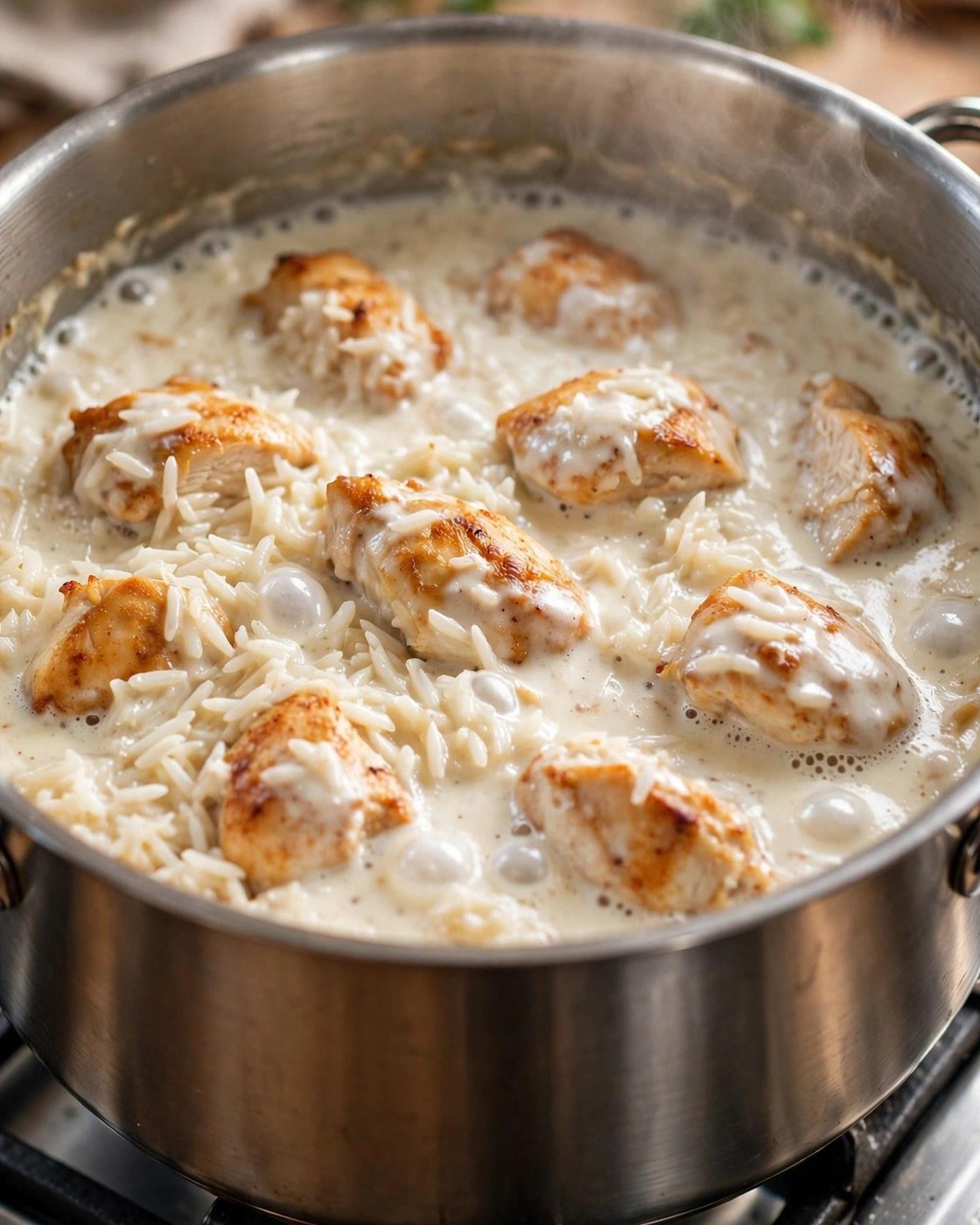
- Return the chicken to the pot. Uncover the pot and fluff the rice gently with a fork or a wide spoon, loosening the grains without mashing them. Fold the seared chicken and every drop of its resting juices back through the rice. If any piece of chicken needs a little more time, this is its moment: cover the pot again and let it sit off the heat for another 2 to 3 minutes, until the chicken is cooked through to 165°F (74°C) and steaming hot. The residual heat of the rice is gentle enough to finish the chicken without drying it out.
- Stir in the Parmesan to finish the sauce. Sprinkle the finely grated Parmesan over the rice a handful at a time, stirring gently after each addition, until it has all melted into a smooth, glossy sauce that coats the grains and chicken. If the sauce looks thicker than you like, stir in a splash of warm broth or cream, a tablespoon or two at a time, until it loosens to a creamy, spoonable consistency. If it looks a little loose, give it 2 minutes standing uncovered — the rice will keep absorbing and the sauce will settle. Take the extra minute here to get the texture right.
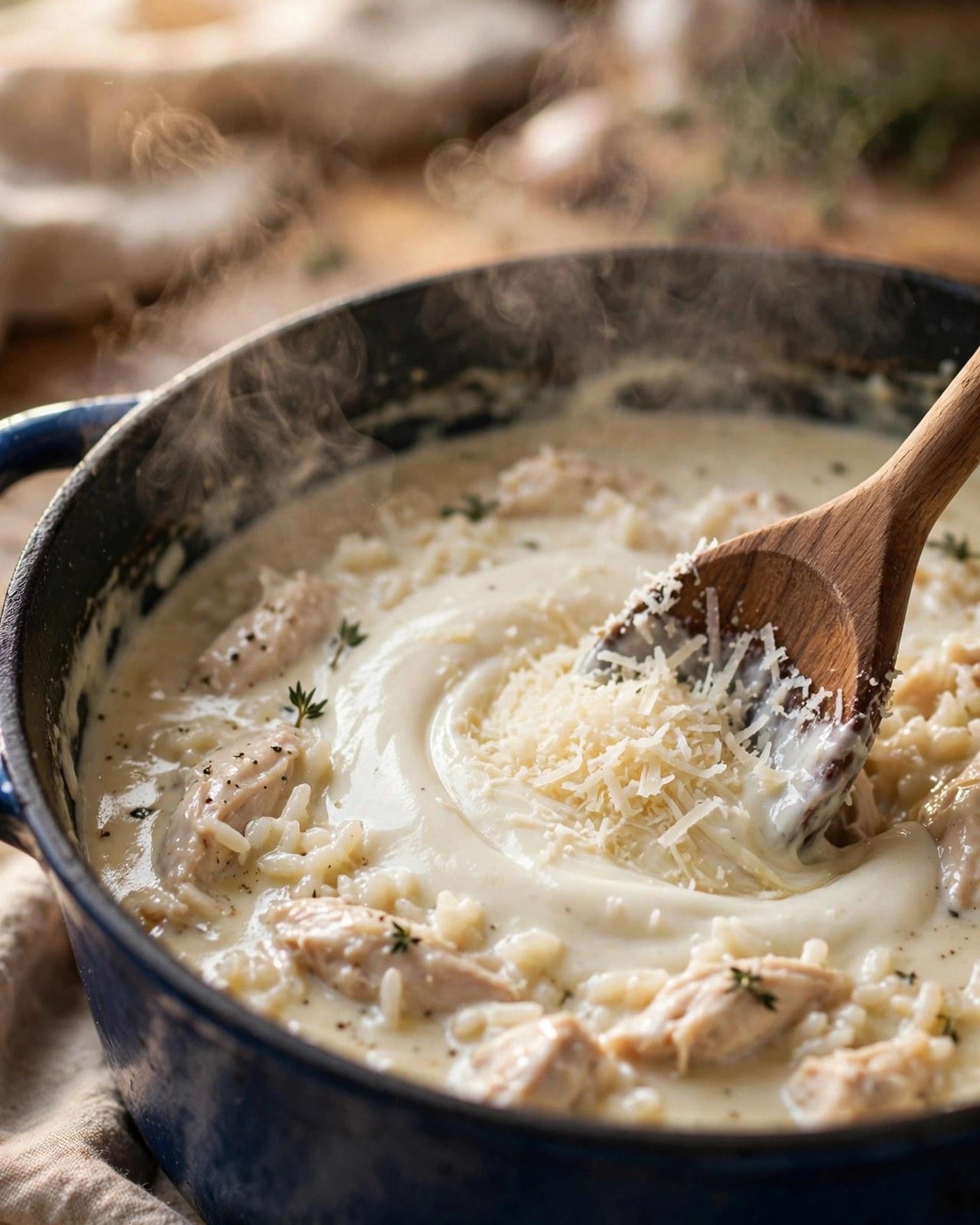
- Taste, adjust, and serve. Taste the rice carefully and adjust the salt and black pepper — Parmesan brands and broths vary enough that this final seasoning pass genuinely matters. Divide the chicken Alfredo rice among warm bowls, or bring the whole pot to the table for serving family style. Finish each serving with extra grated Parmesan, a generous scattering of fresh parsley, and another grind of black pepper. Serve right away, while the sauce is glossy and the rice is steaming, with more Parmesan at the table.
Tips for Success
- Keep the chicken pieces even and dry. Same-size pieces cook at the same rate, so every bite ends up tender at once. Patting them dry matters just as much — surface moisture is the enemy of browning, and golden edges are a real layer of flavor in the finished pot.
- Rinse the rice, every time. Rinsing until the water runs mostly clear removes the loose surface starch that turns one-pot rice gummy — the most reliable difference between creamy rice with distinct grains and a sticky, heavy pot. Drain it well, though; excess rinse water throws off the liquid ratio.
- Hold a true low simmer, and keep the lid on. Rice in cream sauce wants gentle, steady heat. A vigorous boil can scorch the dairy against the bottom of the pot and cook the top layer unevenly, while lifting the lid releases the steam the rice needs to finish. Set the burner to its lowest steady setting, trust the timing, and check only near the end of the range.
- Use finely grated Parmesan, and add it at the end. Fine grating lets Parmesan melt into a smooth sauce instead of clumping, and adding it off the boil protects that melt — cheese stirred into a hard-boiling sauce can turn grainy. A wedge grated at home melts cleanest, since pre-grated cheese carries an anti-caking coating.
- Expect the sauce to tighten as it stands. The pot should look slightly looser than you want when you first stir in the Parmesan, because the rice keeps absorbing liquid for several minutes after cooking. Judge the final texture after the short stand, and keep a little warm broth or cream nearby — a tablespoon or two restores a glossy, spoonable sauce instantly if the bowls sit for a few minutes before serving.
- Stir the whole pot before serving. Creamy rice settles as it sits and the bottom layer holds the most sauce, so a gentle, thorough stir gives every bowl the same balance of rice, chicken, and sauce. Reheat leftovers over low heat for the same reason — a hot burner scorches the cream before the center warms through.
Variations
- Broccoli chicken Alfredo rice. Stir 2 cups (about 180 g) of small broccoli florets into the pot for the last 5 minutes of the simmer, replacing the lid so they steam in the sauce until bright green and just tender. Small florets are key — large pieces stay crunchy when the rice is done. Frozen broccoli works too; add it from the freezer for the last 6 to 7 minutes. It turns this into a complete one-pot meal with the vegetable already included.
- Sweet pea and parsley finish. For a lighter, spring-like version, fold 1 cup (150 g) of frozen peas through the rice when you return the chicken to the pot — the residual heat warms them through in the resting time without any extra cooking, so they stay sweet and bright instead of dull. Finish with extra parsley and a little lemon zest if you have a lemon on hand — that lift of citrus against the cream is simple and surprisingly effective.
- Chicken thigh and mushroom version. Swap the chicken breasts for thighs exactly as written, and add 8 ounces (225 g) of sliced cremini mushrooms to the pot right after the chicken sears, cooking them in the drippings for 4 to 5 minutes until golden before adding the onion. Mushrooms deepen the savory character of the sauce, and a pinch of dried thyme stirred in with them suits this version particularly well.
- Lighter half-and-half version. Replace the heavy cream with 1 cup (240 ml) of half-and-half and increase the broth to 2 3/4 cups (660 ml). The sauce will be a little less rich and slightly looser, so let the pot stand the full resting time before judging it, and consider an extra 2 tablespoons of Parmesan to help it settle. Keep the simmer especially gentle — half-and-half is less forgiving of high heat than cream.
- Gently spicy Alfredo rice. Add 1/4 to 1/2 teaspoon of red pepper flakes with the garlic, or stir 1 teaspoon of your favorite hot sauce into the finished pot. The heat should warm the back of each bite rather than compete with the garlic and Parmesan, so start small and add more at the table if your household likes it bolder. A pinch of smoked paprika on the chicken seasoning is another good route to warmth with a little smoky depth behind it.
- Extra-cheesy three-cheese finish. Keep the Parmesan as written and fold in 1/2 cup (55 g) of shredded low-moisture mozzarella or fontina along with it, plus 2 tablespoons of cream cheese for extra body if you like. The mozzarella makes the sauce pull and stretch, the fontina melts silkily, and the cream cheese guarantees a smooth finish. This is the richest version, so serve it with a simple green salad alongside.
Storage
Let the rice cool until it is no longer steaming, then refrigerate it promptly in an airtight container for up to 3 to 4 days. It will firm up and thicken considerably in the refrigerator as the grains absorb the remaining sauce — that is expected, and it reheats back to creamy with a small splash of liquid. Keep extra Parmesan and parsley separate, adding them only at serving, when they taste brightest.
To reheat on the stove, spoon the rice into a saucepan with 1 to 2 tablespoons of broth, milk, or cream per serving, cover, and warm over low heat, stirring gently, until steaming hot and creamy again. Low and patient is the rule: high heat scorches the cream before the center warms through. For a single serving, the microwave works well — heat in 45-second intervals, stirring between each with that same splash of liquid. Reheated chicken should reach 165°F (74°C).
Freezing is possible but comes with a texture note. Cream sauces can separate slightly when frozen and thawed, and cooked rice turns a little firmer, so this dish is at its best fresh or refrigerated rather than frozen. If you do freeze it, cool it completely, pack it in freezer-safe containers, and freeze for up to 2 months. Thaw overnight in the refrigerator, then reheat gently on the stove with a generous splash of cream or broth, stirring often, which brings the sauce back together in most cases. Taste and re-season after reheating, and finish with fresh parsley and Parmesan as usual.
FAQ
Can I use brown rice or a different kind of rice? Brown rice is the trickiest swap, because it needs more liquid and roughly twice the simmer time, and the cream sauce can reduce too far before it turns tender. To try it, increase the broth to 3 1/2 cups (840 ml) and plan on 40 to 45 minutes of covered simmering. Jasmine and basmati are much easier swaps at the same liquid ratio — start checking near 15 minutes. Avoid short-grain, arborio, and instant rice; short grains turn the pot sticky, and instant rice goes soft before the sauce is ready.
Can I make One-Pot Chicken Alfredo Rice with milk instead of cream? Yes, with a couple of adjustments so the sauce stays smooth. Replace the heavy cream with 1 1/4 cups (300 ml) of whole milk and reduce the broth slightly, to 2 1/4 cups (540 ml), so the total liquid stays balanced. Keep the pot at the gentlest possible simmer once the milk goes in — milk scorches and separates much more readily than cream at a boil — and stir in an extra 2 tablespoons of Parmesan plus 1 teaspoon of cornstarch whisked into the cold milk if you want a little more body. The result is lighter than the cream version but still comfortably creamy. Low-fat milk is not recommended; it tastes thin and can break in the heat.
Why did my rice turn out gummy or still firm? Gummy rice almost always traces back to one of three things: the rice was not rinsed, so its surface starch thickened the pot too far; the simmer ran too hot, which breaks the grains down; or the dish was stirred during cooking, which releases more starch. Still-firm rice is usually a steam problem — a loose lid, a peek or two during simmering, or a burner set so low the pot never truly simmered. For firm rice, stir in 1/4 cup (60 ml) of hot broth, cover, and cook on low for 3 to 5 minutes more, then rest as written. Both problems are fixable in the moment.
Can I add vegetables directly to the pot, and when should they go in? Yes — this recipe welcomes vegetables, and timing is the whole trick. Sturdy vegetables that need real cooking, like small broccoli florets or diced carrots, belong in the pot during the simmer: broccoli for the last 5 minutes, carrots from the start with the rice. Tender vegetables need almost no cooking at all: frozen peas, baby spinach, and thawed corn should be folded in after the simmer, when the chicken goes back in, so the residual heat warms them without dulling their color or texture. Mushrooms are best seared in the drippings after the chicken, as in the variation above, so they brown instead of steaming. Keep total additions to about 2 cups so the liquid ratio still works.
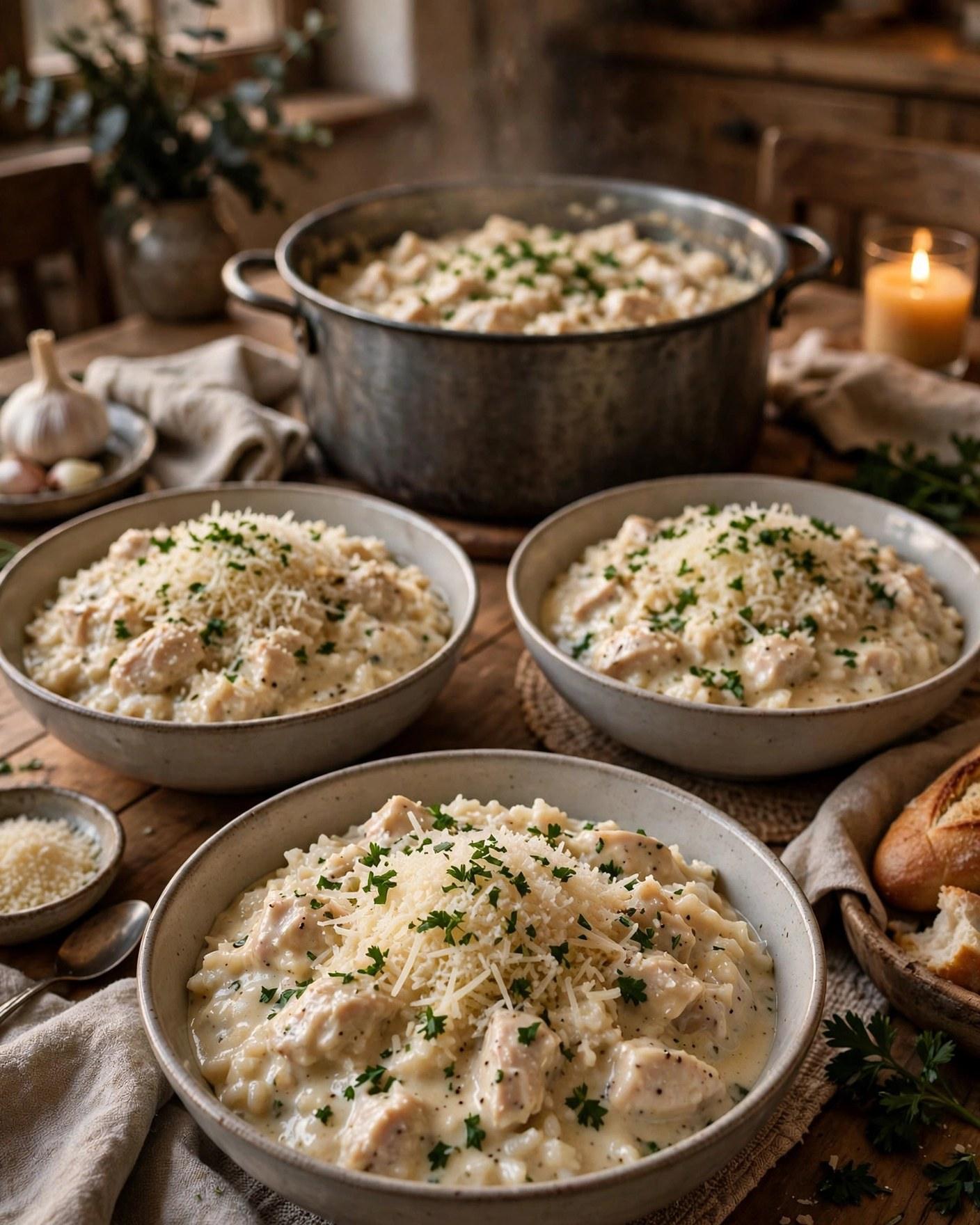
Recipe Card
One-Pot Chicken Alfredo Rice
- Prep Time: 15 minutes (PT15M)
- Cook Time: 30 minutes (PT30M)
- Total Time: 45 minutes (PT45M)
- Servings: 6 servings
- Calories: 610 kcal per serving (estimated)
Tender bite-size chicken and long-grain rice simmered together in one pot in a creamy garlic-Parmesan Alfredo-style sauce with butter, broth, and cream, finished with extra Parmesan and fresh parsley. No pasta and no separate pans — the rice cooks directly in the sauce and thickens it as it goes.
Nutrition (estimated): 610 kcal per serving (estimated, for chicken Alfredo rice with cream and Parmesan), 52 g carbohydrates, 38 g protein, 27 g fat, 2 g fiber, 4 g sugar, 820 mg sodium. Nutrition is estimated and will vary with the cut of chicken, the brand of broth and Parmesan, how much cheese is added at the table, and any variations or substitutions.
Can I use brown rice or a different kind of rice?
Brown rice is the trickiest swap, because it needs more liquid and roughly twice the simmer time, and the cream sauce can reduce too far before it turns tender. To try it, increase the broth to 3 1/2 cups (840 ml) and plan on 40 to 45 minutes of covered simmering. Jasmine and basmati are much easier swaps at the same liquid ratio — start checking near 15 minutes. Avoid short-grain, arborio, and instant rice; short grains turn the pot sticky, and instant rice goes soft before the sauce is ready.
Can I make One-Pot Chicken Alfredo Rice with milk instead of cream?
Yes, with a couple of adjustments so the sauce stays smooth. Replace the heavy cream with 1 1/4 cups (300 ml) of whole milk and reduce the broth slightly, to 2 1/4 cups (540 ml), so the total liquid stays balanced. Keep the pot at the gentlest possible simmer once the milk goes in — milk scorches and separates much more readily than cream at a boil — and stir in an extra 2 tablespoons of Parmesan plus 1 teaspoon of cornstarch whisked into the cold milk if you want a little more body. The result is lighter than the cream version but still comfortably creamy. Low-fat milk is not recommended; it tastes thin and can break in the heat.
Why did my rice turn out gummy or still firm?
Gummy rice almost always traces back to one of three things: the rice was not rinsed, so its surface starch thickened the pot too far; the simmer ran too hot, which breaks the grains down; or the dish was stirred during cooking, which releases more starch. Still-firm rice is usually a steam problem — a loose lid, a peek or two during simmering, or a burner set so low the pot never truly simmered. For firm rice, stir in 1/4 cup (60 ml) of hot broth, cover, and cook on low for 3 to 5 minutes more, then rest as written. Both problems are fixable in the moment.
Can I add vegetables directly to the pot, and when should they go in?
Yes — this recipe welcomes vegetables, and timing is the whole trick. Sturdy vegetables that need real cooking, like small broccoli florets or diced carrots, belong in the pot during the simmer: broccoli for the last 5 minutes, carrots from the start with the rice. Tender vegetables need almost no cooking at all: frozen peas, baby spinach, and thawed corn should be folded in after the simmer, when the chicken goes back in, so the residual heat warms them without dulling their color or texture. Mushrooms are best seared in the drippings after the chicken, as in the variation above, so they brown instead of steaming. Keep total additions to about 2 cups so the liquid ratio still works.

Hi, I’m Emma! I’m the cook and recipe developer behind Sizzle & Sage. From my sunny home kitchen, I share easy, flavor-packed recipes for real life — quick breakfasts, cozy weeknight dinners, and simple bakes anyone can make. Pull up a chair and stay a while!